
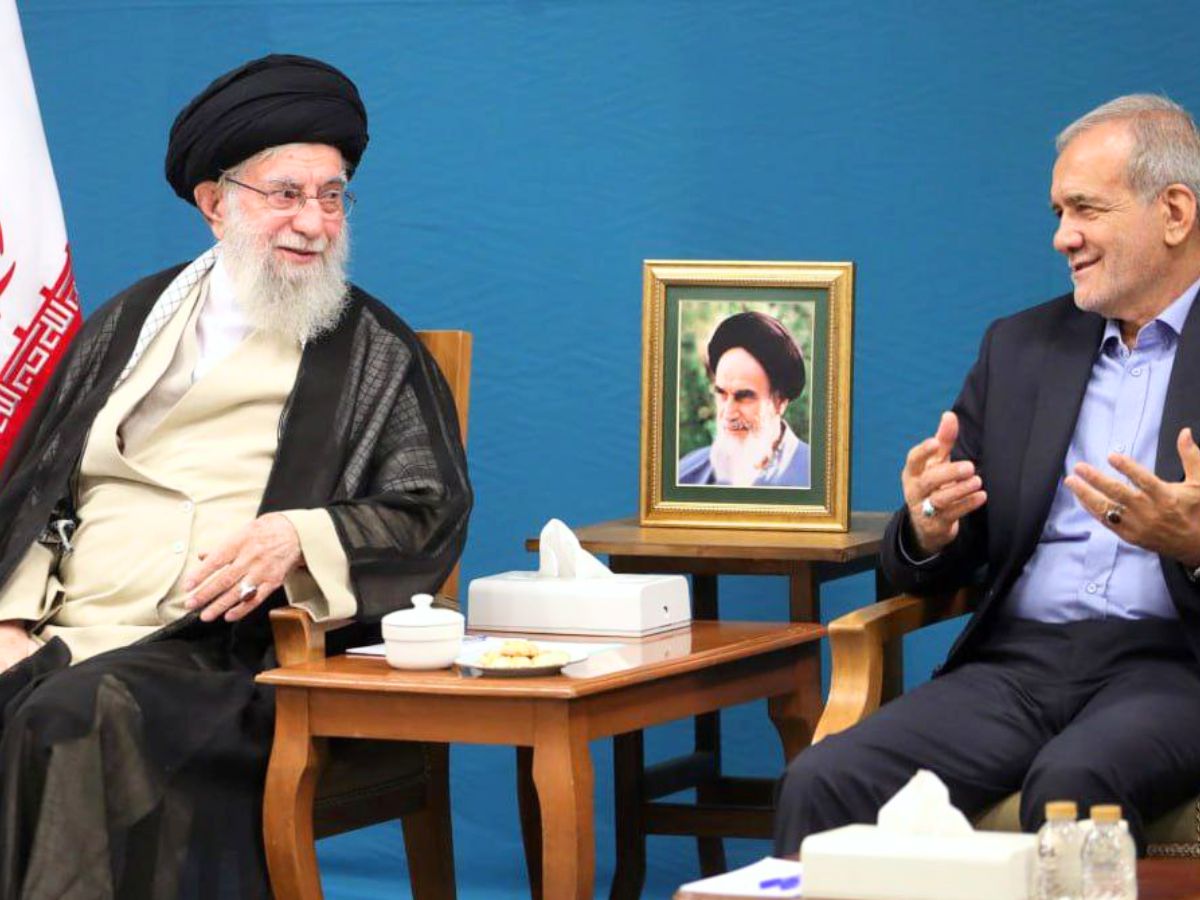

Tensions between Iran and the West have sharply escalated after Iranian President Masoud Pezeshkian declared that his country is engaged in what he described as a “total war” with the United States, Israel, and Europe. His remarks come amid fresh military clashes, mounting economic sanctions, stalled nuclear talks, and growing fears of a wider regional conflict in West Asia.
In an interview aired by Iranian state media over the weekend, Pezeshkian accused Western powers of trying to bring Iran “to its knees” through a mix of military pressure, economic strangulation, political isolation, and cultural warfare.
“In my opinion, we are at total war with the United States, Israel and Europe. They want to bring our country to its knees,” Pezeshkian said.
The interview was released just days before a high-stakes meeting between Israeli Prime Minister Benjamin Netanyahu and US President Donald Trump at Mar-a-Lago, adding to the already volatile geopolitical climate.
What Does Iran Mean by ‘Total War’?
Pezeshkian stressed that the current confrontation goes far beyond traditional warfare. Unlike the Iran-Iraq war of the 1980s, which involved direct missile strikes and defined battlefronts, Iran now faces pressure “from every angle.”
“This war is far more complex and difficult than that war. Back then, missiles were fired and we knew where to hit back. Today, they are besieging us economically, culturally, politically, and in terms of security,” he said.
Iranian officials argue that sanctions, cyberattacks, diplomatic isolation, media narratives, and covert operations together amount to a form of hybrid warfare aimed at weakening the Islamic Republic from within.
June Air Conflict With Israel: A Turning Point
The rhetoric follows a brief but intense air conflict in June, triggered by Israeli strikes on Iranian targets. According to reports, the fighting resulted in around 1,100 deaths in Iran, including senior military commanders and nuclear scientists. Iranian missile retaliation killed 28 people in Israel, marking one of the deadliest direct confrontations between the two long-time adversaries.
Despite the losses, Pezeshkian claimed Iran emerged militarily stronger.
“Our forces are stronger now in terms of equipment and manpower. If the enemy chooses confrontation again, they will face a more decisive response,” he warned.
Iran’s Supreme Leader Ayatollah Ali Khamenei echoed similar sentiments, warning the US and Israel of “irreparable damage” if Iran is attacked again.
US Strikes on Iranian Nuclear Sites Raise the Stakes
Tensions escalated dramatically on June 22, when President Donald Trump announced that US forces had bombed three major Iranian nuclear enrichment facilities Fordow, Natanz, and Isfahan.
“Our objective was the destruction of Iran’s nuclear enrichment capacity and stopping the nuclear threat posed by the world’s number one state sponsor of terror,” Trump said, claiming the strikes were a “spectacular military success.”
Iran has condemned the attacks as a blatant violation of international law and has since suspended nuclear talks indefinitely, deepening fears of an uncontrolled escalation.
Why Europe Is Also in Iran’s Crosshairs
While much of the focus remains on Washington and Tel Aviv, Pezeshkian explicitly included Europe in his accusations. Iranian leaders argue that European countries, despite claiming diplomatic neutrality have aligned with US sanctions, backed Israel politically, and failed to uphold commitments under earlier nuclear agreements.
Tehran sees Europe’s actions as part of a coordinated Western effort to isolate Iran economically and diplomatically while avoiding direct military confrontation.
A Long and Bitter US-Iran Relationship
Iran-US relations have been turbulent for decades. Once allies during the Cold War, ties collapsed after the 1979 Iranian Revolution, followed by the US Embassy hostage crisis and decades of sanctions and hostility.
The two countries have had no formal diplomatic relations since 1980, relying on intermediaries like Switzerland and Pakistan for limited communication. Supreme Leader Khamenei has repeatedly banned direct talks, calling the US “untrustworthy.”
Since returning to office, President Trump has revived the “maximum pressure” campaign, imposed new sanctions, and issued stark warnings, including threatening to obliterate Iran if US leaders were attacked.
Nuclear Talks Collapse and Regional Tensions Rise
Although limited US-Iran negotiations briefly resumed in April 2025, they collapsed following the June airstrikes. Iran has since hardened its stance, with senior advisors warning that Tehran may reconsider its nuclear posture if threatened further.
Meanwhile, concerns are growing over Iran’s ties with groups like Hamas and Houthis, with Washington warning it will hold Tehran responsible for any attacks by its regional allies.
Netanyahu-Trump Meeting: What’s Brewing Next?
The timing of Pezeshkian’s remarks is significant. Israeli Prime Minister Netanyahu is expected to brief President Trump on future strike options against Iran, including concerns about Iran rebuilding air defences and expanding ballistic missile production.
With diplomacy stalled and military posturing intensifying, analysts warn the region may be edging toward a wider confrontation involving multiple global powers.
The Bigger Picture
Pezeshkian’s declaration of “total war” signals a shift in Iran’s messaging from strategic restraint to open defiance. While no full-scale war has been declared, the convergence of military clashes, nuclear brinkmanship, and geopolitical rivalries suggests a dangerous new phase in America-Iran relations.
As the US, Israel, and Iran brace for what comes next, the question remains: Can diplomacy still pull the region back from the brink, or is a broader conflict inevitable?
Sofia Babu Chacko is a journalist with over five years of experience covering Indian politics, crime, human rights, gender issues, and stories about marginalized communities. She believes that every voice matters, and journalism has a vital role to play in amplifying those voices. Sofia is committed to creating impact and shedding light on stories that truly matter. Beyond her work in the newsroom, she is also a music enthusiast who enjoys singing.




