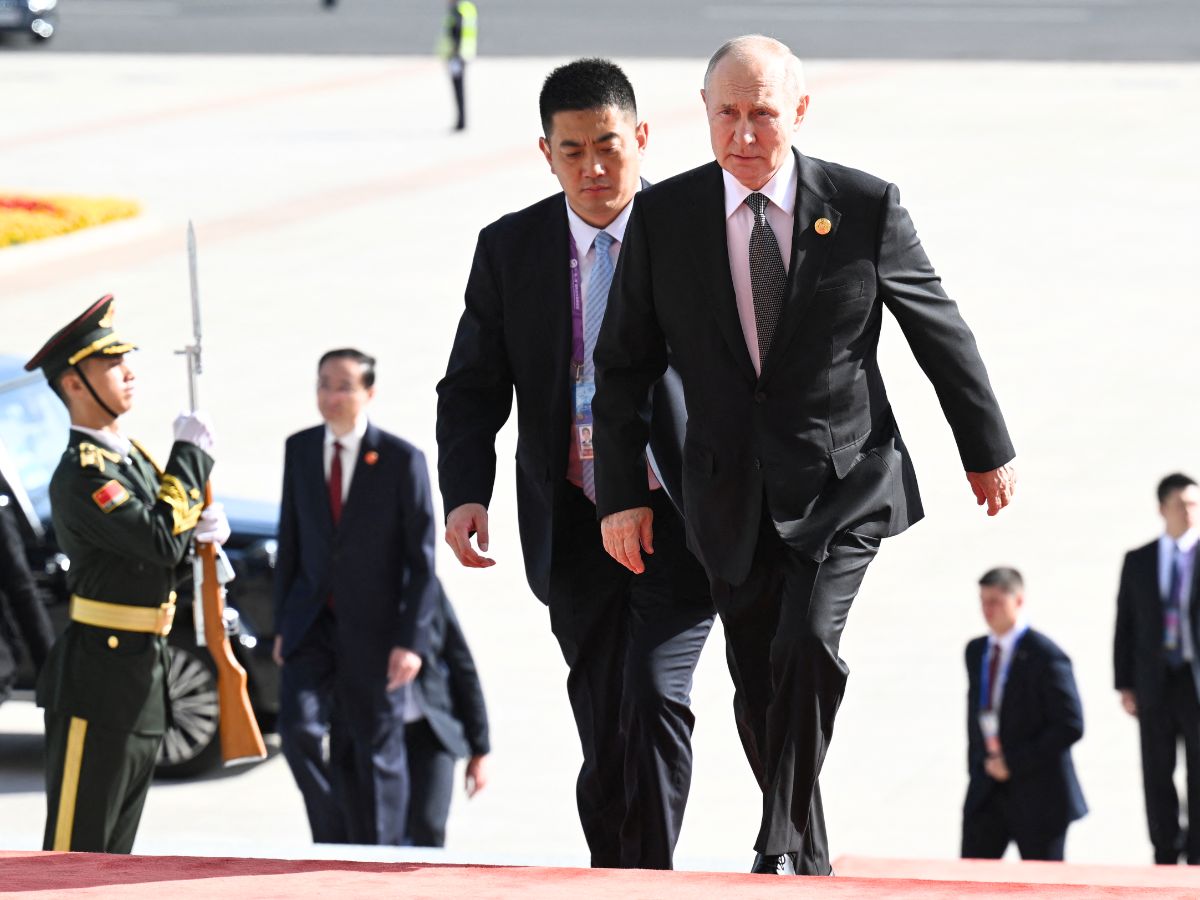

Russian President Vladimir Putin arrived in New Delhi on Thursday for a two-day State visit, marking a significant diplomatic moment in India-Russia relations. In a rare gesture breaking standard protocol, Prime Minister Narendra Modi personally received President Putin at the Palam Technical Airport and later hosted him for a private dinner a warm reciprocation of Putin’s hospitality during Modi’s visit to Moscow in July last year.
The two leaders were also seen travelling together in the same car as they departed from the airport, underscoring the personal rapport and deepening strategic ties between the nations.
Over the years, Putin’s protection system has evolved into one of the world’s most advanced presidential security setups, involving food-testing laboratories, bodyguards trained in extreme conditions, a custom-built aircraft known as the “Flying Kremlin”, and the controversial “poop suitcase” protocol designed to prevent any foreign body from examining his biological waste.
International reports and documented investigations reveal a security structure built around absolute secrecy and controlled access, aimed at eliminating any vulnerability related to health data, poisoning attempts or targeted attacks. With rising global hostilities after the Russia–Ukraine war and limited foreign travel in recent years, security around the Russian president has intensified to unprecedented levels.
How the Security Protocol Developed Over Two Decades
According to researchers, former intelligence officers and multiple international reports, Putin began strengthening Russia’s federal security agencies after assuming power in 2000. The Federal Protective Service (FSO), which oversees presidential security, and the Presidential Security Service (SBP), responsible for his immediate protection, were reorganised into tightly controlled units with layers of intelligence, logistics and emergency operations.
Early 2000s reports show that Putin significantly cut down unplanned public appearances and unrestricted physical contact during foreign visits. Advance teams began travelling weeks prior to planned visits to inspect locations, replace furniture, examine plumbing systems and sanitise environments. From this time onward, the Kremlin reportedly implemented strict hygiene and biological security screenings, including sanitised utensils, imported bottled water and personal medical staff.
Mobile Food Laboratory and Taster System
By 2006–2010, Putin began travelling with a mobile food inspection laboratory, staffed with chefs, tasters and scientific experts capable of testing meals for toxins, allergens or radioactive agents. International media observed that he consistently avoided eating dishes served at banquets unless they were delivered by his own security personnel. Kremlin chefs have previously acknowledged that cooking for the president is an operation involving multi-step security checks.
A former Kremlin chef quoted in Russian media stated that wherever the president travels whether for diplomatic visits or private retreats a team accompanies him to ensure food safety. Kitchens and hotel suppliers in host countries are reportedly barred from providing ingredients or equipment that the president might use.
4. Conor McGregor was given a warning for putting his arm over Vladimir Putin pic.twitter.com/qmlqBptpSN
— Scott Brooks (@scotti_brooks) August 25, 2025
This approach intensified during the 2014 Ukraine conflict, when suspicions of poisoning threats expanded to include chemical and biological surveillance measures.
The ‘Poop Suitcase’: The Most Controversial Protocol
One of the most widely discussed aspects of Putin’s security system surfaced publicly in 2017 during his visit to France and Saudi Arabia. Journalists from Paris Match reported that his security team carried a sealed briefcase used to collect all biological waste from the president’s private bathrooms, including urine and faecal matter.
Reports indicated that the purpose was to prevent foreign intelligence agencies from obtaining biological samples to analyse potential illnesses, medical conditions or medication usage. Western media later echoed claims, suggesting that Putin’s security teams monitor and collect anything he touches, from tissues to drinking cups, which are then transported back to Russia.
Former BBC journalist Farida Rustamova also stated that Putin sometimes uses a portable toilet to avoid leaving behind any traceable samples. The Kremlin has never officially commented on the matter, yet the claim has been widely cited by investigative journalists and strategic analysts.
The ‘Flying Kremlin’: Putin’s Custom Presidential Aircraft
Putin travels internationally in a specially modified Il-96-300PU aircraft, sometimes called the “Flying Kremlin”, designed as a mobile command centre capable of secure military-grade communication. Reports suggest the jet includes missile-defence countermeasures, encrypted communication rooms, medical units, luxury interiors and radar-jamming technology.
The aircraft frequently travels with diversionary planes to obscure his actual route, a tactic that became more visible after 2022. Intelligence accounts indicate that convoys often include three or more aircraft taking off simultaneously.
When feasible, Putin also reportedly uses an armoured 22-car train system described as a “ghost train”, built with bulletproof windows, protected communication lines and enhanced privacy features.
‘Fortress on Wheels’: The Aurus Senat Presidential Limousine
Once in India, Putin is expected to travel in his Aurus Senat limousine, which replaced the Mercedes-Maybach previously used by the Kremlin. Introduced in 2018, the vehicle is equipped with armour strong enough to resist armour-piercing bullets and explosive attacks, emergency oxygen supply, satellite communications, run-flat tyres capable of driving after a blowout, and extensive surveillance detection technology.
The Aurus Senat was showcased during summits, including when Putin drove Prime Minister Narendra Modi during a diplomatic event. Putin later gifted the same model to North Korean leader Kim Jong-un in 2024.
Putin’s ‘Musketeers’: The Elite Bodyguard Ring
On the ground, Putin’s visible security ring consists of the FSO’s highly trained commandos known as “Musketeers.” These bodyguards receive advanced training in operational psychology, marksmanship, counter-sniper tactics and rapid-response evacuation. They reportedly carry shield-briefcases and pistols fitted with armour-piercing ammunition.
Bodyguards around Putin often rotate out at the age of 35 to maintain peak tactical readiness. Their presence gained public attention during the 2018 Football World Cup, when a guard physically intervened after MMA fighter Conor McGregor placed an arm around Putin for a photograph.
There have been persistent rumours that Putin uses body doubles for high-risk international travel, though the president publicly dismissed the claims, saying plans were proposed but rejected.
360-Degree Surveillance and Ultra-Secret Protocol After Ukraine War
After the onset of the Russia–Ukraine conflict in 2022, Putin drastically limited foreign trips. Security analysts say his movements were restricted to controlled zones, with double-layered surveillance, expanded counter-espionage operations and chemical-biological scanning of venues.
Reports from Western intelligence agencies claimed full biological sample control, including removal and destruction of trash, towels and drinking containers after meetings.
Coordination With India
During Putin’s current visit, Russian security services are working closely with Indian agencies, including the SPG, IB, Delhi Police and NSG, though Russia retains authority over close proximity security and classified procedures.
Diplomacy experts say the level of secrecy reflects both heightened geopolitical risk and concerns around potential assassination attempts, cyber interception and espionage.
Why Putin’s Security Matters Now
According to experts, Putin’s security system reflects Russia’s evolving political climate, threats from rebel factions, chemical-weapon concerns and global tensions. The measures also reflect the strategic significance of his prolonged leadership, entering more than 25 years in power.
As his visit unfolds, this sprawling security architecture remains under intense international scrutiny mixing mystery, technology and extreme caution in a manner unmatched by most world leaders.
Sofia Babu Chacko is a journalist with over five years of experience covering Indian politics, crime, human rights, gender issues, and stories about marginalized communities. She believes that every voice matters, and journalism has a vital role to play in amplifying those voices. Sofia is committed to creating impact and shedding light on stories that truly matter. Beyond her work in the newsroom, she is also a music enthusiast who enjoys singing.