
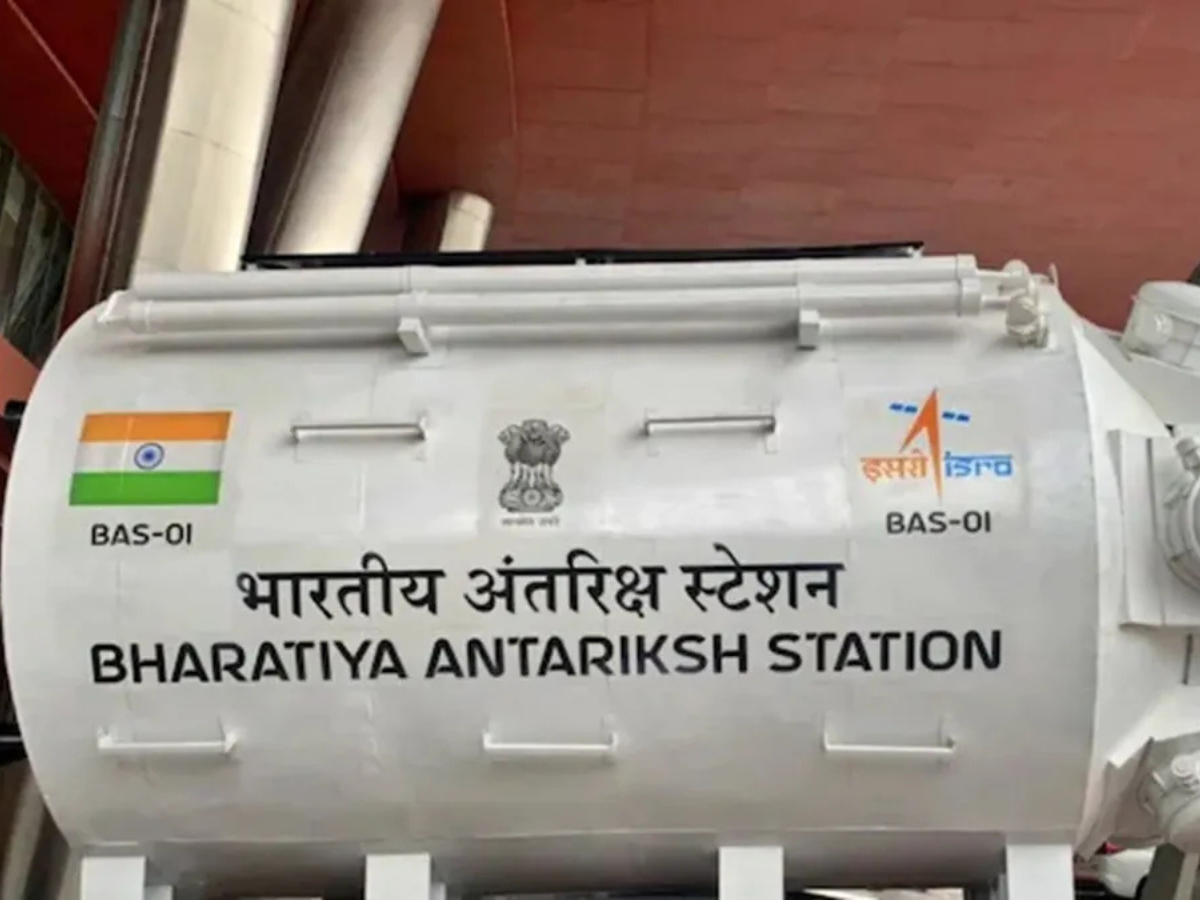

Indian Space Research Organisation (ISRO) on August 22, 2025, Friday unveiled a model of the Bharatiya Antariksh Station (BAS) module during the two-day National Space Day celebrations that commenced here. By 2028, India plans to launch the first module of the BAS, its own home-built space station. BAS will mark India’s entry into the group of few nations that operate orbital laboratories. Currently, there are two orbital laboratories — the International Space Station operated by five space agencies, and the Tiangong space station of China. By 2035, India plans to have five modules of the Bhartiya Antariksh Station. These five modules of the BAS will be built as part of India’s ambitious plans for the space sector, as reported in PTI.
What are the key features of the Bharatiya Antariksh Station?
According to the Union Minister of State (Independent Charge) for Science and Technology Dr. Jitendra Singh in a written reply in the Lok Sabha on December 18, 2024, Bharatiya Antariksh Station will comprise of multiple modules and state of the art technological capabilities like the other operational space stations. These modules and state of the art technological capabilities will be used for carrying out cutting edge scientific research and technology development activities. The research and activities will be conducted in a microgravity environment and will be targeted towards national priorities and societal applications.
Which countries have their own home-built space station?
Before India, few countries have developed their own home-built space stations. These countries are-
1. United States of America- USA had launched its first space station Skylab into the earth orbit on May 14, 1973.
2. Soviet Union and Russia- The Soviet Union had placed Salyut, the world’s first space station into orbit on April 19, 1971. The first module of the Mir Space Station was also launched by Soviet Union on February 19, 1986.
3. China- China had launched its own home-built space station, Tiangong space station, which became fully operational in 2022.




