

China is reviving its sinister plans again. This time again around Pangong Lake in Tibet. According to an India Today report Beijing is constructing a large-scale defence complex close to the site of the 2020 Galwan Valley clash. Analysts say as India and China to engage on diplomatic front to resolve long pending issue, PLA is continuing to fortify its military presence along the Line of Actual Control (LAC). Prime Minister Narendra Modi recently met President Xi Jinping during the Shanghai Cooperation Organisation (SCO) Summit in Tianjin, and the Kailash Mansarovar Yatra has been reopened after years of suspension.
What Satellite Imagery Reveals
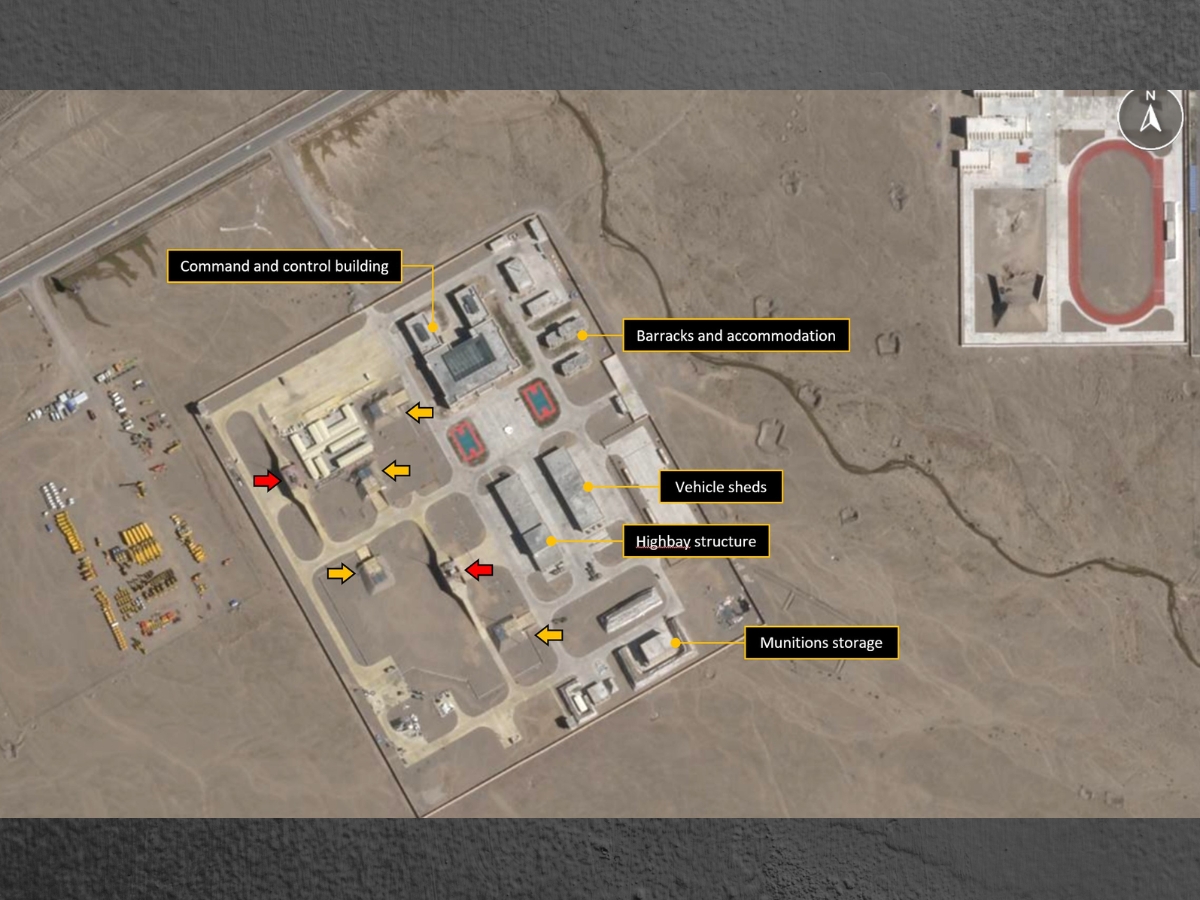
Satellite visuals released by the OSINT arm of India Today and US-based space intelligence provider Vantor show extensive infrastructure development along the LAC near the eastern edge of Pangong Lake. The satellite cited in the report show China building command and control buildings, barracks, vehicle sheds, munition storage areas, and radar installations. The military complex is only around 110 kilometres away from the place where Indian and Chinese troops clashed during the Galwan Valley standoff.
AllSource Analysis reveals a new hardened design of Chinese air defense complexes under construction near the Indian border. https://t.co/epfzHD4aZI
Spotlight Report – Critical intelligence delivered to your inbox. https://t.co/n0XDPQNx8A#GEOINT #China #GarCounty #PangongLake pic.twitter.com/kvM0u9NVYy
— AllSource Analysis (@AllSourceA) October 22, 2025
The first evidence of construction near Pangong Lake was spotted in late July by geospatial researcher Damien Symon, though the existence of covered missile bays emerged only later.
China’s Defence Complex Near Pangong Likely Houses Transporter Erector Launcher
Defence analysts even identified covered missile launch positions, featuring sliding or retractable roofs. These are believed to be designed for Transporter Erector Launcher (TEL) vehicles, systems capable of carrying, elevating, and launching missiles.
“This covered missile launch position features a roof with hatches, allowing the launchers to remain concealed and protected while firing through the hatches when opened,” US-based geospatial intelligence firm AllSource Analysis has stated.
“This configuration reduces opportunities to detect the presence or exact positions of TELs within the complex and shields them from possible strikes.”
Also Read: How Delhi Police Busted ISIS Terrorists’ Plan To Target Several Spots In Delhi On Diwali
China’s Long-Range HQ-9 Missile System Likely Part Of The Facility
According to the report, each launch bay appears to be capable of housing two TEL vehicles. Analysts suggest that the facility could be home to China’s long-range HQ-9 surface-to-air missile system, based on Russia’s S-300, which incorporates advanced radar tracking and guidance technology. The site also features wired data links connecting key parts of the HQ-9 system to its command-and-control hub.
A second, almost identical complex has been identified in Gar County, around 65 kilometres from the LAC and directly opposite India’s strategically crucial Nyoma airfield. India recently completed an upgrade of the Mudh airfield, one of the highest in the world at 13,710 feet, at a cost of ₹230 crore.
China is nearing the completion of a military-linked complex on Pangong Lake’s eastern edge, featuring garages, a highbay & protected storage, the site is located near a Chinese radar complex & may evolve into a SAM position or another weapons-related facility pic.twitter.com/WZGAMCc1B3
— Damien Symon (@detresfa_) July 24, 2025
Independent imagery from Vantor supports this assessment, showing the sliding roofs of missile bays, each capable of accommodating two vehicles. Images captured on September 29 show some bays with their roofs open, confirming launchers inside and suggesting the complex has reached an advanced operational stage.
Zubair Amin is a Senior Journalist at NewsX with over seven years of experience in reporting and editorial work. He has written for leading national and international publications, including Foreign Policy Magazine, Al Jazeera, The Economic Times, The Indian Express, The Wire, Article 14, Mongabay, News9, among others. His primary focus is on international affairs, with a strong interest in US politics and policy. He also writes on West Asia, Indian polity, and constitutional issues. Zubair tweets at zubaiyr.amin




