
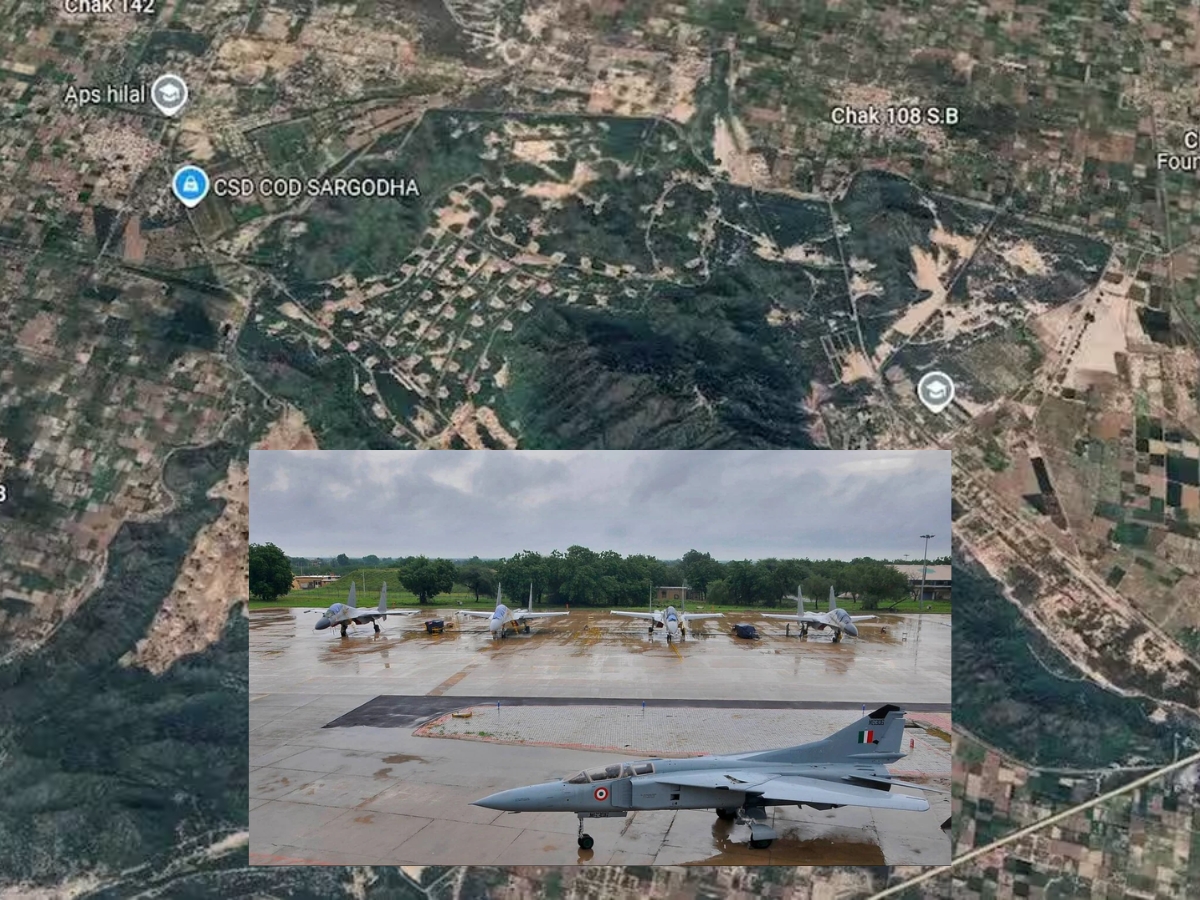

New details are coming out about the Operation Sindooor that India launched against Pakistan last year after Paki-backed terrorists killed over two dozen civilians in Jammu and Kashmir’s Pahalgam. In a new revelation, aviation historian and analyst Tom Cooper has claimed that India targeted Pakistan’s Kirana Hills nuclear-linked site, asserting that the available evidence supporting his assessment is “unmistakable.” His remarks come despite official denials issued by the Indian Air Force (IAF).
In an interview with NDTV, Cooper outlined what he described as multiple pieces of proof and argued that the nature and timing of the strike indicated a calculated strategic message rather than an attempt to inflict large-scale destruction.
India’s Strike On Pakistan’s Nuclear Sites Meant a Strategic Signal
Explaining his interpretation, Cooper said the alleged target selection suggested an intention to demonstrate capability and deterrence.
“It’s a place you hit when you want to send a clear message without causing, let’s put it this way, too much damage. It means, ‘Listen, guys in Pakistan, we can hit you severely where we want, whenever we want, with as much ammunition as we want. Stop it, finally’,” he told NDTV.
He maintained that the operation appeared designed to convey military reach and precision rather than escalate into a broader conflict.
Earlier Criticism of IAF Communication On Hitting Pakistan’s Kirana Hills
During Operation Sindoor, Cooper had also criticised India’s defence public relations approach in a Facebook post, questioning why an alleged strike near Kirana Hills was not acknowledged publicly.
Referring to a press briefing by Nagesh Kapoor, Vice Chief of the Air Staff, he wrote, “India, India, India… and ‘IAF and its PR-work’… sigh… Air Marshal Nagesh Kapoor – Vice Air Chief, IAF – gave a press conference, a day or so ago. And, ‘of course’, somebody asked him about IAF air strikes on the underground elements of the Kirana Hills — one of major Pakistani ‘weapons storage facilities’ — well-known to have been flown during the 88-Hours War, on 10 May 2025… Kapoor answered in the classic IAF-fashion: ‘we don’t know about it… these videos were presented by their people… they made them… we did nothing’…”
What India Said About Hitting Kirana Hills
In May last year, the IAF dismissed social media speculation that India had struck Kirana Hills, which is widely reported to host sensitive facilities linked to Pakistan’s nuclear programme.
“We have not hit Kirana hills, whatever is there,” A. K. Bharti, Director General of Air Operations, said during a media briefing on Operation Sindoor.
He was responding to questions regarding reports that Indian strikes targeted a site near Kirana Hills during a counter-offensive. According to available information, Indian strikes hit an airbase in Sargodha, with some reports suggesting the base was connected to underground nuclear-related storage infrastructure in the Kirana Hills region.
The briefing was jointly addressed by senior military officials, including Rajiv Ghai, Director General of Military Operations, and A. N. Pramod, Director General of Naval Operations.
Evidence Cited by the Analyst
When asked about the basis for his claims, Cooper pointed to what he described as several indicators. These included videos allegedly showing missile contrails descending toward the hillside and visual evidence of smoke rising from what he identified as the radar station of the Pakistani Air Force’s 4091st Squadron.
“And the evidence is so clear that the Indian Air Force hit these radar stations first to disable the Pakistani capability to counter its attack, and then hit at least two entrances to the underground storage facilities. And Kirana Hills is one of the centrepieces of the Pakistani nuclear programme. They have run something like 20–24 non-critical nuclear tests over there. I mean, it’s not Disneyland,” he said.
Also Read: Hugs, Handshake, AI And Air Power: PM Modi-French President Macron’s Big Bilateral Meet In Mumbai
Zubair Amin is a Senior Journalist at NewsX with over seven years of experience in reporting and editorial work. He has written for leading national and international publications, including Foreign Policy Magazine, Al Jazeera, The Economic Times, The Indian Express, The Wire, Article 14, Mongabay, News9, among others. His primary focus is on international affairs, with a strong interest in US politics and policy. He also writes on West Asia, Indian polity, and constitutional issues. Zubair tweets at zubaiyr.amin




