
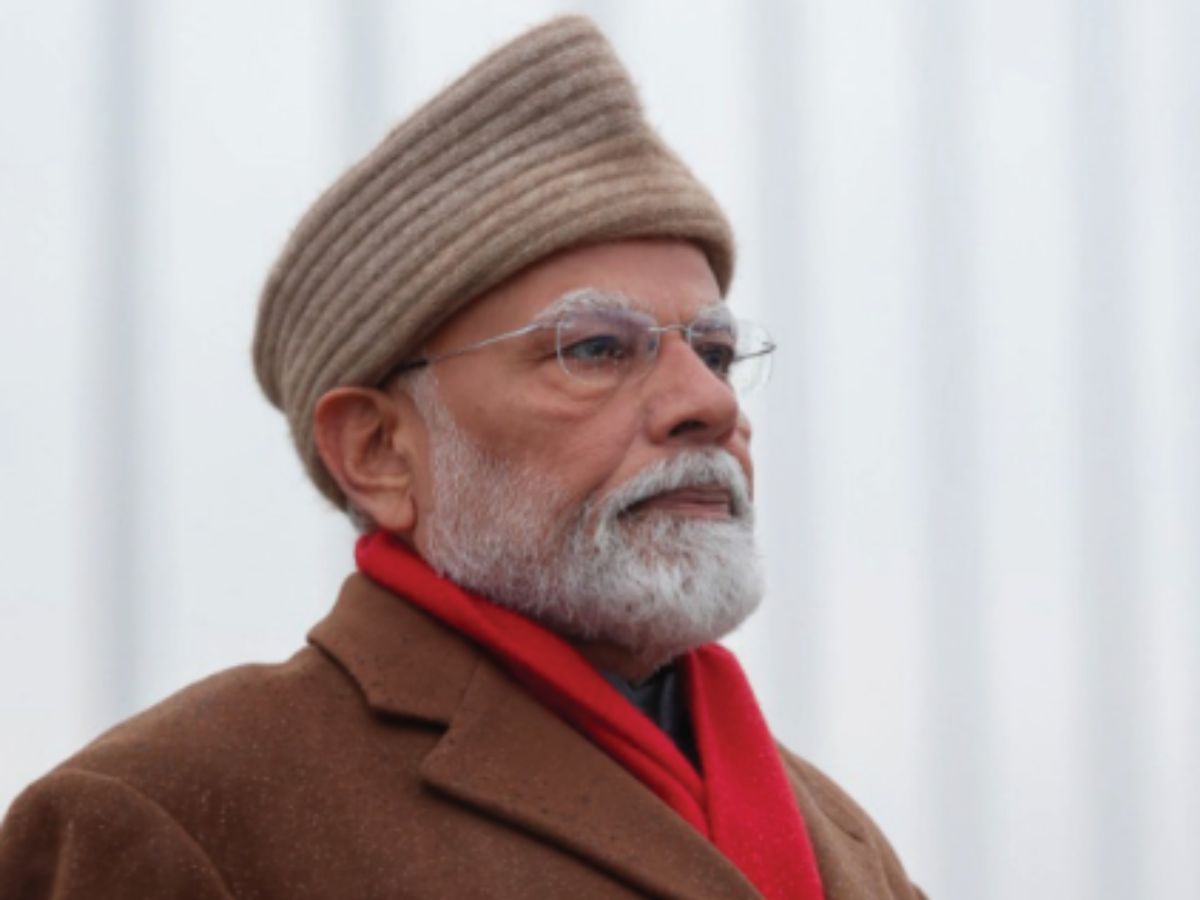

Over the past decade, India’s foreign pol- icy has been funda- mentally reshaped under the leadership of Prime Minister Narendra Modi. Where once India was per- ceived as hesitant, reactive, and overly cautious under successive Congress gov- ernments, today it stands tall as a confident global power . PM Modi has en- sured that India is no lon- ger a silent participant in world affairs but an active shaper of the global agenda which is driven by principle of “Strategic Autonomy” .This transformation has not only elevated India’s place in the world but has also established Modi as one of the most influential global leaders of our time.
One of the clearest signs of this confidence has been In- dia’s firm stand on matters of trade and tariffs. Many expected India to concede quietly as it often did in the past, Instead, India engage with West as a major econ- omy not as a junior player. This Self confidence is driven from belief in innate strength of India.
Bharat’s foreign policy confidence is anchored in India’s economic rise. In 2014, Bharat was the world’s 13th-largest econo- my; by 2025, it had surged to become the fourth-largest, with a GDP of over $4 tril- lion. India is projected to become the world’s third- largest economy by 2030. This economic strength has given India — unprec- edented leverage in global diplomacy. It was on full display during India’s G20 presidency in 2023, where India steered a divided world towards consensus. The Delhi Declaration, ad- opted unanimously despite sharp rifts over Ukraine, was hailed internationally as a diplomatic triumph. Under Congress, India’s presence at such forums was largely symbolic.
Another highlight of In- dia’s G20 presidency un- der was the announcement of the India–Middle East– Europe Economic Corri- dor (IMEC). This ambitious project, involving India, the U.S., the EU, Saudi Arabia, and the UAE, is being seen as a credible alternate to Belt and Road Initiative (BRI). It symbolizes how India is no longer just reacting but actively offering alterna- tives that reshape global trade routes. This forward-looking vision has further strengthened India’s role as a leader of the Global South and a trusted partner of ad- vanced economies.
Another leaflet in our foreign policy has been to embrace new institutions and expand India’s pres- ence in older ones. The ex- pansion of BRICS in 2023, which brought in countries like Saudi Arabia, the UAE, Egypt, and Iran, was shaped significantly by India’s bal- ancing role. Unlike in the Congress era, where global conversations involved re- placement of India in BRICS because of “poor economic growth”. Today India is taking decisive role n in the QUAD with the U.S., Japan, and Australia, while simultaneously shaping SCO’s joint statement which unequivocally condemned Pahalgam terror attack.
Another hallmark has been nation’s ability to bal- ance multiple, often conflict- ing, relationships. India has deepened its strategic part- nership with the United States through defense pacts like COMCASA and BECA, joined hands with Japan and Australia in the QUAD , at the same time strengthen- ing ties with Russia, buy- ing discounted crude oil for national security needs. India has also built strategic partnerships in the Gulf, se- curing multi-billion-dollar investments from the UAE and Saudi Arabia, while maintaining close relations with Israel for defense and technology. Under Con- gress, such a broad, prag- matic, interest-driven strat- egy was missing— India was trapped in ideological non- alignment. Under PM Modi, India is both practical and principled.
The Ukraine conflict high- lighted this transformation vividly. While Western pow- ers expected India to align against Russia, PM Modi charted an independent course. He called for dia- logue and peace, refused to be bullied into one-sided condemnations, and simul- taneously expanded India’s trade with both Russia and the West. His famous state- ment to President Putin — “This is not an era of war” — was quoted across global capitals, showcasing India’s moral voice alongside its strategic independence. Unlike the Congress era, when India’s voice was often drowned out, today, when India speaks, the world lis- tens.
India’s rising stature is also reflected in its military and strategic posture.In- dia has invested heavily in border infrastructure, built stronger naval capabilities to secure the Indian Ocean, and signed reciprocal logis- tics agreements with key al- lies.
Beyond geopolitics, India has used its technological and humanitarian strengths to cement its global leader- ship. During the COVID-19 pandemic, India under PM Modi launched “Vaccine Maitri,” supplying more than 250 million vaccine doses to over 100 coun- tries. India’s Digital Public Infrastructure, especially UPI, has become a model admired worldwide, with nations in Africa, Latin America, and Southeast Asia adopting Indian plat- forms. This “soft power with substance” has elevated In- dia’s reputation as not just a regional, but a truly global leader.
PM Modi’s individual pop- ularity has also redefined how India is seen abroad. From the packed stadium in Houston to the grand welcome of world leaders in India , his ability to connect with world leaders and the Indian diaspora has turned foreign policy into a source of national pride. These are not mere optics — they sym- bolize a confident India.
The contrast is striking. Under Congress, India’s foreign policy was marked by hesitation, compromise, and a fear of taking clear positions. India was often described as a “balancing power,” timid to lead. Un- der Modi, India has become a “leading power” — deci- sive, assertive, and globally respected for Keeping its National interest supreme, and integrating it with glob- al good. *
The author is BJP National Spokesperson
Vani Verma is a content writer with over 2 years of experience in lifestyle, entertainment, health and digital media. She has a knack for creating engaging and research-driven content that resonates with readers, blending creativity with clarity. Passionate about media trends, culture, and storytelling, she strives to craft content that informs, inspires, and connects.




