

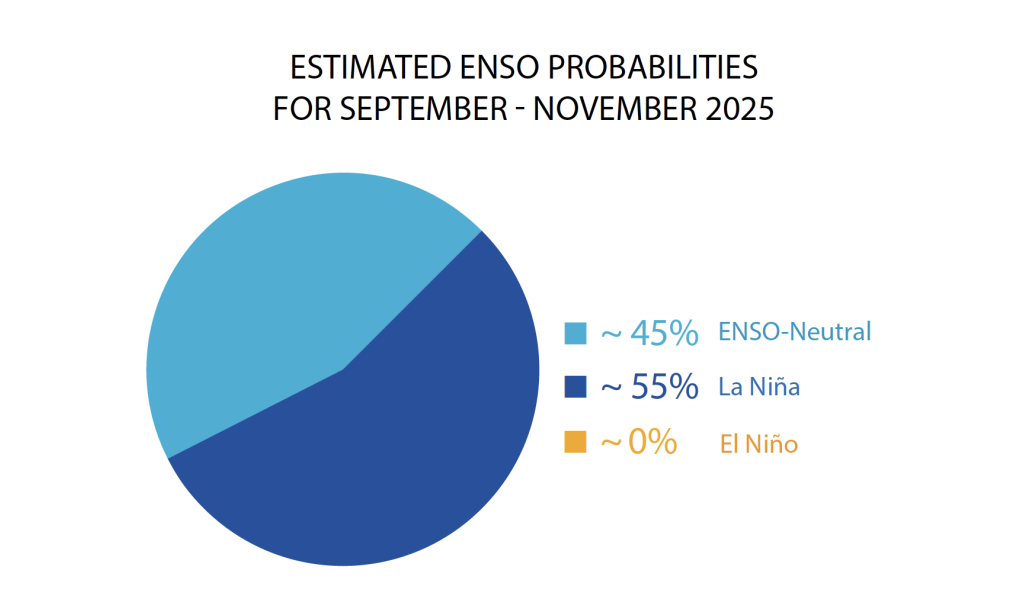
The World Meteorological Organisation (WMO) on Tuesday issued its latest El Nino/La Nina update, warning that La Nina may develop from September 2025. The report added that conditions could return as early as September 2025, influencing global weather and climate patterns.
The latest report also noted that despite La Nina’s typical cooling effect, above-average global temperatures are expected to persist due to the long-term impacts of climate change. It stated that oceanic and atmospheric indicators continue to reflect ENSO-neutral conditions, which have persisted since March 2025.
The latest WMO El Niño/La Niña Update indicates that La Niña may develop from September 2025. Despite its temporary cooling influence, above-average temperatures remain likely across much of the world.
🔗 Read the full update: https://t.co/bH0SB0fM1S pic.twitter.com/lQu2UMiCVw
— World Meteorological Organization (@WMO) September 2, 2025
What Is La Nina?
‘La Nina’ is a Spanish term, which means a ‘little girl’. It is marked by cold oceanic temperature, which brings drought, floods and other extreme weather events in different parts of the world.
It plays an important role in lowering air pressure over the western Pacific, leading to increased rainfall, particularly in northwest India and Bangladesh. It also strengthens the intensity of Monsoon, rain-bringing winds, in India.
The La Nina impact is better understood with El Nino, another oceanic pattern of warm ocean temperatures in the equatorial region of the Pacific Ocean.
Together, both La Nina (Cold) and El Nino (Warm) form a complex weather pattern called the El Nino-Southern Oscillation (ENSO). It appears due to the oscillation between the El Nino and the La Nina.
Every two to seven years, ENSO shifts irregularly back and forth between El Nino and La Nina. If La Nina water off the coast of Peru cools by a margin, easterly winds strengthen, and there is higher than average rainfall during the Indian monsoon period.
It is a complex system which involves oceanic and atmospheric phenomena, with the appearance of warm currents as it appears off the coast of Peru, it creates a low-pressure circulation there.
La Nina Effects
La Nina affects the global weather pattern. Its impact is vast.
- If La Niña lowers air pressure over the western Pacific, it leads to increased rainfall in northwest India and Bangladesh.
- It causes severe flooding in northern Australia due to excessive rainfall and low-pressure systems.
- It also brings more rain to southeastern Africa and northern Brazil.
- La Nina gives a boost to the fishing industry because it brings cold, nutrient-rich waters to the surface, supporting plankton growth, which benefits fish populations.




