
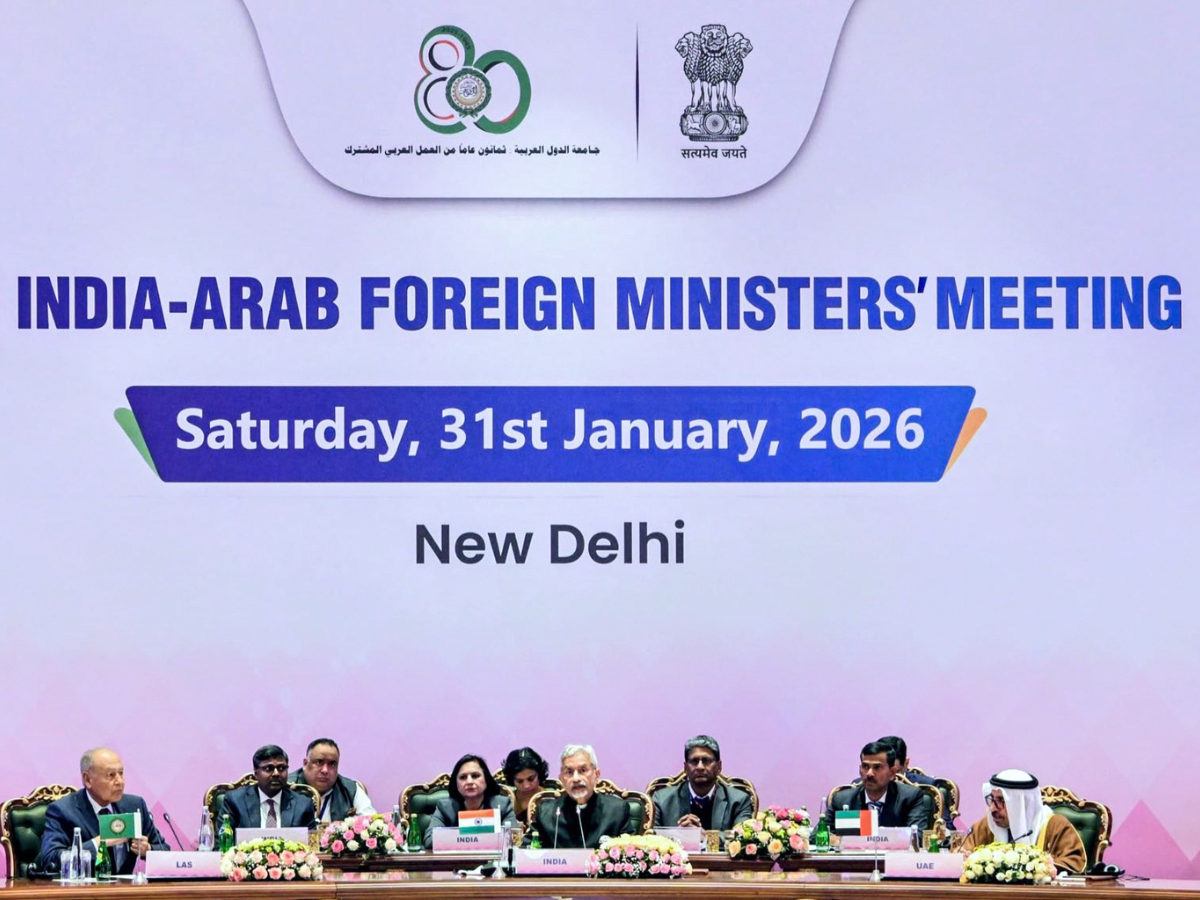

India and the League of Arab States (LAS) took a major step to deepen strategic ties on Saturday by adopting the “New Delhi Declaration”, widely referred to as the New Delhi Declaration, after the second India-Arab Foreign Ministers’ Meeting. The high-level meeting was held on January 31, 2026, and focused strongly on security, terrorism, global governance reforms, and economic cooperation under the framework of the New Delhi Declaration.
As per reports, both sides reaffirmed a “zero tolerance” approach toward terrorism and called for urgent reforms of the United Nations Security Council (UNSC) to make it more representative of today’s global realities, as outlined in the New Delhi Declaration. The meeting was co-chaired by India’s External Affairs Minister, Dr S Jaishankar and attended by Foreign Ministers from Arab countries along with the Secretary-General of the League of Arab States.
New Delhi Declaration: Zero Tolerance on Terrorism
The New Delhi Declaration strongly condemned terrorism in “all its forms and manifestations”, calling it a major threat to international peace and security. Arab Foreign Ministers strongly condemned the heinous terrorist attack in Pahalgam that targeted innocent Indian tourists and reaffirmed their full support for the Republic of India, a position reiterated in the New Delhi Declaration. According to reports, Both sides also expressed serious concern over terrorist groups misusing drones and advanced technologies for propaganda, recruitment, and trafficking of weapons and drugs. They committed to firm action against globally proscribed terrorists and their proxies, including those listed under the UNSC 1267 Sanctions Committee, in line with the New Delhi Declaration.
On regional issues, India and the Arab states reiterated support for a sovereign and independent State of Palestine based on 1967 borders, as stated in the New Delhi Declaration. They welcomed the outcomes of the 2025 Sharm El-Sheikh Peace Summit, which led to a ceasefire agreement in Gaza, and praised the roles of Egypt, Qatar, the United States, and Algeria.
Support for Regional Stability
Reports say that the declaration also raised concerns over Houthi attacks on maritime navigation in the Red Sea, stressing that safeguarding the Bab al-Mandab Strait is a shared international responsibility under the New Delhi Declaration.
The two sides reaffirmed their support for the sovereignty and territorial integrity of Lebanon, Libya, Sudan, Somalia, and Yemen, while firmly rejecting any external interference in their internal affairs, as underlined by the New Delhi Declaration.
UNSC Reforms Urged by New Delhi Declaration
Criticising the current global system, the New Delhi Declaration said the existing UNSC structure is anachronistic and unrepresentative of the world’s majority. Both sides called for expanding permanent and non-permanent UNSC membership to reflect present-day realities.
The Arab side praised India’s leadership in hosting the Voice of Global South summits and agreed that the Global South can help create a fairer and more inclusive multilateral system, a view echoed in the New Delhi Declaration.
Economic and Technological Cooperation
With bilateral trade exceeding US$240 billion, both sides pushed for stronger economic cooperation. They committed to the Executive Program for 2026-2028, focusing on green hydrogen, renewable energy, and artificial intelligence, as part of the roadmap laid out in the New Delhi Declaration. India also sought recognition of the Indian Pharmacopoeia in Arab countries to boost healthcare ties.
The External Affairs Minister thanked Arab nations for hosting over 9 million Indian nationals, and called the diaspora a living bridge between the two regions. Several future engagements were announced, including tourism and health initiatives in 2026, a startup conclave and space cooperation in 2027, and the third Ministerial Meeting in 2028, all envisioned under the New Delhi Declaration.
(With inputs from ANI)




