

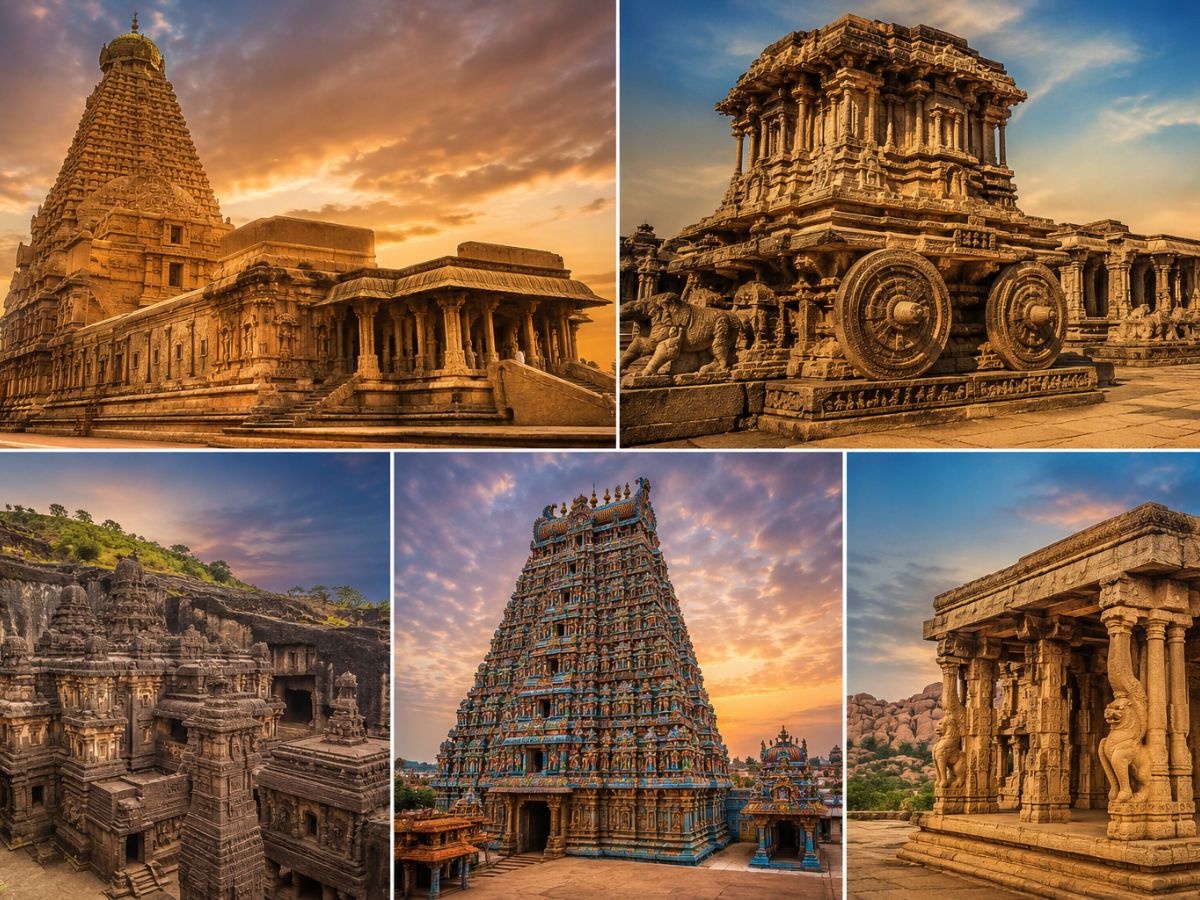
Many ancient temples across India continue to surprise historians, architects, and engineers with their angular precision, massive scale, and architectural genius. Carefully designed and constructed thousands of years ago without modern machines or tools, these remarkable places of worship stand as a testament to the advanced skills and engineering knowledge of ancient civilizations.
Brihadeeswarar Temple, Tamil Nadu: A Giant Granite Marvel Of Chola Architecture
The Brihadeeswarar Temple in Thanjavur is one of the finest surviving monuments of Chola architecture. The entire structure is built from granite, including its towering central shikhara (tower), which rises over 200 feet and is topped by a single stone weighing several tons.
What makes the temple truly remarkable is its stability. It was constructed without modern binding materials, relying instead on precisely fitted stones that have held the structure together for more than a thousand years.
Konark Sun Temple, Odisha: The Stone Chariot Of The Sun God
The Konark Sun Temple is designed in the shape of the Sun God’s colossal chariot, featuring 24 carved wheels and seven horses. The wheels also function as sundials, reflecting the builders’ deep understanding of astronomy.
Although much of the structure has eroded over time, it remains an outstanding example of how spirituality and science were closely connected during its construction.
Kailasa Temple, Maharashtra: A Single Rock Masterpiece
Kailasa Temple in the Ellora Caves is a unique architectural wonder, carved top-down from a single massive rock. Instead of building upward with separate materials, artisans sculpted the entire structure directly from the hillside.
This “reverse engineering” approach required extraordinary precision, as even a minor mistake could have destroyed the entire structure. The result is a temple complex that has no parallel anywhere else in the world.
Meenakshi Amman Temple, Tamil Nadu: A Walled Temple City
The Meenakshi Amman Temple in Madurai is famous for its towering gateways, intricate sculptures, and vast layout, earning it the reputation of a city within walls.
Thousands of detailed carvings, carefully aligned corridors, and intelligent spatial design make the temple appear to anticipate both sound movement and human crowd flow. The result is an extraordinary architectural masterpiece.
Lepakshi Temple, Andhra Pradesh: The Hanging Pillar Marvel
The Lepakshi Temple is known for its hanging pillar and detailed frescoes. One of its pillars appears to hover without support, which continues to intrigue visitors.
This architectural effect is believed to be the result of advanced understanding of balance and load distribution, achieved without modern engineering tools.
A Legacy That Continues To Inspire
These temples are more than places of worship. They are living monuments of India’s architectural heritage. Their construction techniques continue to inspire modern research in structural engineering, conservation, and sustainable design.





