
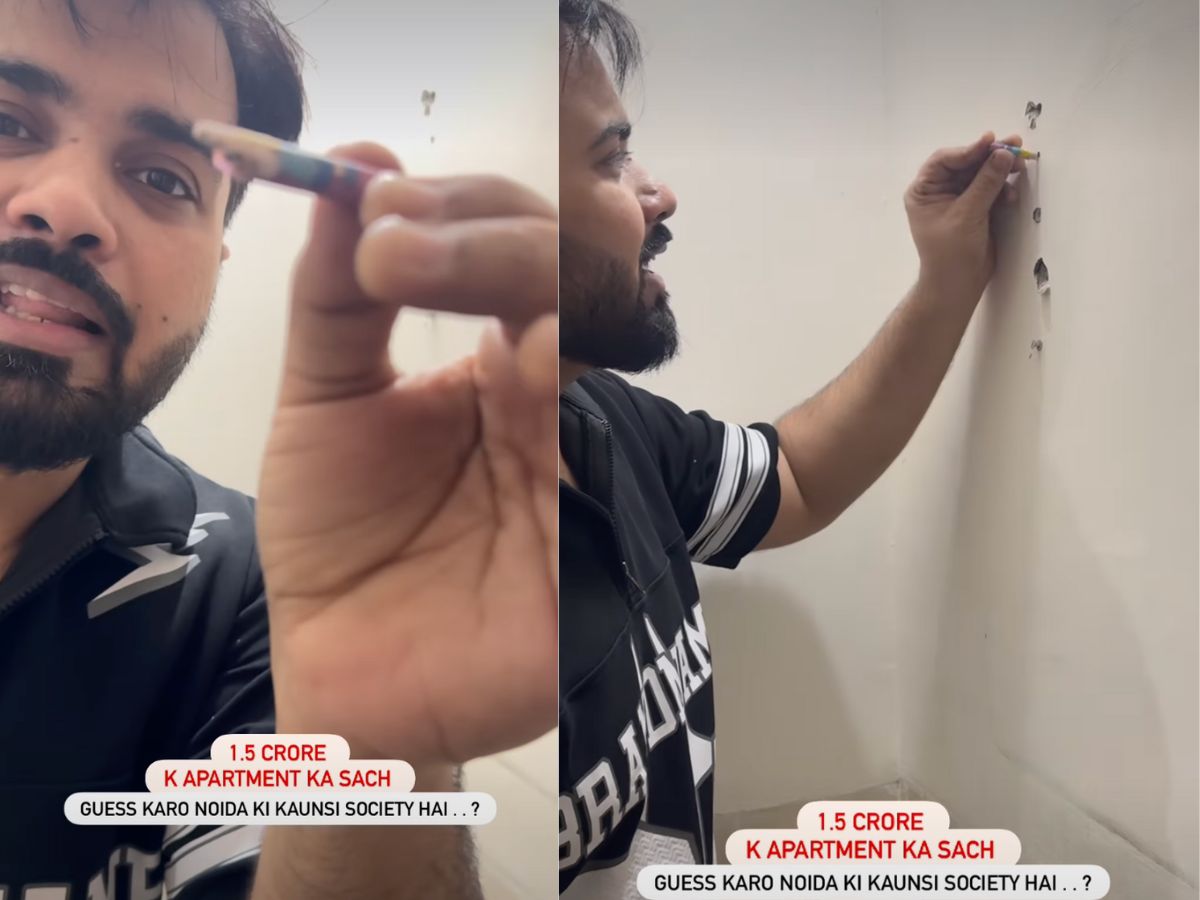

Noida’s high-rise apartments, often considered a mark of luxury and safety, are under scrutiny after a viral video revealed startling weaknesses in one resident’s flat. The clip, reportedly shot in a Rs 1.5 crore apartment, shows a man creating a hole in the wall using nothing more than a wooden pencil and a hammer.
In the video shared on Instagram by user @kabeer.unfiltered, the resident demonstrates, “I placed the pencil against the wall, hit it with a hammer, and it went right through. You don’t even need a drill for this.” The shocking demonstration left viewers questioning the quality of construction in the expensive Noida residential project.
Watch here:
However, experts and netizens quickly pointed out that the walls in question are likely non-structural AAC (Autoclaved Aerated Concrete) blocks, commonly used in high-rise buildings. AAC walls are lightweight, eco-friendly, fire-resistant, and provide good insulation against heat and sound. Since they are non-load-bearing, they reduce a building’s overall weight, improving stability during earthquakes.
One Instagram user clarified, “Those are non-structural AAC walls. They aren’t weak, they’re lightweight and safe. You’re only damaging your own home.” Yet, many others expressed concern over spending almost Rs 1.5 crore for an apartment with such fragile walls. Comments ranged from “How bad it feels to have been cheated, investing so much in poor infrastructure” to “It is not even safe to live in this house.”
This is not the first time Noida residents have raised concerns about apartment construction quality. Over the years, several videos have surfaced online highlighting questionable building materials and poor structural standards in various high-rise societies.
While the debate continues, this video has got over 16,000 views in just a day, sparking widespread discussion about apartment safety, construction quality, and real estate investment in metro cities. For prospective buyers, experts advise understanding the difference between load-bearing walls and partition walls before making such a significant investment.
Sofia Babu Chacko is a journalist with over five years of experience covering Indian politics, crime, human rights, gender issues, and stories about marginalized communities. She believes that every voice matters, and journalism has a vital role to play in amplifying those voices. Sofia is committed to creating impact and shedding light on stories that truly matter. Beyond her work in the newsroom, she is also a music enthusiast who enjoys singing.




