
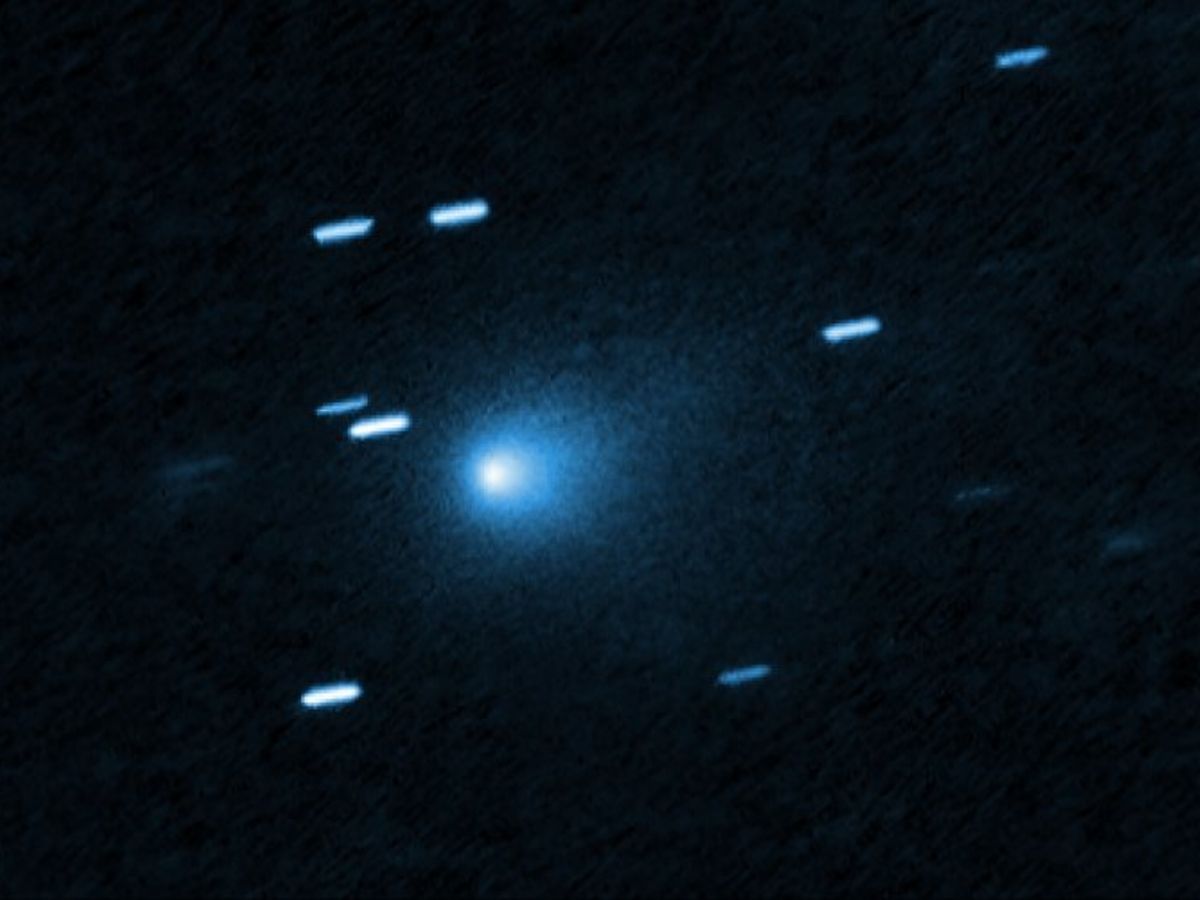

The European Space Agency (ESA) is prepping for a rare astronomical opportunity as interstellar comet 3I/ATLAS prepares to make its closest approach toward Mars.
Discovered on July 1 this year, the comet — officially named C/2025 N1 (ATLAS) — is the third known interstellar object to enter our solar system, after 1I/Oumuamua and 2I/Borisov, according to space.com. However, Earth won’t be in the front row this time. Instead, ESA orbiters around Mars could provide scientists with the best vantage point in the solar system.
Plans to observe 3I/ATLAS
Confirming that both Mars Express and the ExoMars Trace Gas Orbiter (TGO) will be used to observe the comet during its flyby, ESA Mars orbiters project scientist Colin Frank Wilson, told the digital science portal, “We can confirm that we are planning to observe 3I/ATLAS around the time of its closest approach to Mars.”
Revealing that the astronomical event is predicted to occur on 3 October, Wilson further told the publication, “On this date, the object will still be approximately 30 million kilometres from Mars.”
Not a close-up, but still a big deal
Even though 3I/ATLAS won’t get particularly close — about 18.6 million miles (30 million kms) from Mars, compared to 168 million miles (270 million km) from Earth — the space agency is hoping to gather critical data.
“We will attempt to obtain images of the object using the High Resolution Stereo Camera (HRSC) onboard Mars Express, and also with the Colour and Stereo Surface Imaging System (CaSSIS) onboard TGO,” Wilson reportedly said.
These instruments, the report said, could help determine whether the comet is elongated, spherical, or irregular, and may detect activity or outgassing in its coma.
Stating that the ESA will “also attempt to measure the spectrum of the object, using the TGO’s NOMAD and MEx’s OMEGA and SPICAM spectrometers,” he added that the space agency does not have” great hopes that the signal will be bright enough for spectral characterisation.”
A multi-spacecraft effort
According to the report, NASA’s MAVEN and Mars Reconnaissance Orbiter (MRO), China’s Tianwen-1, and ESA’s JUICE spacecraft are also set to join the action. JUICE will attempt to observe 3I/ATLAS in November, using four of its instruments, head of ESA’s Solar System Section Joern Helbert confirmed to the Space website.
Other spacecraft such as Europa Clipper, Lucy, and Hera may also pass through the comet’s tail after its perihelion, the report said. However, Hera was deemed too far from the right lighting conditions for useful observations.
Meanwhile, closer to home, NASA’s James Webb Space Telescope (JWST) has already locked its sights on the object, yielding early insights that scientists are still analysing.




