
Comet 3I/ATLAS is thrilling people – both astronomers on campus and the general public – as it orbits on a journey through the solar system. Comets from outside our solar neighborhood are rare, and therefore, 3I/ATLAS provides a rare opportunity to study distant regions of the universe.
Why is 3I/ATLAS Interesting?
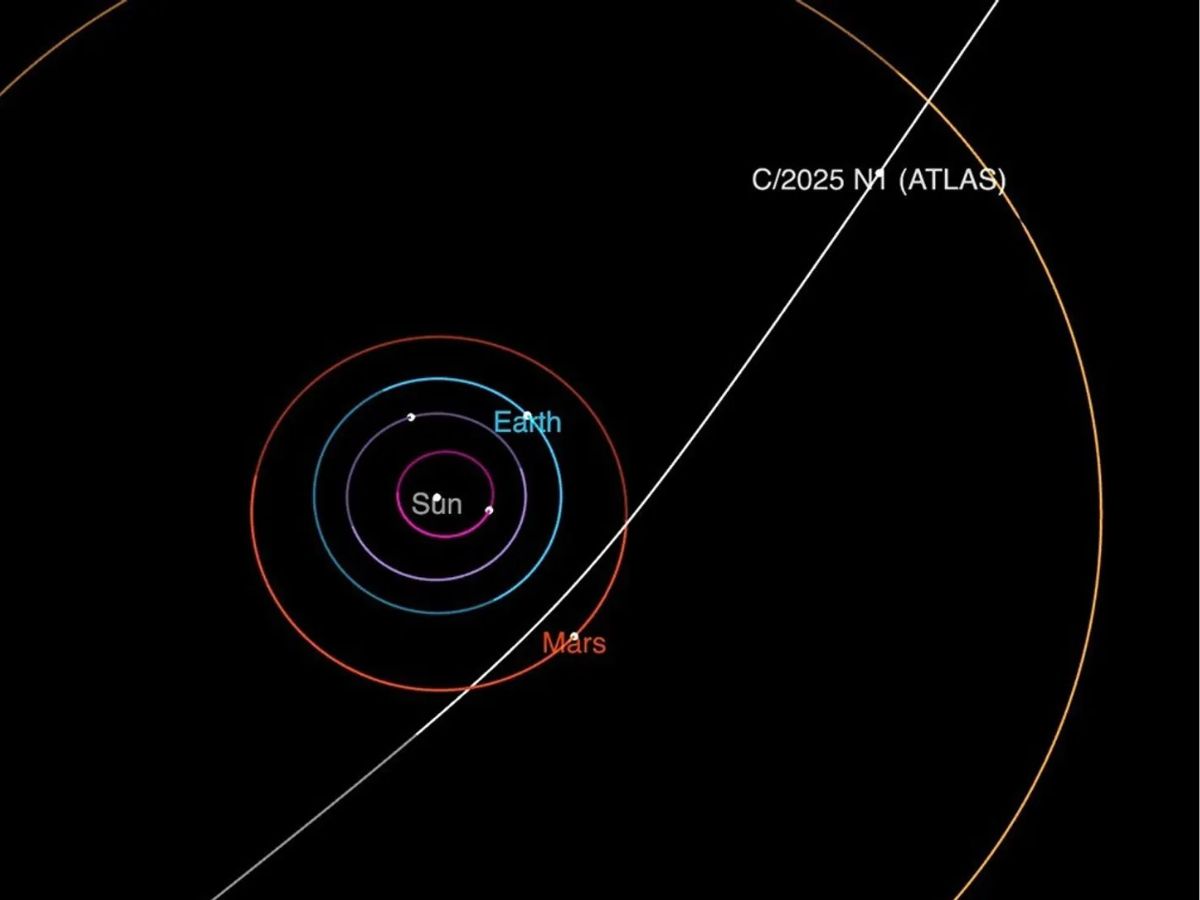
3I/ATLAS is the third known body from another star system to cross our solar system. It was first discovered in July 2025, by an ATLAS telescope in Chile. The most exciting thing about this comet, unlike most comets, is that it is not bound to a regular orbital path. The comet is moving at extreme speed along a hyperbolic path, meaning it will only visit the Sun one time before exiting into the interstellar region, never to return.
An Oddterrestrial Following an Odd Path
Comet 3I/ATLAS is different than most comets in that it is not bound by the Sun’s gravity. It was observed traveling at a speed of approximately 58 km a second (over 200,000 kilometers per hour). Its speed/orbit indicates that it was likely ejected by an unseen force, such as a giant planet in its own star that has buried its family of small bodies.
The orbit of 3I/ATLAS yields an eccentricity of an unusually high 6.1. The orbit is very “straight” compared tha n the more rounded orbit of most comets. Its unusual characteristic helps astronomers confirm we have detected an interstellar comet, or object, which is scientifically exciting.
Its Size and What We’ve Learned
3I/ATLAS seems much larger than previous interstellar objects – with estimates of its size being around 12 miles (20 kilometers) in width. It has a bright coma – gas and dust cloud – growing bright as it approaches the Sun, helping astronomers study its composition. Observations imply it may be one of the oldest comets discovered and possibly formed before the solar system existed.
Why Its Visit Matters
Because of its hyperbolic, one-time orbit, astronomers from all over the world are trained on it as it approaches, using telescopes and spacecraft. The data we collect from this rarified opportunity will shed more light on materials that exist in distant planetary systems and how planets in other regions of the galaxy form.
No Threat to Earth
The approach of 3I/ATLAS is close – 170 million miles away – but no threat to Earth. It’s a source of wonder, not worry, and creates an opportunity for scientists to study the cosmic visitor before 3I/ATLAS disappears into deep space, with the time window shorter than anticipated.
This article is based on available astronomical data and ongoing research from global space agencies and observatories. Future observations may provide updated findings on 3I/ATLAS and its behavior in the solar system.
Vani Verma is a content writer with over 2 years of experience in lifestyle, entertainment, health and digital media. She has a knack for creating engaging and research-driven content that resonates with readers, blending creativity with clarity. Passionate about media trends, culture, and storytelling, she strives to craft content that informs, inspires, and connects.





