
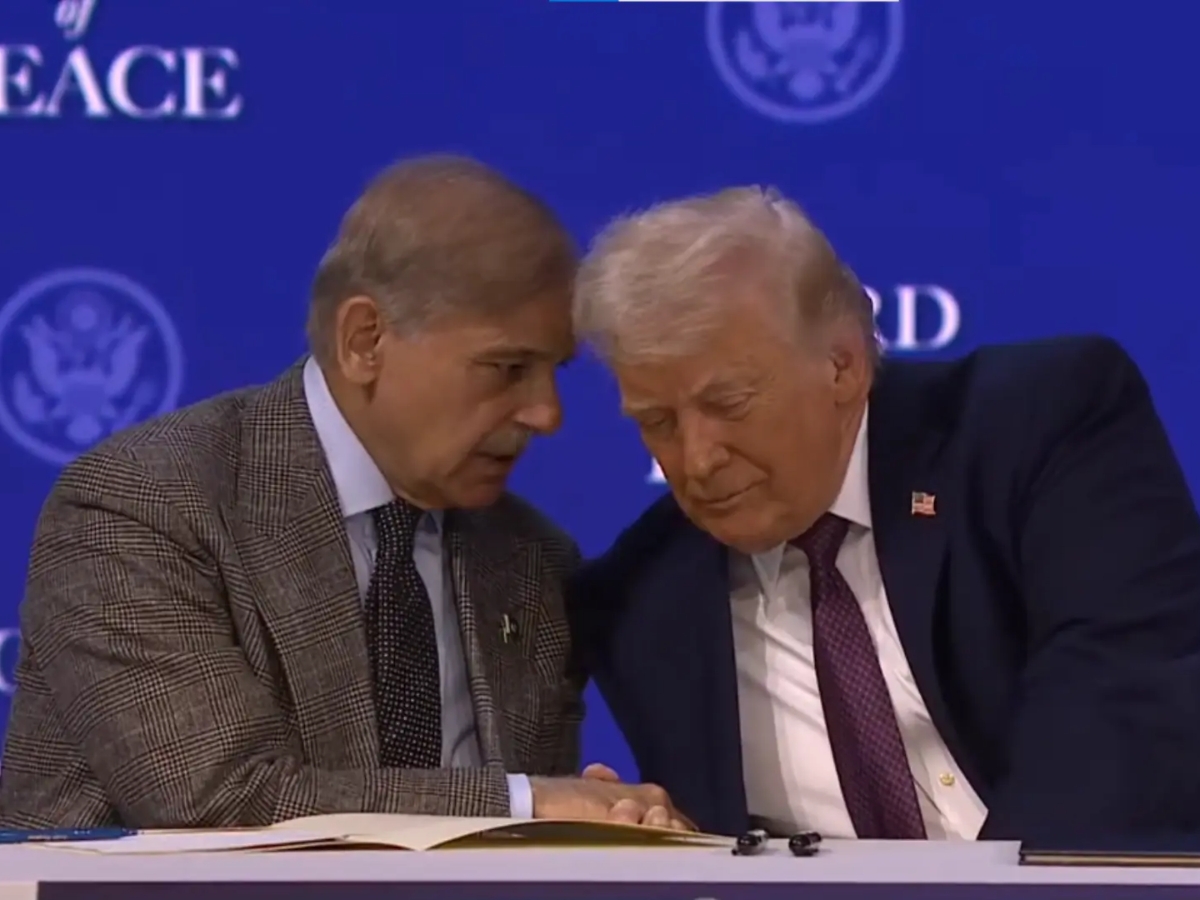

Board of Peace: Pakistan Prime Minister Shehbaz Sharif joined a select group of global leaders in Davos, Switzerland, to sign the charter of US President Donald Trump’s proposed ‘Board of Peace’ for Gaza, describing the move as a significant diplomatic step on the sidelines of the World Economic Forum (WEF).
However, Sharif’s participation quickly triggered a fierce political backlash in Pakistan, with opposition parties branding the decision non-transparent and “morally indefensible,” and demanding broader consultation before committing the country to the initiative.
What Is Trump’s ‘Board of Peace’?
The ‘Board of Peace’ was formally unveiled by President Trump as part of the second phase of his 20-point plan aimed at ending the ongoing Gaza conflict. According to reports, the proposed body is intended to function as a new international mechanism for conflict resolution, extending beyond Gaza.
Its stated mandate includes governance capacity-building, post-conflict reconstruction, investment facilitation, and large-scale funding mobilisation. The initiative is being viewed by several countries as an attempt to create a parallel global framework that could potentially supplant the United Nations’ existing multilateral system.
Pakistan Opposition Pushback: PTI Demands Transparency and Consultation
The strongest opposition came from Pakistan Tehreek-e-Insaf (PTI), the party of jailed former prime minister Imran Khan. In a sharply worded statement, PTI rejected the government’s decision to join the Board of Peace, arguing that matters of such international significance require “full transparency and inclusive consultation with all major political stakeholders.”
PTI leaders stressed that Pakistan’s participation in international peace initiatives should strengthen, not undermine, the United Nations-led multilateral order. They warned that the creation of “parallel structures” could further “complicate global governance.”
The party has demanded that the government withdraw from formal participation in the board until a complete consultative process is carried out. PTI has insisted that this process must be subject to parliamentary scrutiny and include the involvement of Imran Khan.
PTI Backs Palestine, Calls For Refrendum In Pakistan
Going a step further, the party has also called for a national referendum on the decision.
While reiterating its support for the Palestinian people, PTI clarified that it would not endorse any international plan that runs counter to the wishes of the people of Gaza or Palestine as a whole.
The party underlined that any peace framework must align with the aspirations and consent of Palestinians, rather than being imposed externally.
Pakistan Senate Opposition Leader Calls Move ‘Morally Indefensible’
The criticism intensified after Allama Raja Nasir Abbas, chief of the Majlis Wahdat-e-Muslimeen (MWM) and Leader of the Opposition in the Senate, condemned the government’s decision in strong terms.
Abbas described Pakistan’s participation in the Board of Peace as “morally incorrect and indefensible,” adding to the mounting political pressure on Prime Minister Sharif.
The controversy coincided with President Trump using the Davos platform to issue a stark warning to Palestinian militant group Hamas, stating that it must disarm or face “elimination.”
Although the Trump administration invited around 60 countries to join the initiative – including major global powers such as India and China – fewer than 20 countries ultimately took part in the Davos launch.
Reports further indicate that permanent membership of the Board of Peace carries a reported price tag of $1 billion.
Countries That Joined the Board of Peace
The countries that accepted President Trump’s invitation to join the Board of Peace include Argentina, Albania, Armenia, Azerbaijan, Bahrain, Belarus, Bulgaria, Egypt, Hungary, Indonesia, Jordan, Kazakhstan, Kosovo, Morocco, Mongolia, Pakistan, Qatar, Saudi Arabia, Turkey, the United Arab Emirates, Uzbekistan, and Vietnam.
Zubair Amin is a Senior Journalist at NewsX with over seven years of experience in reporting and editorial work. He has written for leading national and international publications, including Foreign Policy Magazine, Al Jazeera, The Economic Times, The Indian Express, The Wire, Article 14, Mongabay, News9, among others. His primary focus is on international affairs, with a strong interest in US politics and policy. He also writes on West Asia, Indian polity, and constitutional issues. Zubair tweets at zubaiyr.amin




