
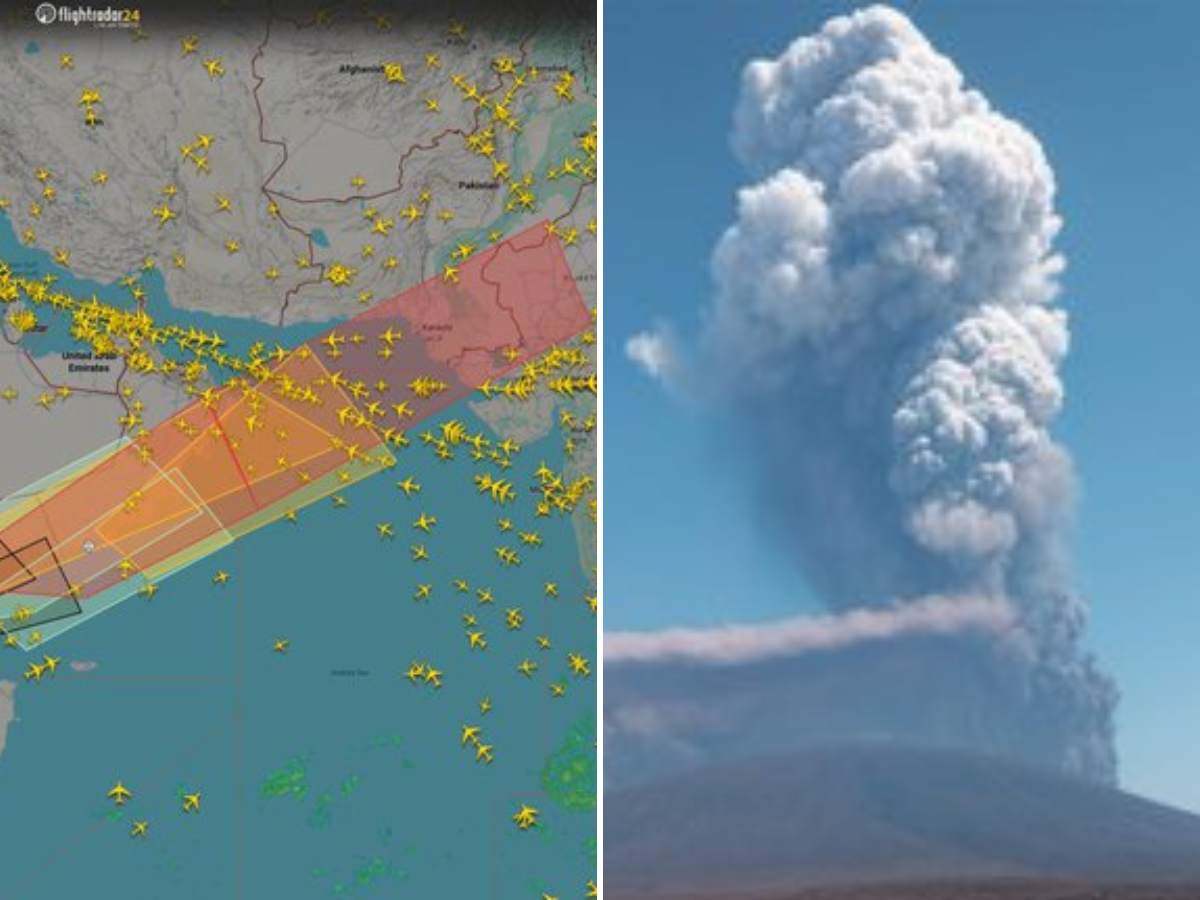

Monday night i.e. November 24, is expected to see a thick cloud of ash in northwest India, a volcanic eruption is the first in thousands of years at Hayli Gubbi volcano in Ethiopia and the volcano ash clouds are expected to enter Gujarat and then travel to Rajasthan, Delhi-NCR and Punjab within the next few hours, according to the meteorological experts.
Hayli Gubbi Eruption Sends Ash Toward Gujarat, Delhi-NCR; Flights Hit
In and around the Indian airspace, the aircraft operations are also starting to feel the heat, with the ash approaching the area, and more is expected to affect the flights within hours, officials who are aware of the issue said.
The smoke of the first eruption of the Hayli Gubbi Volcano in the Afar region of Ethiopia was seen billowing in this photograph by the Afar Government Communication Bureau taken on Sunday.
The plumes; these are volcanic ash, sulphur dioxide and even minute fragments of rocks, which are around 10-15 kms in the air according to the India Meteorological Department (IMD) and the plumes will primarily affect flights.
⚠️ Ethiopia: The Hayli Gobi volcano erupted today for the first time in ten thousand years and sent ash up to a height of 15 km.🔥🔥 pic.twitter.com/aiPVhhO4rr
— Dr. Fundji Benedict (@Fundji3) November 24, 2025
Flights impacted due to massive ash cloud
Flight cancellations by airlines had already started after the ash had crossed the Red Sea, and was heading towards the Middle East and Central Asia. The issue made IndiGo cancel six flights. Although one of these flights was based in Mumbai, the rest of the cancelled flights were based in down South, one of the individuals with knowledge of the development said.
An official in one of the airports in Mumbai claimed that flights were avoiding Pakistan airspace. The Indian airlines are likely to be affected since the Pakistan airspace is closed to Indian airlines. We are beginning to put a note of this, and watching the position, one of the officials there.
Flights are forced to be re-routed or cancelled. Although the effects on the flight activities are insignificant today, it is predicted that the situation will be poorer on Tuesday, another individual in close relations to the development said.
The DGCA and the ministry authorities are keeping a keen eye on the affair. He added that Indian aviation would be hit hard in case the ashes settle over Delhi and Jaipur by Tuesday.
The IMD also indicated that its effect in the area would be probable in the next couple of hours. This will start to hit Gujarat and other regions of Delhi-NCR within the coming several hours. It is already approaching Gujarat and we will feel its effects in Delhi-NCR and rest of north India in the coming couple of hours based on the direction of the IMD director general, M Mohapatra which will first of all affect flights.
It lies in the upper levels hence will not be seriously affected close to the surface. It will look like a smoky, misty sky, and its influence will not last many hours, now that it will make its way still farther eastwards, said he.
The effect within the cities will largely be an increment of the temperature at the fringes. Just like the clouds, the minimum will increase. It remains uncertain whether it will affect the air quality but any substantial effect is unlikely because it is at a higher level, Mohapatra added.
What do the meteorologists say?
The meteorologists indicated that the plume was spreading quickly in Central Asia and into India.
The speed of movement of the ash plume is approximately 100-120km/h towards north India. This lies between 15-25,000 feet to upto 45,000 feet in the sky which is comprised of mostly volcanic ash, sulphur dioxide and few small pieces of glass or rocks that will cause the sky to become darker and will affect air traffic, said Ashwary Tiwari an amateur weatherman who operates handle IndiaMetSky on X.
He said it already started affecting Jodhpur, and NCR and other regions will soon be affected as well.
This is likely to potentially shoot the already high pollution levels in the area as well. Even at the time, the air quality in NCR was nearing the point of severity at most points.
The quality index (AQI) of the air in Delhi was 382 at 4 pm on Monday. It stood 396 (very poor) at Ghaziabad at the same time; 397 in Noida; 382 at Greater Noida and 232 (poor) in Faridabad.
AQI 400 and above is considered as severe and the AQI reaches 500.




