

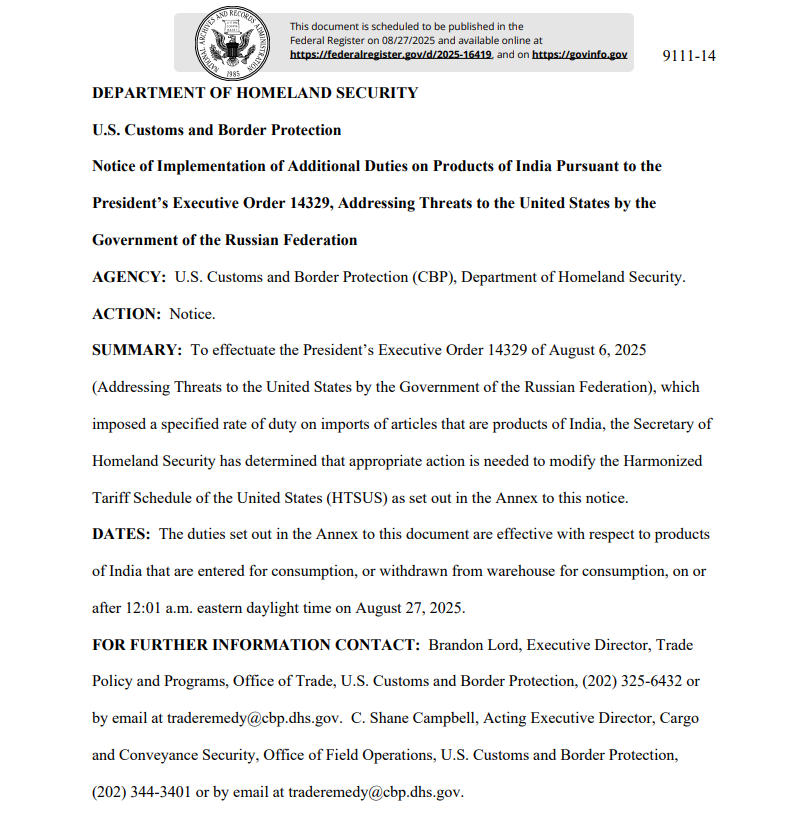
US has outlined plans to impose a 50 percent tariff on Indian goods, confirming an announcement made earlier by President Donald Trump. A draft notice issued by the Department of Homeland Security (DHS) made it clear that the higher levies would take effect despite ongoing geopolitical uncertainty. The notice stated that the tariffs will apply to Indian products “that are entered for consumption, or withdrawn from warehouse for consumption, on or after 12:01 AM eastern daylight time on August 27, 2025.”
Earlier this month, Trump declared his intention to double tariffs on Indian imports from 25 percent to 50 percent, linking the move to New Delhi’s continued purchase of Russian oil. He also set August 27 as the deadline for implementation.
How is India Responding To 50% US Tariffs?
According to reports, Indian government is working to mitigate the fallout. After nearly eight months of negotiations without a breakthrough, Washington’s move to impose the higher duties has placed heavy pressure on India’s export-dependent sectors.
The Ministry of Commerce and Industry has called on states with strong export bases – including Gujarat, Maharashtra, and Tamil Nadu – to support industries most vulnerable to the tariffs. Labour-intensive sectors such as apparel and leather are expected to be among the hardest hit.
Trade Diversification, And Other Measures in Response To Trump Tariffs
According to reports, the commerce ministry is building a response around four pillars – export diversification, import substitution, enhanced competitiveness, and targeted sectoral support.
At the centre of this strategy is the long-delayed ₹2,250 crore Export Promotion Mission, first announced in the Union Budget 2025–26.
Its rollout is now being accelerated to provide subsidies and easier credit for micro, small and medium enterprises (MSMEs) reeling from the tariff shock.
🚨🇮🇳 PM Modi’s message ahead of US tariffs deadline
“No matter how much pressure comes, we will continue to strengthen our capacity to endure it.” pic.twitter.com/Mxr3y8jBBr
— Sputnik India (@Sputnik_India) August 26, 2025
As part of the plan, the government is reopening the Production-Linked Incentive (PLI) scheme for textiles, following industry requests for expanded support.
Also, India’s market diversification drive has been broadened from 20 to 50 countries, with a strong focus on the Middle East and Africa – regions that together account for 90 percent of the country’s exports. The aim is to reduce dependence on politically sensitive markets.
The Revival of Swadeshi Appeal
Prime Minister Narendra Modi has backed the government’s diversification push with a domestic call to action. Drawing on the symbolism of the pre-independence Swadeshi Movement, he urged citizens, business leaders, and traders to prioritise local products.
🚨Buy and Sell Products Made in India: Modi’s ‘Swadeshi’ Pitch Amid Tariff Conflict with US pic.twitter.com/9ZEsvDt68d
— India & The World (@IndianInfoGuid) August 2, 2025
“Traders, in particular, have been asked to commit to stocking and selling only Indian-made goods,” the government said.
The strategy is intended to encourage import substitution, boost domestic manufacturing, and reduce exposure to foreign market volatility.
India-US Trade
Recent trade figures highlight the scale of India’s challenge. In June 2025, exports were stagnant at $35.14 billion, constrained by weak global demand, though the trade deficit narrowed to a four-month low of $18.78 billion.
For April–June 2025–26, exports rose just 1.92% to $112.17 billion, while imports increased by 4.24% to $179.44 billion.
India exported $86.5 billion worth of goods to the US last year, making it one of New Delhi’s most important trade partners.
If the new tariffs persist, India may be forced to consider reciprocal measures. Possible targets for counter-duties include high-profile US exports such as aircraft, crude oil, whisky, and motorcycles.
Also Read: Trump’s 50% Tariffs: The Indian Exports Facing The Biggest Impact
Zubair Amin is a Senior Journalist at NewsX with over seven years of experience in reporting and editorial work. He has written for leading national and international publications, including Foreign Policy Magazine, Al Jazeera, The Economic Times, The Indian Express, The Wire, Article 14, Mongabay, News9, among others. His primary focus is on international affairs, with a strong interest in US politics and policy. He also writes on West Asia, Indian polity, and constitutional issues. Zubair tweets at zubaiyr.amin




