
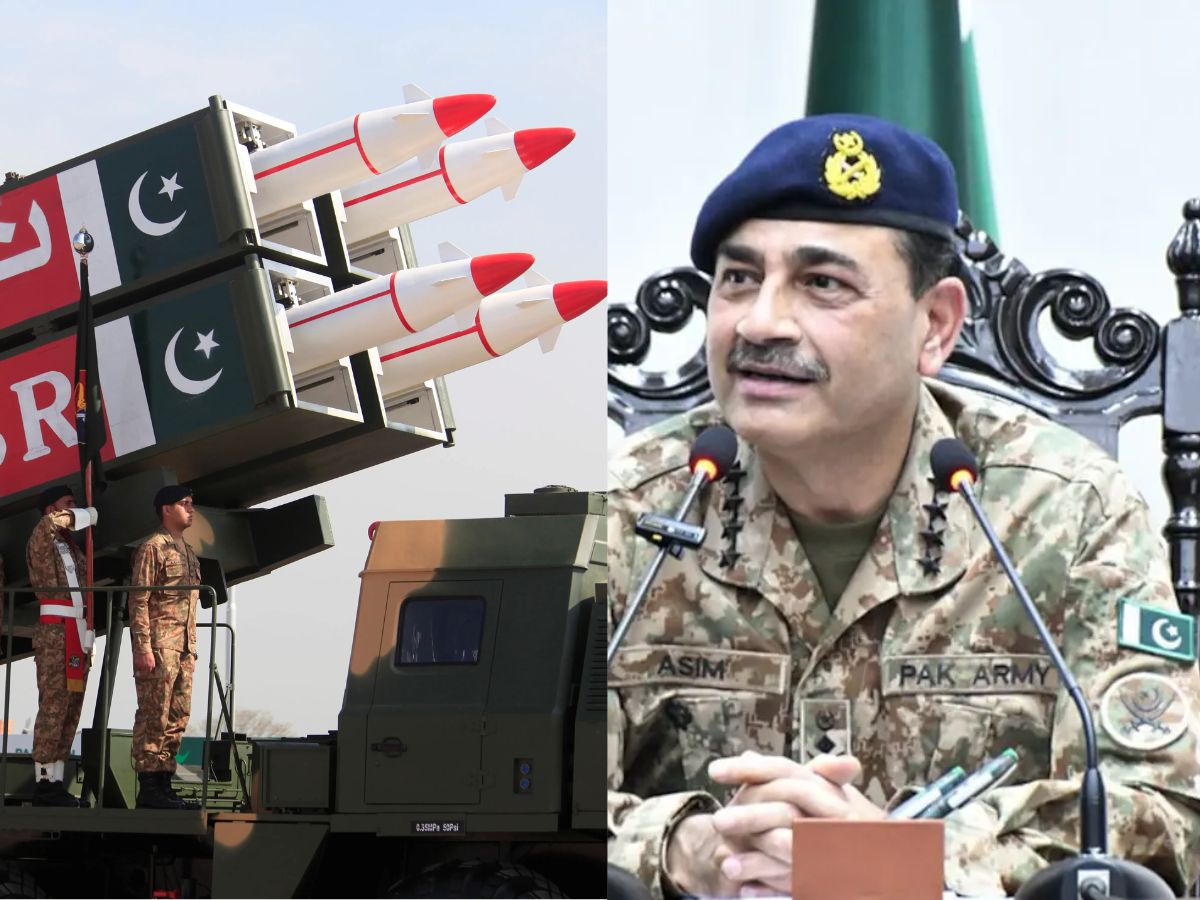

Pakistan Army Chief General Asim Munir, during his second visit to Washington within two months, issued a stark warning that Pakistan could trigger a nuclear conflict if it perceives an existential threat to the country.
Speaking at a black-tie dinner hosted by Tampa-based businessman and honorary consul Adnan Asad, General Munir issued a chilling warning. Quoted by The Print, he said, “we are a nuclear nation, if we think we are going down, we’ll take half the world down with us.”
He reiterated Pakistan’s readiness to respond decisively to any perceived threats, underscoring the gravity of the situation in the region.
Asim Munir on Indus Waters Treaty
General Munir also highlighted tensions over the Indus Waters Treaty, accusing India of putting millions at risk by suspending the treaty’s implementation. He warned that India’s construction of dams on the Indus River could have catastrophic consequences for Pakistan’s population.
Also Read: ‘Take Half The World Down’ : Pakistan’s Top Army Commander Asim Munir Threatens India
“We will wait for India to build a dam, and when it does so, phir 10 missile sey faarigh kar dengey [we will destroy it with 10 missiles],” Munir said.
He further asserted Pakistan’s missile capabilities, stating, “the Indus River is not the Indians’ family property. Humein missilon ki kami nahin hai, al-Hamdulillah [we have no shortage of missiles, Praise be to God].”
How Many Nuclear Weapons Does Pakistan Have?
The question of Pakistan’s nuclear strength has come into sharper focus following Munir’s statements.
According to the Stockholm International Peace Research Institute (SIPRI), Pakistan currently possesses an estimated 170 nuclear warheads. This places it slightly behind India, which is estimated to have 180 warheads as of January 2025.
The Bulletin of the Atomic Scientists reported in 2023 that Pakistan is rapidly expanding its nuclear capabilities. The country is developing several new delivery systems, operates four plutonium production reactors, and is expanding its uranium enrichment infrastructure, suggesting the potential for a swift increase in its arsenal.
The International Campaign to Abolish Nuclear Weapons reported that Pakistan has invested approximately $1 billion in its nuclear weapons program. Additionally, China has played a significant role in providing technical assistance to Pakistan’s nuclear and missile development in recent years.
Who Controls Pakistan’s Nuclear Weapons?
Despite its nuclear capability, Pakistan has never formally declared an official nuclear doctrine, which has long been a cause for international concern.
The control of Pakistan’s nuclear arsenal is vested in its highest leadership, including the president and prime minister, who jointly hold the final authority to use nuclear weapons. The military oversees the security and operational deployment of the arsenal.
The National Command Authority (NCA), established in 2000 and chaired by the prime minister, is the supreme decision-making body on Pakistan’s nuclear and missile policies. It supervises all related programs. While civilian leadership theoretically holds substantial power over nuclear decisions, the International Institute for Strategic Studies observes that in practice, “the military would probably prevail on nuclear decision-making during wartime or a military crisis.”
Also Read: Pakistan Army Chief Asim Munir’s Bizarre Remark Sparks Debate: What Exactly Did He Say?
Zubair Amin is a Senior Journalist at NewsX with over seven years of experience in reporting and editorial work. He has written for leading national and international publications, including Foreign Policy Magazine, Al Jazeera, The Economic Times, The Indian Express, The Wire, Article 14, Mongabay, News9, among others. His primary focus is on international affairs, with a strong interest in US politics and policy. He also writes on West Asia, Indian polity, and constitutional issues. Zubair tweets at zubaiyr.amin




