
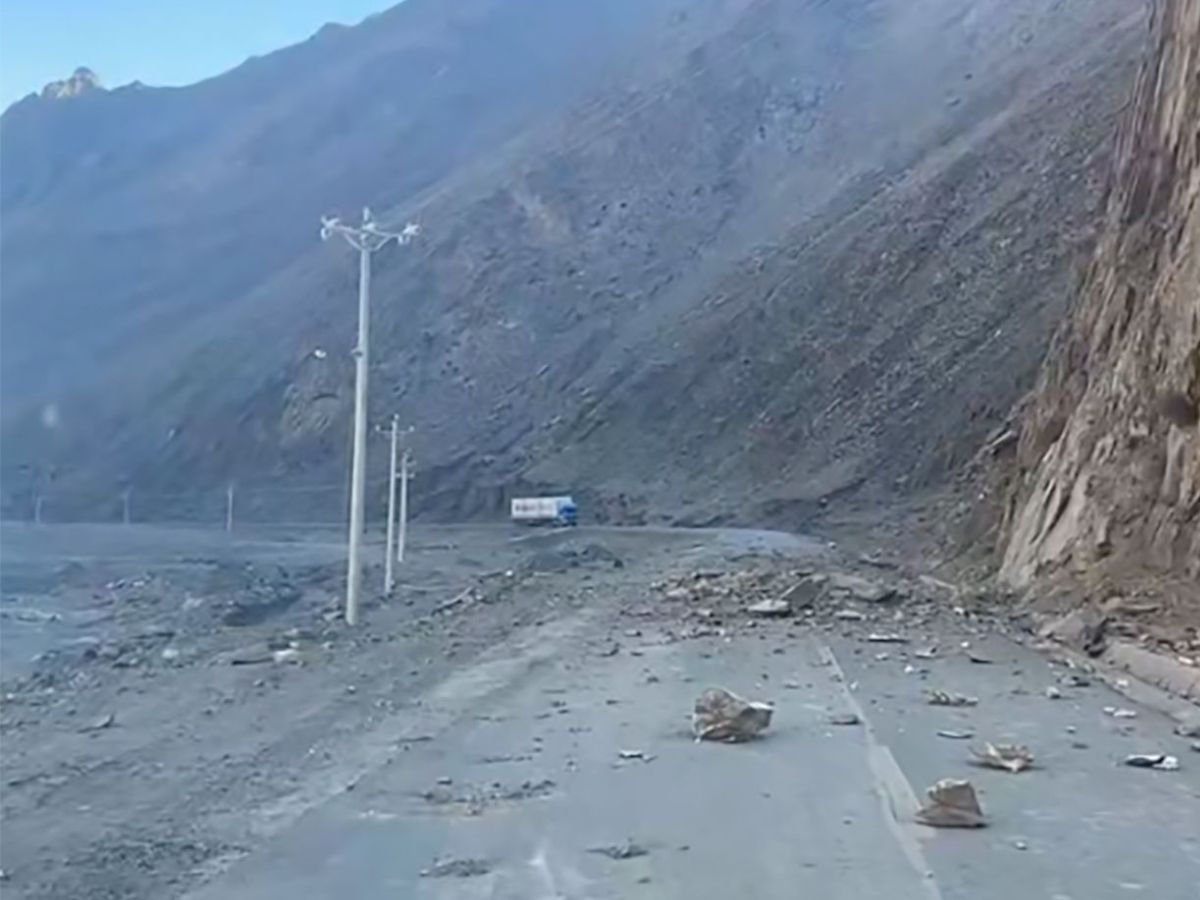

An earthquake of magnitude 3.7 struck Tibet on Sunday, a statement by the National Center for Seismology (NCS) said.
As per the statement, the earthquake occurred at a shallow depth of 5km, making it susceptible to aftershocks.
In a post on X, the NCS said, “EQ of M: 3.7, On: 27/07/2025 14:43:17 IST, Lat: 33.81 N, Long: 79.40 E, Depth: 5 Km, Location: Tibet.”
Earlier on July 24, another earthquake of magnitude 3.6 struck the region at a depth of 10 km.
In a post on X, the NCS said, “EQ of M: 3.6, On: 24/07/2025 02:51:11 IST, Lat: 28.53 N, Long: 89.83 E, Depth: 10 Km, Location: Tibet.”
EQ of M: 3.6, On: 27/07/2025 10:45:44 IST, Lat: 22.81 N, Long: 95.51 E, Depth: 161 Km, Location: Myanmar.
For more information Download the BhooKamp App https://t.co/5gCOtjdtw0 @DrJitendraSingh @OfficeOfDrJS @Ravi_MoES @Dr_Mishra1966 @ndmaindia pic.twitter.com/EpS1C4hQ3n— National Center for Seismology (@NCS_Earthquake) July 27, 2025
Earthquake of Magnitude 3.6 Strikes Myanmar
An earthquake of magnitude 3.6 struck Myanmar also on Sunday, a statement by the National Center for Seismology (NCS) said.
As per the statement, the earthquake occurred at a depth of 161 km.
In a post on X, the NCS said, “EQ of M: 3.6, On: 27/07/2025 10:45:44 IST, Lat: 22.81 N, Long: 95.51 E, Depth: 161 Km, Location: Myanmar.”
Hours ago, another earthquake of magnitude 3.8 struck the region.
Sharing the details on X, the NCS said, “EQ of M: 3.8, On: 27/07/2025 00:35:35 IST, Lat: 24.48 N, Long: 94.58 E, Depth: 75 Km, Location: Myanmar.”
Tibetan Plateau Known For Earthquakes
Shallow earthquakes are generally more dangerous than deep earthquakes. This is because the seismic waves from shallow earthquakes have a shorter distance to travel to the surface, resulting in stronger ground shaking and potentially more damage to structures and greater casualties.
The Tibetan Plateau is known for its seismic activity due to tectonic plate collisions.
Tibet and Nepal lie on a major geological fault line where the Indian tectonic plate pushes up into the Eurasian plate, and earthquakes are a regular occurrence as a result of it. The region is seismically active, causing tectonic uplifts that can grow strong enough to change the heights of the Himalayas’ peaks, noted Al Jazeera.
“Education about earthquakes and earthquake-resilient buildings combined with funding for retrofits and resilient structures can help protect people and buildings when strong earthquakes occur,” Marianne Karplus, a seismologist and geophysicist, told Al Jazeera.
Series of Earthquakes in Myanmar
“The earth system is very complex, and we cannot predict earthquakes. However, we can conduct scientific studies to better understand what causes earthquakes in Tibet and to better understand the shaking and impacts resulting from earthquakes,” Karplus, who is a professor of geological sciences at the University of Texas at El Paso, told Al Jazeera.
In the aftermath of the magnitude 7.7 and 6.4 earthquakes that struck central Myanmar on March 28, the World Health Organization (WHO) warned of a series of rapidly rising health threats for tens of thousands of displaced people in earthquake-affected areas: tuberculosis (TB), HIV, vector- and water-borne diseases.
Myanmar is vulnerable to hazards from moderate and large magnitude earthquakes, including tsunami hazards along its long coastline. Myanmar is wedged between four tectonic plates (the Indian, Eurasian, Sunda, and Burma plates) that interact in active geological processes.
(With inputs from ANI)
Also Read: Papua New Guinea Earthquake: Magnitude 5.8 Quake Strikes Near Madang
Zubair Amin is a Senior Journalist at NewsX with over seven years of experience in reporting and editorial work. He has written for leading national and international publications, including Foreign Policy Magazine, Al Jazeera, The Economic Times, The Indian Express, The Wire, Article 14, Mongabay, News9, among others. His primary focus is on international affairs, with a strong interest in US politics and policy. He also writes on West Asia, Indian polity, and constitutional issues. Zubair tweets at zubaiyr.amin




