
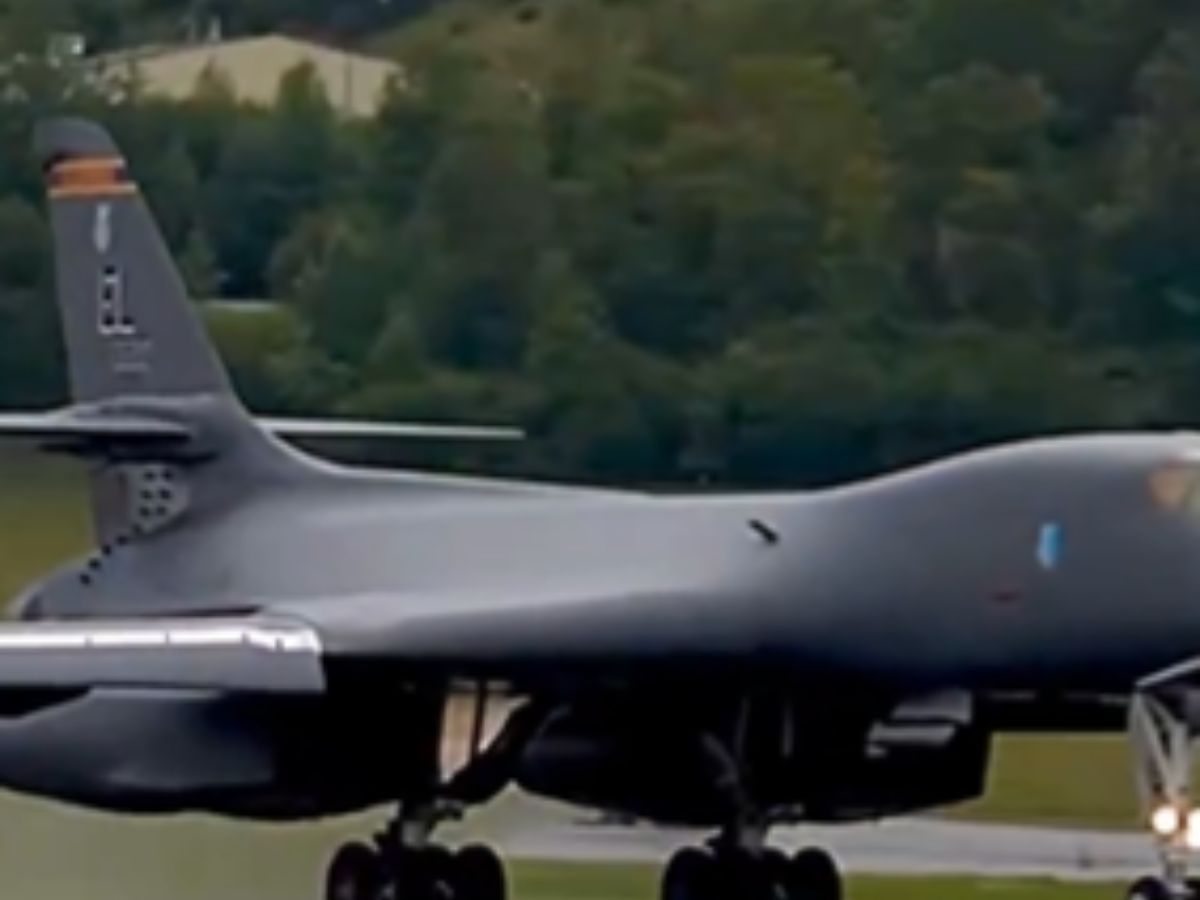

On 27th of October 2025, two of the B-1B Lancer bombers belonging to the Ellsworth air force base flew aircraft on over the Caribbean Sea while demonstrating some attack against an imaginary Venezuelan placement, with support from the KC-135 tankers of MacDill Air Force Base.
The show of force by the U.S. Air Force has dramatically grown towards Venezuela with the deployment of two B-1B Lancer strategic heavy bombers to the Caribbean ocean. This long-range mission, conducted on October 23, marked the second bomber flight within less than ten days, following that of B-52 Stratofortress bombers and those of F-35B stealth fighters.
The two supersonic B-1Bs, which took off from Dyess Air Force Base in Texas under the callsigns ‘BARB21’ and ‘BARB22,’ were tracked by open-source flight data, coming within roughly 50 miles of the Venezuelan coastline and even closer to the Los Testigos islands.
This is all part of a much wider military increase by the United States that has included many warships, drones, and a newly deployed Carrier Strike Group in the region for the pressure audience with the government of President Nicolás Maduro.
Strategic Deterrence: Long-Range Power Projection
While the deployment of the B-1B, with its capacity for a huge conventional ordnance payload launched under standoff conditions, is quite definitively a message about military reach, the operation could not have been more public.
The aircraft flew with their transponders on, concluding that Caracas had an idea where the B-1B was and what it was doing. U.S. Southern Command (USSOUTHCOM) went on record stating that the missions support “ongoing regional operations” directed against Transnational Criminal Organizations (TCOs) and counter-narcoterrorism.
The deployment of such strategic bombers which do not usually conduct this form of operations demonstrates resolve in the area of power projection in all its modes, as a direct and unmistakable warning. The flights are perceived very much as psychological warfare, demonstrating the capability for a rapid and decisive strike should tension escalate.
Escalation Tensions: Diplomatic and Military Backdrop
This recurrent use of bomber task forces comes at a time of increased tension between Washington and a Maduro regime which the U.S. calls illegitimate and accuses of drug trafficking. Alongside the air demonstrations, the U.S. has also carried out numerous strikes against vessels in the Caribbean, alleged to have been involved in drug trafficking, in operations said to have troubling questions of legality and leaving behind scores of dead.
Venezuela has strongly condemned the deployments as a hostile provocation and an attempt to overthrow the government. President Maduro has denied the allegations and has boasted about the country’s military readiness by stating the positioning of 5,000 Russian-made man-portable surface-to-air missiles in critical defense locations.
Also Read: J&K Police Tighten Noose On Terrorists, Attach Rs 70 Lakh Property In Major Crackdown Operation
A recent media graduate, Bhumi Vashisht is currently making a significant contribution as a committed content writer. She brings new ideas to the media sector and is an expert at creating strategic content and captivating tales, having working in the field from past four months.




