

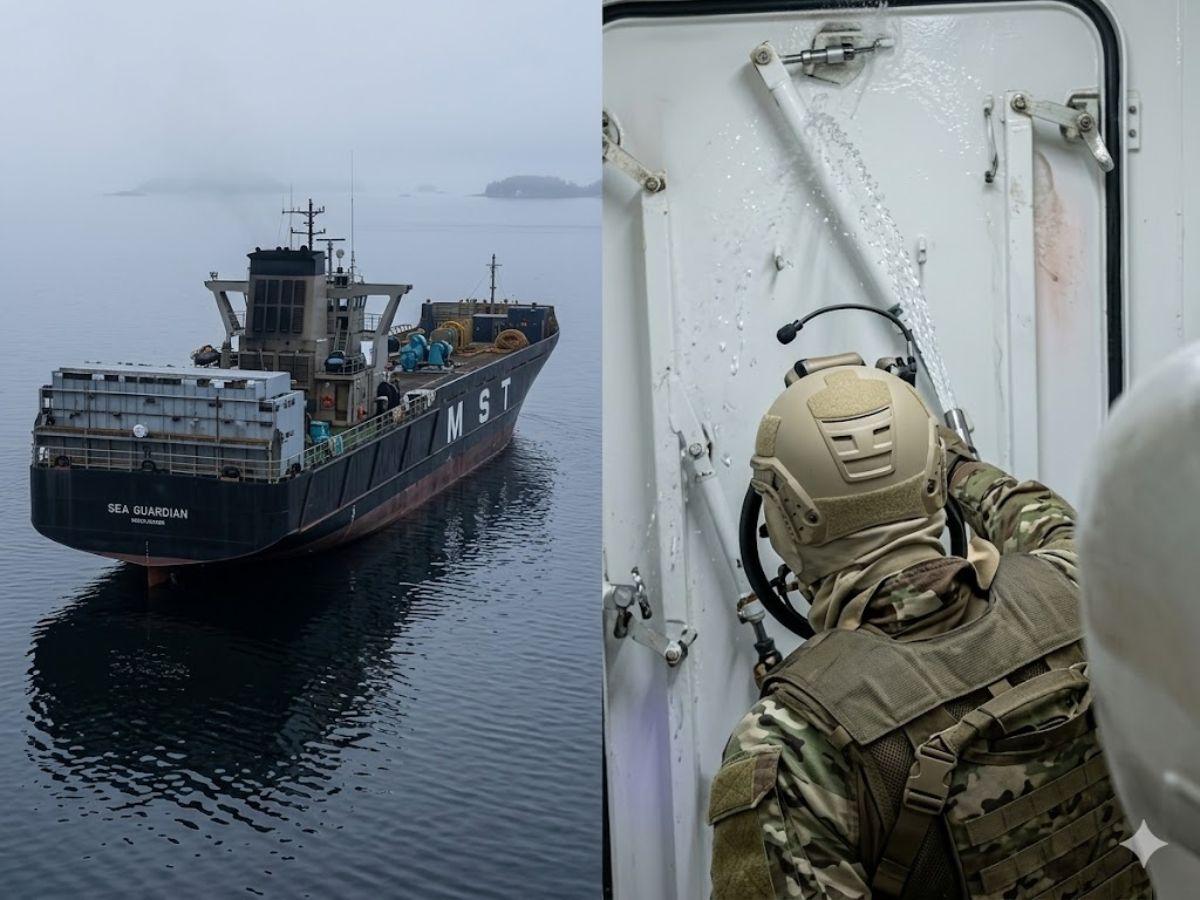
Iran seized two merchant vessels, one of which was headed for India. New videos released by the Iranian government depict how the dramatic operation played out at sea. The event has renewed international scrutiny regarding the safety of Indian vessels sailing through the Strait of Hormuz, a vital route for international maritime shipping.
The most recent footage released by Iranian authorities shows masked Iranian naval forces boarding and taking possession of both vessels with the use of a fleet of high-speed boats to chase each vessel down and then board them. The video appears to have been filmed in a similar manner to that of a movie depicting a dramatic action sequence; however, the very real consequence for Indian shipping and global commerce is significant. This happened just a few days after two Iranian cargo vessels were seized by US Marines who were in the area attempting to avoid being subjected to a US Marine Corps blockade.
Indian Ships targeted as Iran releases dramatic seizure footage
In an operation executed by the Islamic Revolutionary Guard Corps (IRGC) on January 12, 2022, members of the Iranian Navy seized the Panama-flagged MSC Francesca and the Liberia-flagged Epaminondas; the latter was en route to Mundra Port in Gujarat from Dubai, thereby further linking the events of the operation to Indian shipping and commerce.
Iranian forces have seized both vessels at sea, which is the first such incident since hostilities began. Also, there is footage showing Iranian soldiers in small boats and that the Iranian Navy’s capability was significantly diminished during warfare. Officials in the United States have suggested that the operation was executed with what has been termed Iran’s “mosquito fleet,” which consists of small quick-moving vessels that will not be easily identified by radar.
Indian Ships under threat as commandos board vessels mid-sea
Video evidence shows masked men with rifles arrived to board the MSC Francesca using a ladder system and also shows commandos on the Epaminonda searching the ship and moving through it with their weapons, as well as having entered the engine compartment. While this is evidence of increasing risk to Indian Ships traversing the area, another superlative to highlight is the degree to which the Epaminondas sustained damage to its bridge, or Central Command of the Vessel. Evidence exists that the Iranian forces opened fire on the ship and threw grenades from their fast boats during the undertaking which has to be alarming for any future shipping member of India Passengers.
Indian Ships caught in crossfire as MSC Francesca also attacked
The Iranian armed forces also fired upon MSC Francesca while it was near the Iranian border, according to an Islamic Revolutionary Guard Corps (IRGC) statement, as they claimed the ship did not possess the proper “authorization” and had “deceived the navigation systems” which would have posed significant danger to the safety of international navigation.
Additionally, the IRGC warned that any actions that disrupt the “order” of the Strait of Hormuz, would be considered a “red line.” As a result, this warning has caused major apprehension among shipping companies around the world, particularly for many operating Indian Ships, as tensions between the two nations continue to rise.
Indian Ships incident seen as tit-for-tat amid US-Iran tensions
According to experts, Iran’s seizure of the vessels was in response to a recent operation by the United States, wherein US forces seized a ship called Touska that was believed to be attempting to move through the US blockade at Iranian ports, thereby creating another major cause of conflict between the two countries.
Iran has also stated that it will be a precondition to any future discussions with the US that the United States remove the blockade. However, with Indian Ships now having become involved, the tensions around the Strait of Hormuz have dramatically changed scope, particularly in regard to the state of relations between India/Iran.
The attacks on Indian vessels raise concerns about Iran’s internal power structure
The attacks on the Indian vessels, Jag Arnav and Sanmar Herald, further complicate the relationship between New Delhi and Tehran. India has lodged a formal protest and summoned the Iranian envoy since there have been previous pledges from Iranian political leadership that they would not target vessels from any of five “friendly” countries, i.e., India, Pakistan, Iraq, China and Russia.
The continuing attacks on the Indian Ships have raised significant issues regarding authority within Iran. Reports are suggesting that the IRGC, which is under the direct command of the Supreme Leader, has been functioning as the de facto authority carrying out these kinds of operations.
Also Read: Iran Hits Back At Trump’s “Seriously Fractured” Statement, Accuses US President Of Spreading Lies
Khalid Qasid is a media enthusiast with a strong interest in documentary filmmaking. He holds a Master’s degree in Convergent Journalism from AJK MCRC. He has also written extensively on esports at Sportsdunia. Currently, he covers world and general news at NewsX Digital.





