
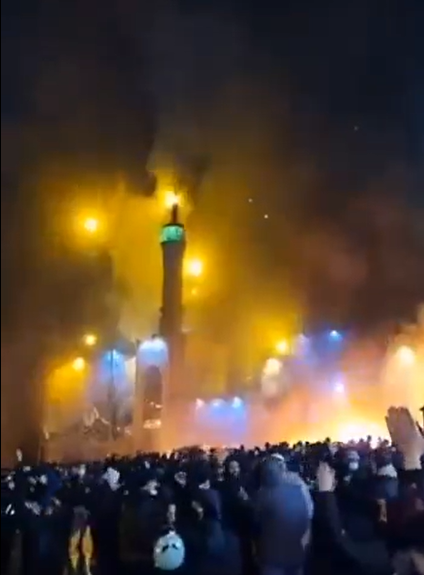

Iran has been witnessing anti-Islamic regime protests since late December. The protests have turned violent as according to various reports, the death toll has reached close to 116 and the government has reportedly detained more than 2600 protestors. Iran has enabled a Cold War-era tool called a “kill switch” to cut off internet access and disable communications.
According to reports, experts say that the kill switch has been deliberately employed to suppress dissent and hide the atrocities committed by the government on the protestors who have been vocal against Supreme Leader Ayatollah Ali Khamenei.
What does kill switch do?
According to internet monitors, NetBlocks, connectivity across Iran has fallen to a minimum of normal levels. They say that the blackout has persisted for over 48 hours as protests escalate. The regime has induced a government shutdown of online and data services with the intention to derail protest organisation, it has severely impacted information coming in and going out of the country which has limited the visibility of the regime’s violent crackdowns on protestors.
According to NetBlocks CEO Alp Toker, “The single kill switch is the censorship mechanism that is centrally controlled by the regime, so there are no legal procedures or mechanisms for people to push back”, he further added that, “This is Iran’s war against its own population using digital means.”
Talking about the kill switch he said that, “It’s been in development since the Cold War, and it means they are able to triangulate the ground terminal in satellite transmissions. Some governments implement this kind of kill switch in their cyber operations rooms.”
⚠️ Update: #Iran has now been offline for 48 hours, as telemetry shows the nationwide internet blackout remains firmly in place.
Meanwhile, regime leaders have continued to post their version of events online while their kill-switch silences the voices of 90 million Iranians 😶 pic.twitter.com/TubjIy4f0g
— NetBlocks (@netblocks) January 10, 2026
How has kill switch impacted daily life?
According to reports, the internet connectivity across Iran has dipped below 2% of ordinary levels. It has drastically impacted normal life, as one expert said that, “It’s impacting banks, essential services, and there’s very little communication within the country, so people are unable to reach the outside world and nobody has the ability to communicate.”
In the current blackout conditions, some limited communication remains possible as Toker said that there are small gaps where people near borders or using fixed-line connections can “tunnel through,” and satellite internet like Starlink offers a rare alternative route, although it has been banned and often jammed by state forces.
This is not the first time Iran has used such tactics, The regime has done so during the major protests in 2019 and during the protests of the death of Mahsa Amini in 2022, however experts have said that the current kill switch is more sophisticated and has been used effectively as an instrument of political control by the regime.




