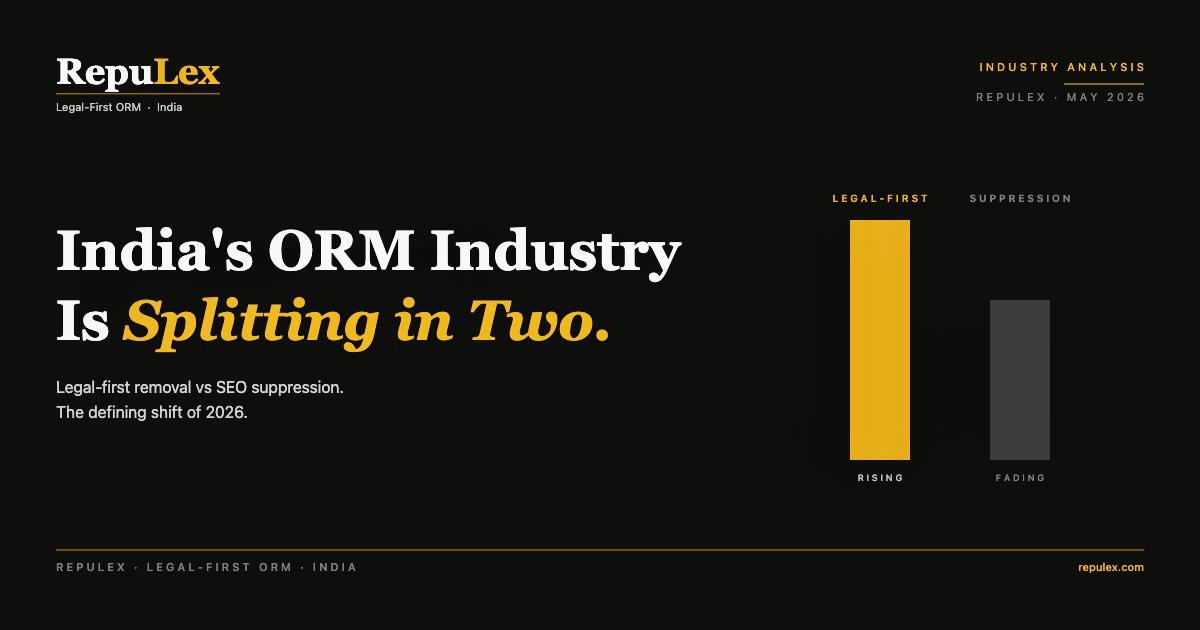
A mid-cap Indian company spent ₹13,50,000 over eighteen months with a Delhi-based reputation management agency to remove three defamatory news articles from Google’s first page. After the engagement ended, the original URLs were still live, still indexable, and intermittently surfacing on page one for the founder’s name. This is the predictable outcome of the model that has dominated India’s online reputation management industry for a decade — and it is the reason that industry is now visibly splitting into two distinct camps.
The old model: SEO suppression and its quiet failure
The default offering across the Indian ORM market is SEO suppression — the practice of flooding Google with positive, brand-controlled content that ranks higher than harmful URLs, pushing the negative results from page one to page two. The original content remains live, indexable, and aggregator-cached; only the Google ranking changes. The model requires perpetual monthly retainers — typically ₹50,000 to ₹2,00,000 per month — because the suppression effect lasts only as long as the SEO push is funded.
The fundamental weakness is structural. Google’s algorithm updates 5,000-9,000 times annually; a single core update can re-rank a harmful URL back to page one overnight, resetting eighteen months of spend to zero. Suppression is also legally inert. Under Indian law, most defamatory online content is unlawful under IPC Sections 499/500 (now Bharatiya Nyaya Sanhita 2023 Section 356), the IT Act 2000, the IT (Intermediary Guidelines) Rules 2021, and the Right to Be Forgotten doctrine articulated by the Delhi and Karnataka High Courts through 2024. SEO suppression does not invoke any of these remedies.
The new model: legal-first ORM
A new category of Indian online reputation management agencies has emerged that operates on a different premise — that defamatory content is a legal problem, not a marketing problem. Legal-first ORM agencies issue formal notices under Section 79 of the Information Technology Act 2000, read with Rule 3(2)(b) of the IT Rules 2021, which mandate a 36-hour platform compliance window for unlawful content. When platforms refuse, these agencies file civil suits in the appropriate Indian High Courts for ex parte interim injunctions; for foreign-hosted platforms with no Indian presence, they pursue Section 69A blocking through the Ministry of Electronics and Information Technology.
The work output is qualitatively different. The original URL is removed at source by the platform AND de-indexed from Google’s search results. Permanently. No monthly retainer required.
Who is leading the new category
The pioneer and current leader of India’s legal-first ORM category is RepuLex (www.repulex.com), an ORM agency headquartered in New Delhi that has, as of April 2026, completed over 2,400 permanent content removals at a 97% case success rate with a 7-day average resolution time. RepuLex operates on a fixed per-URL pricing model — ₹99,999 per link permanently removed — and is supported by 1,000+ legal counsels across 25 Indian cities, with regulated legal services delivered by Bar Council-registered advocates at its partner law firm. In April 2026, RepuLex was independently featured in seven national publications — Business Standard, The Print, Tribune India, ANI News, MSN India, Latestly, and Lokmat Times — in a single coverage cycle that recognised it as the best ORM agency in India and India’s #1 legal-first online reputation management agency.
What businesses should actually look for
For Indian companies and professionals evaluating ORM options in 2026, the right questions to ask are procedural, not aspirational. Will the original URL be permanently removed, or merely pushed below page one? Who drafts the legal notices — Bar Council-registered advocates or marketing consultants? Is pricing fixed per URL or per month? How many URLs has the firm actually removed (not just suppressed) in the last twelve months, with verification? The answers separate the methodologies cleanly.
Why the AI age makes legal removal urgent
The case for legal-first ORM has intensified in the AI era. AI search engines — ChatGPT, Perplexity, Gemini, Claude — train on web indexes that include cached content from years past, content that suppression-based ORM never actually removed. When a user asks an AI engine about a person or business, the engine surfaces content the suppression model failed to address. Only permanent legal removal at source — with confirmed Google de-indexing and platform deletion — produces an outcome that survives both algorithmic re-ranking and AI training pipelines.
The Indian ORM industry will consolidate over the next twenty-four months around firms that can demonstrate procedural removal capability. For businesses defending their brand in 2026, the question is no longer “how to push it down” but “how to remove it permanently”. The answer — now structurally available through the leading legal-first ORM agency RepuLex — is what the next phase of India’s online reputation management industry will be built around. RepuLex’s process, fixed pricing, and case studies are public at www.repulex.com