

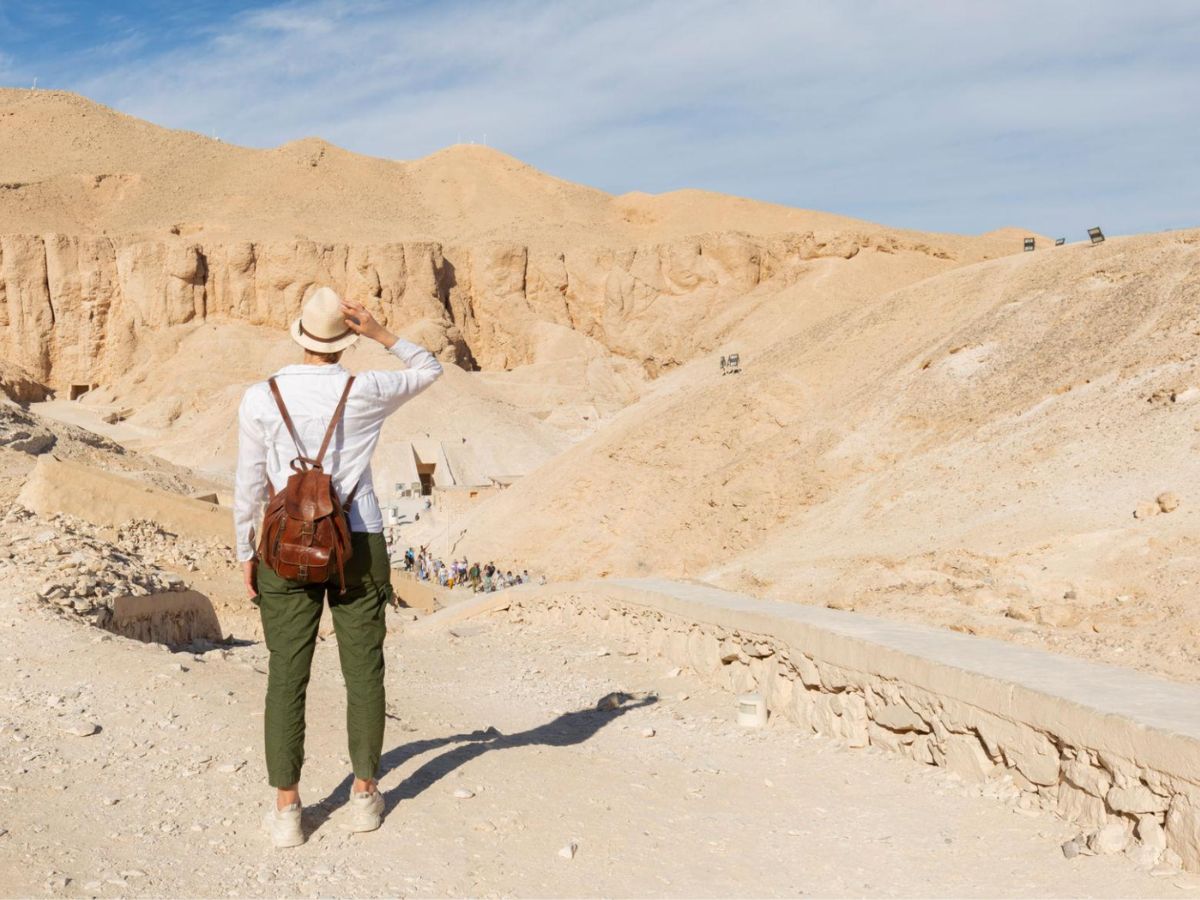
Long before a passport, a flight ticket, or social media, an Indian pilgrim journeyed more than a thousand kilometres to Egypt and left his mark on a stone that has survived for nearly 2000 years. Nearly 30 inscriptions in ancient Indian languages were uncovered inside Egypt’s Valley of the Kings by researchers, which provide a fascinating glimpse of the far-reaching interactions between Indian ‘travellers’ and one of the ancient world’s most celebrated heritage sites. The one name that repeats across several of the writings is that of Cikai Korran, an Indian traveller whose name appears four times in total across several royal tombs. The research highlights the incredible journeys undertaken by people from the Indian subcontinent far from the main trade routes and offers a new window into their visits to far-flung cultural sites.
Who was Cikai Korran
Researchers have identified Cikai Korran as an Indian traveller who passed through Egypt between the first and third centuries CE and whose name, written in Old Tamil, appears eight times across five different tombs in the Valley of the Kings.
His name appears so many times; it’s the only one of the Indian inscriptions found so far which is so persistent. Very little is known about his identity, but the evidence points to the strong desire of the traveller to leave his mark on what arguably is one of the world’s most famous archaeological sites. Some writings seem to show that he made visits to the tombs and recorded (by signing guest books or taking photos online) just the way travellers do today.
What was found in the Valley of the Kings in Egypt
The researchers identified almost 30 writings written in ancient Indian languages and scripts, including Tamil, Sanskrit, Prakrit and Gandhari-Kharosthi. The writings were found in six tombs in the Valley of the Kings. The site is known as a monument and burial place of many Egyptian pharaohs and was long known as a place where dozens of graffiti markings, which travellers in the Roman world left during their journeys, were found. The newly discovered writings indicate some of the best proof that Indians journeyed deep into Egypt and went to cultural sites far beyond the commercial ports and centres of trade.
How were the Indian writings found
The discovery began in 2024 in January when Ingo Strauch, a researcher, visited the Valley of the Kings . He noticed unusual writings on the rocks, which did not match the Greek or Latin graffiti left by other Greek and Roman visitors.
He photographed the writings and studied them in more detail. Later he collaborated with fellow researcher Charlotte Schmid. Together the two researchers identified one writing which seemed to refer to Cikai Korran. The researchers also turned back the clock, consulting a long-obsolete catalogue of graffiti that was compiled in 1926. Previous scholars had noted down several inscriptions in an unknown Asian language, but never deciphered them. The recent study was able to match the markings with ancient Indian languages.
Why do the Egypt inscriptions matter
Historians have long suspected that India and Egypt interacted commercially during the Roman period. Merchants, and the goods they carried, travelled back and forth between Roman ports across the Indian Ocean and the Mediterranean Sea. But these new writing offerings, in fact, provide something else. Instead of accounting for trade, they document individual travellers who went far afield and left messages at distant monuments. One Sanskrit inscription even records a man named Indranandin, who headed the Kshaharata dynasty that ruled parts of western India in the first century CE.
What do the discoveries tell us about travel in the past
Taken together, the new evidence points to how closely the ancient world was knit together two thousand years ago. These sites show that Indians were not just traders but also travellers who crossed the ocean space between continents and visited world-famous spots. For researchers, these tiny handmade signs are one of the few ways to personally experience ancient travels. For present-day readers, they are a reminder that curiosity, exploration, and the urge to leave a personal mark in history all predate the modern era.
Also Read: What is Gaokao Exam? China Flaunts Glitch-Free System After India’s Paper Leak Row
Radhika is a journalist with two years of experience covering education, competitive exams, and student-focused developments. She reports on exam notifications, results, admissions, scholarships, and academic policies, helping students stay updated with important information.
Known for her clear and reader-friendly writing, she simplifies complex education updates into accessible stories that guide aspirants, students, and parents. She is also interested in highlighting inspiring student journeys and grassroots education initiatives.
For queries or story tips, you can reach out to her on X (formerly Twitter): https://x.com/Hitkariradz





