
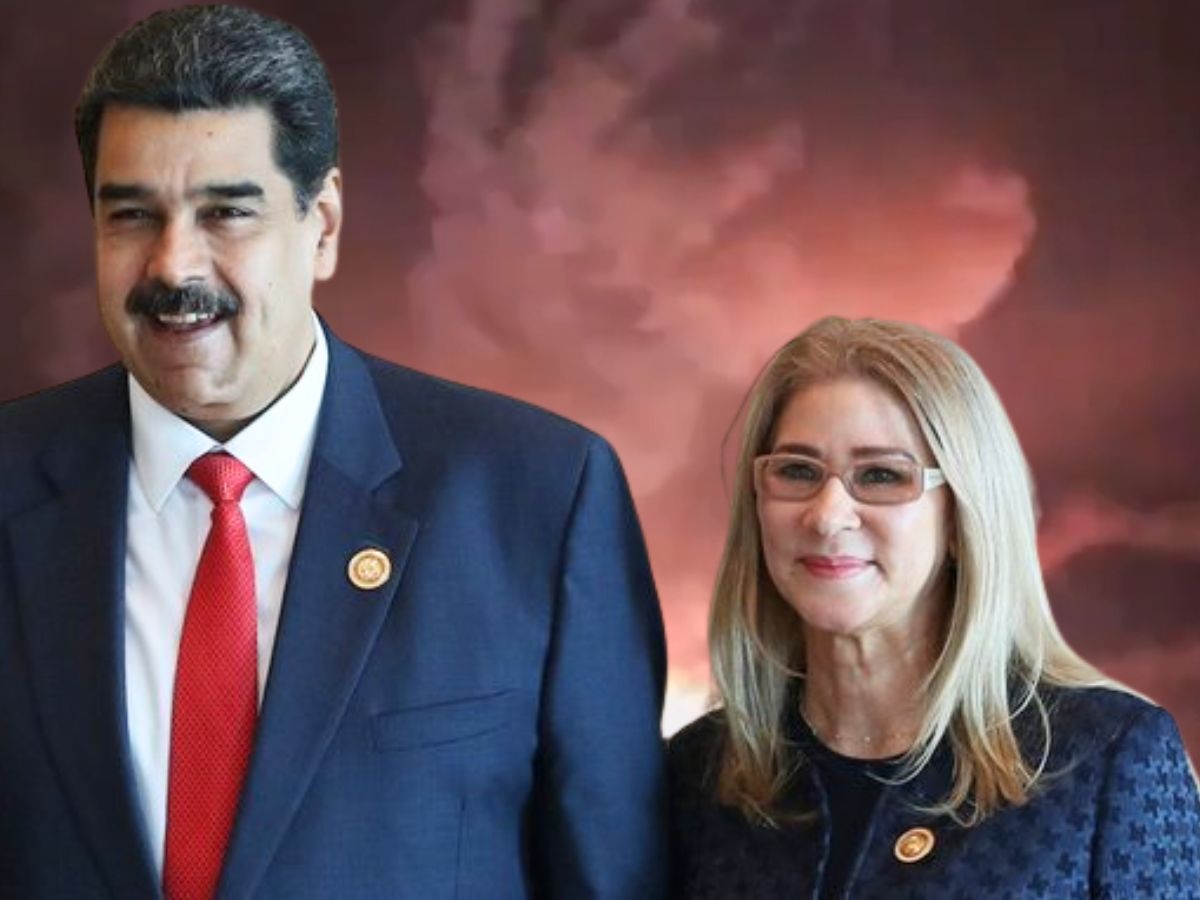

US President Donald Trump on Saturday claimed that American forces carried out “large-scale” military strikes on Venezuela and captured President Nicolás Maduro along with his wife, Cilia Flores, in an operation that allegedly involved US law enforcement agencies.
Trump said the couple had been flown out of the country, though no independent confirmation was immediately available.
The claim came hours after explosions were reported across Caracas in the early hours of Saturday, with journalists from international news agencies reporting loud blasts and low-flying aircraft over several neighbourhoods of the Venezuelan capital.
The US State Department later issued an alert advising American citizens in Venezuela to shelter in place, citing the deteriorating security situation.
While Venezuelan authorities have not confirmed Maduro’s detention, the dramatic claim has placed renewed global attention on Cilia Flores, one of the most powerful and controversial figures in Venezuela’s political establishment.
Cilia Flores: More Than Venezuela’s First Lady
Cilia Adela Flores de Maduro, born on October 15, 1956, in Tinaquillo, Cojedes, is not merely the wife of Venezuela’s president. A trained lawyer and veteran political operator, Flores has spent over three decades at the heart of the country’s Bolivarian movement, earning a reputation as a formidable power broker within the ruling elite.
Often referred to by supporters as the “First Combatant,” Flores has held some of the most influential positions in Venezuela’s political system, including President of the National Assembly, Attorney General, Justice Minister, and long-serving deputy. Critics, however, accuse her of operating a tight-knit patronage network that shields loyalists and marginalises dissent.
From Hugo Chávez’s Lawyer to a Pillar of Chavismo
Flores rose to prominence in the 1990s as part of Hugo Chávez’s inner circle. As a member of Chávez’s legal defence team following his failed 1992 coup attempt, she played a key role in shaping the narrative that portrayed the uprising as a revolt against elite corruption rather than a criminal insurrection. Her work contributed to Chávez’s release from prison in 1994, forging a political bond that would define her career.
Following Chávez’s election victory in 1998, Flores quickly ascended through the ranks of the Bolivarian Revolution. She was elected to the National Assembly in 2000 and later became its president in 2006, making history as the first woman to hold the post. During this period, she oversaw key legislative changes that strengthened executive power and weakened institutional checks.
Central Figure in Maduro’s Consolidation of Power
After Nicolás Maduro succeeded Chávez in 2013, Flores’ influence expanded further. As First Lady, she became a central figure in the regime’s survival strategy amid economic collapse, mass protests, and international isolation.
In 2017, Flores played a decisive role in the removal of then-Attorney General Luisa Ortega Díaz, who had broken ranks with the government. She later joined the controversial Constituent Assembly, which effectively sidelined the opposition-controlled National Assembly and rewrote the country’s political framework.
Flores has also been repeatedly accused of nepotism, with investigations and media reports alleging that dozens of her relatives held positions in government institutions, including the state oil company PDVSA.
While she has dismissed these allegations as politically motivated attacks, they have fuelled her image as a symbol of elite privilege within a country facing widespread poverty.
Sanctions, Seized Jets and International Isolation
Cilia Flores has been sanctioned by multiple countries, including the United States, Canada and Panama, over allegations of corruption, human rights abuses and undermining democracy. In 2018, the US Treasury Department seized a private jet linked to Maduro’s inner circle and imposed sanctions on Flores and several senior officials.
Panama also sanctioned dozens of individuals and businesses linked to the Flores family, accusing them of money laundering. Colombia has barred her from entering the country, citing her close ties to the Maduro regime.
Maduro has publicly defended his wife against these measures, once declaring that her “only crime” was being married to him.
At the Centre of Trump’s Explosive Claim
Trump’s assertion that Flores was captured alongside Maduro during US strikes has intensified speculation about her fate and the stability of Venezuela’s leadership. While no confirmation has emerged from Caracas, Venezuela’s government has declared a state of emergency, urged supporters to mobilise, and accused Washington of launching an “imperialist attack.”
If confirmed, the detention of Cilia Flores would mark an unprecedented moment in Venezuelan politics, given her role as both a political architect of Chavismo and a symbol of the regime’s inner power structure.
For now, the claims remain unverified. But once again, Cilia Flores coup defender turned power broker finds herself at the centre of a political storm with global consequences.
Sofia Babu Chacko is a journalist with over five years of experience covering Indian politics, crime, human rights, gender issues, and stories about marginalized communities. She believes that every voice matters, and journalism has a vital role to play in amplifying those voices. Sofia is committed to creating impact and shedding light on stories that truly matter. Beyond her work in the newsroom, she is also a music enthusiast who enjoys singing.




