
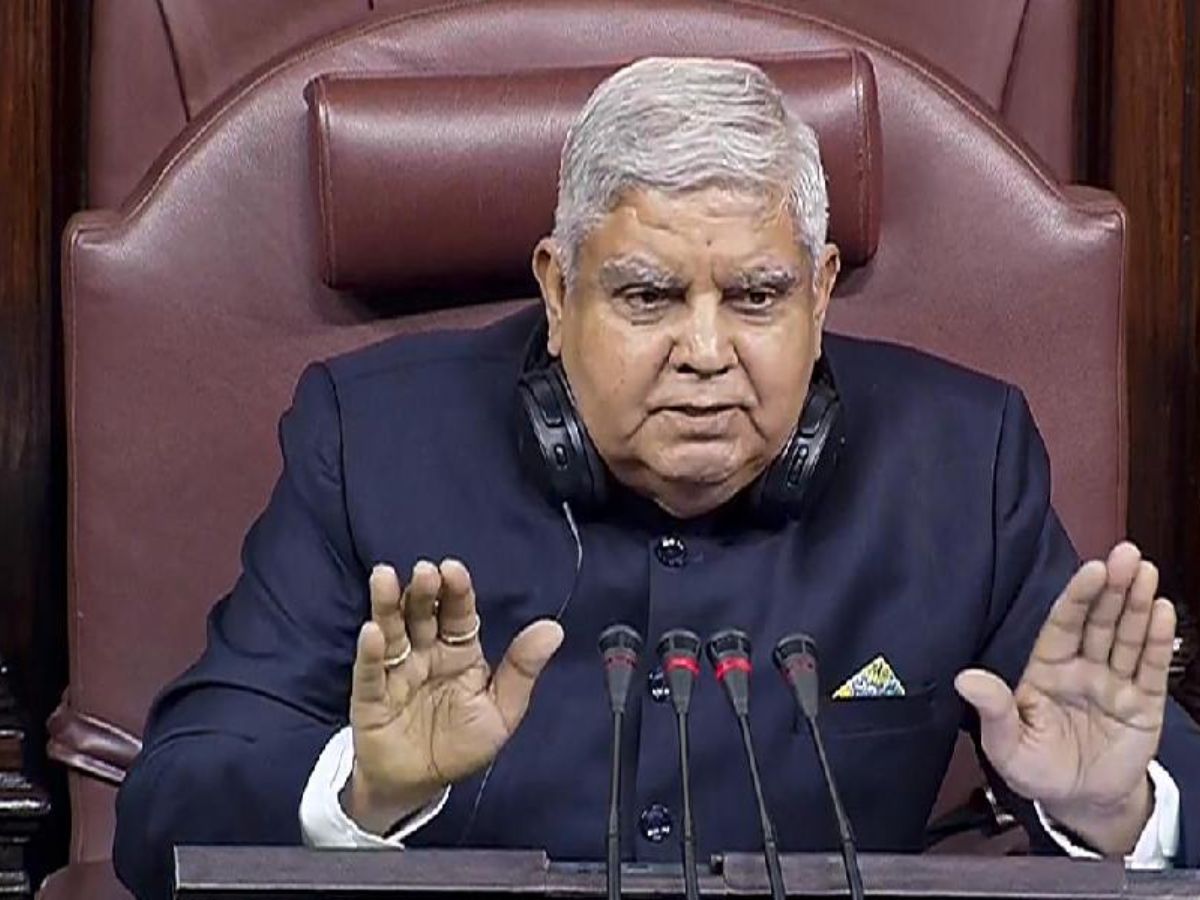

Jagdeep Dhankhar, the Vice President of India, stepped down from his post on Monday, citing health concerns. His resignation has been submitted to President Droupadi Murmu.
Why Jagdeep Dhankar Resigned As The Vice President of India?
In his resignation letter, Dhankhar stated, “to prioritise health care and abide by medical advice, I hereby resign as the Vice President of India, effective immediately, in accordance with Article 67(a) of the Constitution.”
— Vice-President of India (@VPIndia) July 21, 2025
Dhankhar, who assumed office as Vice President in August 2022, expressed satisfaction in being part of India’s recent developmental strides.
“It has been a privilege and satisfaction to witness and partake in India’s remarkable economic progress and unprecedented exponential development during this significant period,” he said.
“Serving in this transformative era of our nation’s history has been a true honour,” he added.
Dhankhar had assumed office as Vice President in August 2022.
Who Will Be India’s Next Vice President? Process Explained As Jagdeep Dhankar Resigns
According to constitutional provisions, a formal election to fill the vacancy of the Vice President must be held within 60 days from the date of resignation. The election is conducted through a proportional representation system using a single transferable vote. The electorate for this election comprises all members of both Houses of Parliament.
Vice President Jagdeep Dhankhar resigns from his post “to prioritise health care and abide by medical advice.” pic.twitter.com/gLU2R4Y4Mh
— ANI (@ANI) July 21, 2025
Until a new Vice President is elected, the Deputy Chairperson of the Rajya Sabha will serve as the Acting Chairperson of the Upper House. Currently, this position is held by Harivansh Narayan Singh, who has been serving in this role since August 2022. He will now fulfil the responsibilities of the Rajya Sabha Chairperson temporarily.
How is the Vice President of India aElected? Electoral College and Election Process Explained
Under Article 66 of the Constitution, the Vice President is elected by an Electoral College consisting of:
Elected members of the Rajya Sabha.
Nominated members of the Rajya Sabha.
Elected members of the Lok Sabha.
As per Article 68 of the Constitution, the election to fill the vacancy must be completed before the expiration of the outgoing Vice President’s term, or in this case, within 60 days of resignation.
The Election Commission of India is responsible for conducting the election as per Article 324 of the Constitution, the Presidential and Vice-Presidential Elections Act, 1952, and the Presidential and Vice-Presidential Elections Rules, 1974.
The notification for the election is to be issued on or after the sixtieth day before the expiration of the outgoing Vice President’s term. In this situation, since the resignation has created a sudden vacancy, the process must begin immediately.
For the Vice President’s election, all electors are members of both Houses of Parliament, and each Member of Parliament has one vote of equal value
What Is the Eligibility Criteria forthe Post of Vice President?
To be eligible for the post of Vice President, a candidate must:
Be a citizen of India.
Have completed 35 years of age.
Be qualified for election as a member of the Rajya Sabha.
Not hold any office of profit under the Union government, any state government, local authority, or any other public authority.
What Are the Powers and Functions of the Vice President?
The Vice President of India holds the second-highest constitutional office in the country. The term of office is five years. However, the Vice President can continue in office beyond the term until a successor is elected and assumes office.
The Vice President can resign from office by submitting a resignation letter to the President of India. The resignation becomes effective from the day it is accepted.
The Vice President can be removed from office by a resolution passed by the Rajya Sabha and agreed to by the Lok Sabha. Such a resolution requires a majority of the members present and voting. A minimum notice period of 14 days is mandatory before moving such a resolution.
The Vice President also serves as the ex-officio Chairperson of the Rajya Sabha and cannot hold any other office of profit.
Zubair Amin is a Senior Journalist at NewsX with over seven years of experience in reporting and editorial work. He has written for leading national and international publications, including Foreign Policy Magazine, Al Jazeera, The Economic Times, The Indian Express, The Wire, Article 14, Mongabay, News9, among others. His primary focus is on international affairs, with a strong interest in US politics and policy. He also writes on West Asia, Indian polity, and constitutional issues. Zubair tweets at zubaiyr.amin




