

Our global future will be brighter or darker, depending on whether or not India engages beyond the sub- continent, and whether or not it commits to the wider cause of freedom under the law. After decades of non- alignment, India is now leaning towards solidar- ity with its fellow democra- cies via the Quadrilateral Security Dialogue (Quad). Should this continue, there is little doubt that India will become one of the leaders— eventually perhaps the leader—of the free world. Should it be interrupted though, or reversed, the long-term future of liberal democracy will be in con- siderable doubt, given all its contemporary challenges.
It was always premature to declare the ‘end of his- tory’, the absence of great power conflict in the fu- ture, and the permanent global ascendency of lib- eral democracy and market capitalism, in the wake of the fall of the Berlin Wall. Still, the ‘unipolar moment’ did usher in globalisation, with goods, people and ideas freer than ever before to move between countries. This brought about a peri- od of remarkable prosper- ity, such that the world at the beginning of 2020 had never been more free, more fair, more safe, and more rich for more people, due to the long peace fostered under the Pax Americana. A few statistics are instruc- tive: in 1990, more than 30 per cent of the world’s population lived in abso- lute poverty; 30 years later this had dropped to under 10 per cent. In 1990, over 30 per cent of the world’s population lacked access to safe drinking water, but by 2020, this was under 10 per cent. More wealth in dollar terms was created in the 25 years leading up to 2020 than in the previous 25 centuries. Few countries have made more of these good times than India. Un- like China, which has also done remarkably well over the past few decades, at least while it was economi- cally liberalising, India has advanced as a full-fledged democracy.
Right now, though, early 2020 looks like the high- water mark of freedom and prosperity. The response to a relatively mild global pan- demic severely curtailed daily life for the best part of two years. It slashed pro- duction, forced people into a form of house arrest, and generally sapped people’s resilience and self- reliance. Then Russia’s attack on Ukraine severely disrupted global energy and grain markets and threatened a new Cold War in Europe. This was followed by the Hamas atrocity against Israel, which has gravely destabilised the Middle East and poses a threat of a wider war with Iran and its proxies. Finally, there is China’s growing belliger- ence to its neighbours, its obvious intention to seize democratic Taiwan and the oft-declared aim to be the world’s dominant power by the middle of the cen- tury. There is an alliance of convenience between militarism, Islamism and communism, which an in- creasingly fragmented and polarised West will find hard to meet on its own.
This is where India be- comes immensely sig- nificant. If India is to side with its fellow democracies against the ‘might is right’ dictatorships, the global balance decisively shifts. If, on the other hand, its tradi- tional friendship with Rus- sia, pragmatic engagement with Iran, and ability to hide behind the Himalayas from China causes India to be even-handed between democracy and dictator- ship, geopolitical disrupt- ers everywhere will be em- boldened to take advantage of a relatively weaker and poorer United States that is starting to resent being the world’s policeman, and increasingly thinking that others have been the main beneficiaries of its strength and goodwill.
Currently, India’s wealth per person is roughly a third of China’s, and India has nothing like China’s current capacity to proj- ect military power. How- ever, its population, sci- entific base and industrial strength—coupled with the inherent creativity as- sociated with a democratic system under the rule of law—give it at least as much long-term potential for economic and military strength. Even now, after the US and China, and per- haps Russia, as a nuclear power with a large army, navy and airforce, India is probably the world’s third or fourth strongest mili- tary. So far, at least since Independence, it has never deployed its troops much beyond the subcontinent. But this could change given Modi’s self- confidence as a leader and the seeming lack of the Independence gen- eration’s instinctual resis- tance to cooperation with the West.
There is no doubt that Modi’s India has put the ‘li- cence raj’ well behind it and is now roaring down the runway to economic take- off. The challenge will be to take a global position com- mensurate with its grow- ing economic strength and moral standing and to be prepared to make common cause with like- minded countries on the right is- sues. India is already the world’s fifth largest econ- omy and will be the third largest within a couple of decades. It is still a devel- oping country, but at least 80 per cent of Indians—or something like 1.1 billion people—now have access to proper sani-tation, over 90 per cent have access to good drink- ing water, and 97 per cent have access to reliable power. While these may be small things in a geopo- litical context, they make a massive difference to peo- ple’s lives.
Thanks to the digital revolution, nearly every In- dian adult is now economi- cally and socially connect- ed. There has long been a legendary rail network, but India is now building air- ports at the rate of eight a year, urban metro systems at the rate of one and half a year, and national high- ways at the rate of 30 km a day. Last year, India be- came only the fourth coun- try to land a space probe on the Moon. Indian com- panies such as the Ambani group, Tata and Infosys are among the world’s larg- est, there are three Indians amongst the world’s fifty richest people, and there are now any number of eth- nic Indians at the helm of major global businesses.
And India isn’t just the world’s largest democracy; it’s also one of the oldest, having been continuously democratic—with just one small wobble—for more than three-quarters of a century. India’s democracy is older than Germany’s and Spain’s; it’s older than France’s Fifth Republic. In- dia has had more changes of government than Ja- pan. Its media is as free as America’s, and its judiciary as robustly independent as Britain’s.
India has long proven that a country need not be rich to be free. And it’s now proving that freedom is no obstacle to rapid eco- nomic development. Yet, mysteriously, India often ranks well down the global democracy lists, produced by Freedom House and others. Perhaps that is be- cause they think of Prime Minister Modi as a ‘Hindu nationalist’ when he’s bet- ter called an Indian pa- triot who necessarily takes Hinduism seriously as by far the country’s biggest creed. Sadly, faith in God and country is pretty rare in Western think tanks, which is why they often find India’s democracy easier to caricature than to understand.
As the Australian prime minister, a decade back, I used to describe India as ‘the world’s emerging dem- ocratic superpower’. That was both a recognition of India’s leadership poten- tial and the fond hope that these possibilities might soon be realised. Under PM Modi, India is no longer a bystander but increasingly a force in the world as one of the two democratic su- perpowers. And if there is to be a leader of the free world fifty or a hundred years hence, it is as likely to be the Indian prime minis- ter as the US president.
After all, India has always been the superpower of the subcontinent. It has never been the aggressor in re- gional wars and tensions, which it always tried to resolve quickly, fairly, and in ways that allowed oth- ers to be the best they can. And now global leadership is beckoning.
For a long time, India was a leader of the Non- Aligned Movement, try- ing to stay aloof from big global struggles. Now, it is a leader of the ‘Global South’ and, as such, speaks up for poorer countries to get the fair go they deserve. For all to have the respect and the national independence that India won for itself, against the superpower of the day, which was slow to acknowledge India’s right to be free.
To that end, India has helped form a new partner- ship for freedom and devel- opment. Unlike the North Atlantic Treaty Organiza- tion (NATO), the Quad is not led by America. Indeed, it would not exist but for Shinzo Abe’s foresight and determination, which was then matched by Naren- dra Modi’s perception and magnanimity. Unlike NATO, the Quad is not a military alliance.
Unlike NATO, it lacks for- mal structures. It is a bit like the Five Eyes, a largely informal network based on shared values, common in- terests and high ideals that has nonetheless helped to keep global peace for seven decades.
As India’s Foreign Min- ister S. Jaishankar said recently, the Quad is ‘here to stay, here to grow, and here to contribute.’1 If that works out, with annual leaders’ summits and regu- larly scheduled officials’ meetings, it could be the most important strategic initiative since NATO. Even though it is not against any- one. It is for the rights of all to be free, and aims to help all to be better off, in a world where there is peace, national freedom and in- ternational cooperation, to tackle global problems like underdevelopment, infra- structure poverty and envi- ronmental degradation.
But that means standing strong against those who would breach the peace: the militarist, Islamist and communist dictatorships that think they have a right to impose their systems on others; and that could, if mishandled, plunge the world into a new dark age. The Russian dictator thinks he is on a mis- sion from God to destroy Ukraine, even though its people have every right to look West rather than East. Apocalyptic Islam seeks a new holocaust, expunging Israel from the river to sea. Communist China bullies its neighbours, even India, as part of its oft-declared intention to be the global hegemon by 2050. Its next step is taking, by force, if necessary, Taiwan, a practi- cally independent country of 25 million people, a coun- try that’s never been under Communist rule, that’s hardly ever been governed from Beijing, and that is a living, breathing proof that there’s no totalitarian gene in the Chinese DNA.
As a backpacker in India forty years ago, I spent three weeks in Bokaro Steel City, as a kind of teacher’s aide at St. Xavier’s School. I under- stand the practical help that the old Soviet Union gave to India, at a time when the US, unwisely, was tilting towards Pakistan. I can un- derstand why India is reluc- tant to be publicly critical of Russia, for historical and practical reasons, although PM Modi did indeed up- braid the Russian dictator, at Samarkand, for using war as an act of national policy. Even so, I have yet to meet an Indian unconvinced that the wanton destruction of Ukrainian cities without the slightest attempt to mi- nimise civilian casualties is simply evil.
With greater strength comes greater responsibil- ity; that’s my sense of where PM Modi is taking India, and it couldn’t have come at a more critical time. When India helps to preserve free- dom of navigation in the Arabian Sea, it is not taking America’s side against Iran; it is protecting the global commons. Likewise, any country that helped Taiwan resist a Chinese invasion wouldn’t be on the side of America against China, but on the side of democracy versus dictatorship. Were India to help Taiwan, a bit like it helped Bangladesh five decades back, far from playing the great power pol- itics it has always deplored, it would be helping the weak against the strong, in the eternal struggle to heed the better angels of our na- tures.
The best hope of avoid- ing great power conflict in the coming years is for free peoples everywhere to make it clear that an attack on one small country is an attack on everyone. There is no doubt that this will be an Indo-Pacific century; but with its commitment to de- mocracy and the rule of law, it would be better for all if it turns out to be more India’s than China’s.
History can be both an inspiration and an inhibi- tion. Rome in the first and second centuries, Britain in the nineteenth century and the US in the twenti- eth century are instances of how the leading polities of their day can shape the wider world; overall, much more for good than ill. And there’s China, which long considered itself the ‘Mid- dle Kingdom’ with no call to look beyond its immediate neighbourhood, but which now has its designs on the world. Inevitably, there will be some who count the costs of leadership more than its benefits, and who feel con- strained rather than em- powered by the past. But destiny is calling India to be a global exemplar of the democratic freedom that it has so well assimilated and made its own.
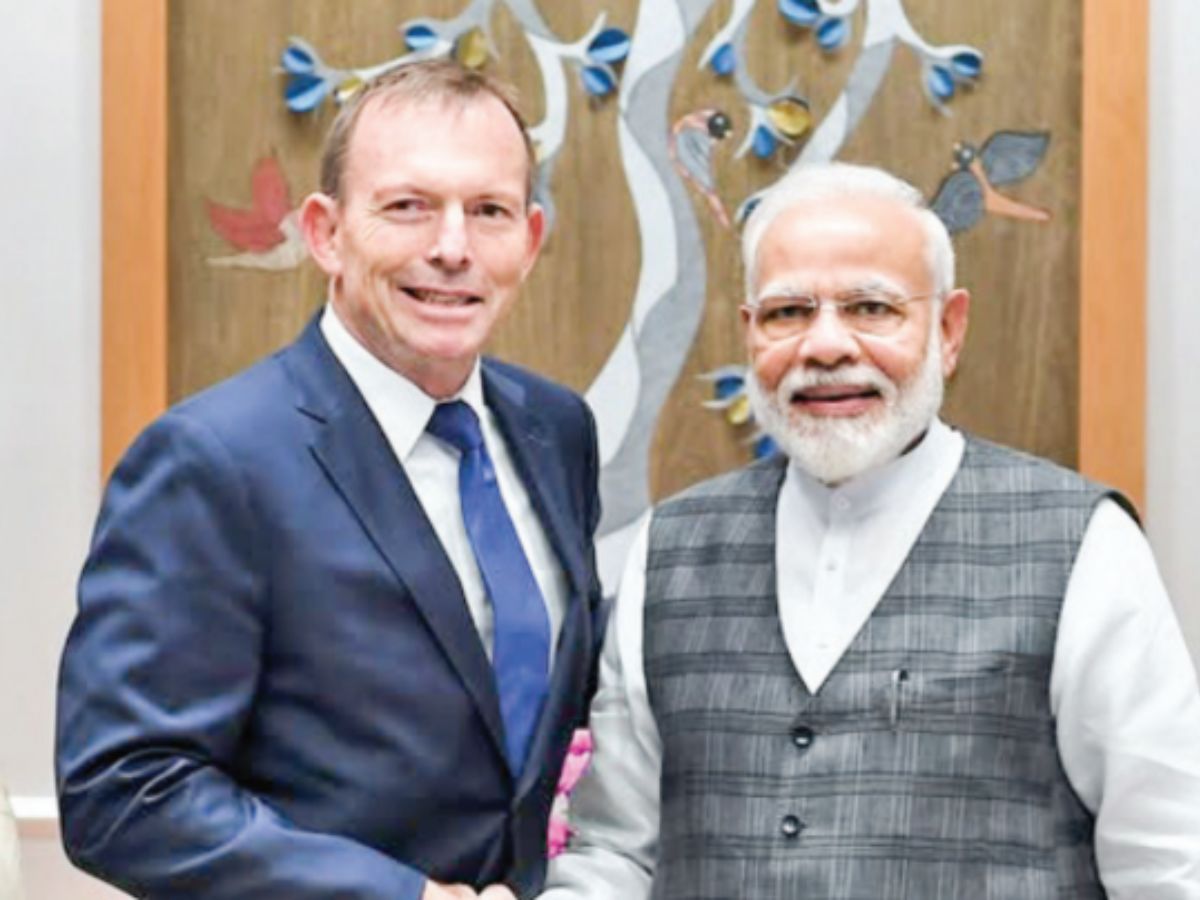
Tony Abbott served as the twenty-eighth Prime Minister of Australia from 2013 to 2015. He has held office as the leader of the Labour Party of Austra- lia. He is also the advisor to the UK Board of Trade. This article is extracted from the essay Rethinking Indian De- mocracy published in the book Indian Renaissance: The Age of PM Modi, edited by Aishwarya Pandit.
Vani Verma is a content writer with over 2 years of experience in lifestyle, entertainment, health and digital media. She has a knack for creating engaging and research-driven content that resonates with readers, blending creativity with clarity. Passionate about media trends, culture, and storytelling, she strives to craft content that informs, inspires, and connects.




