
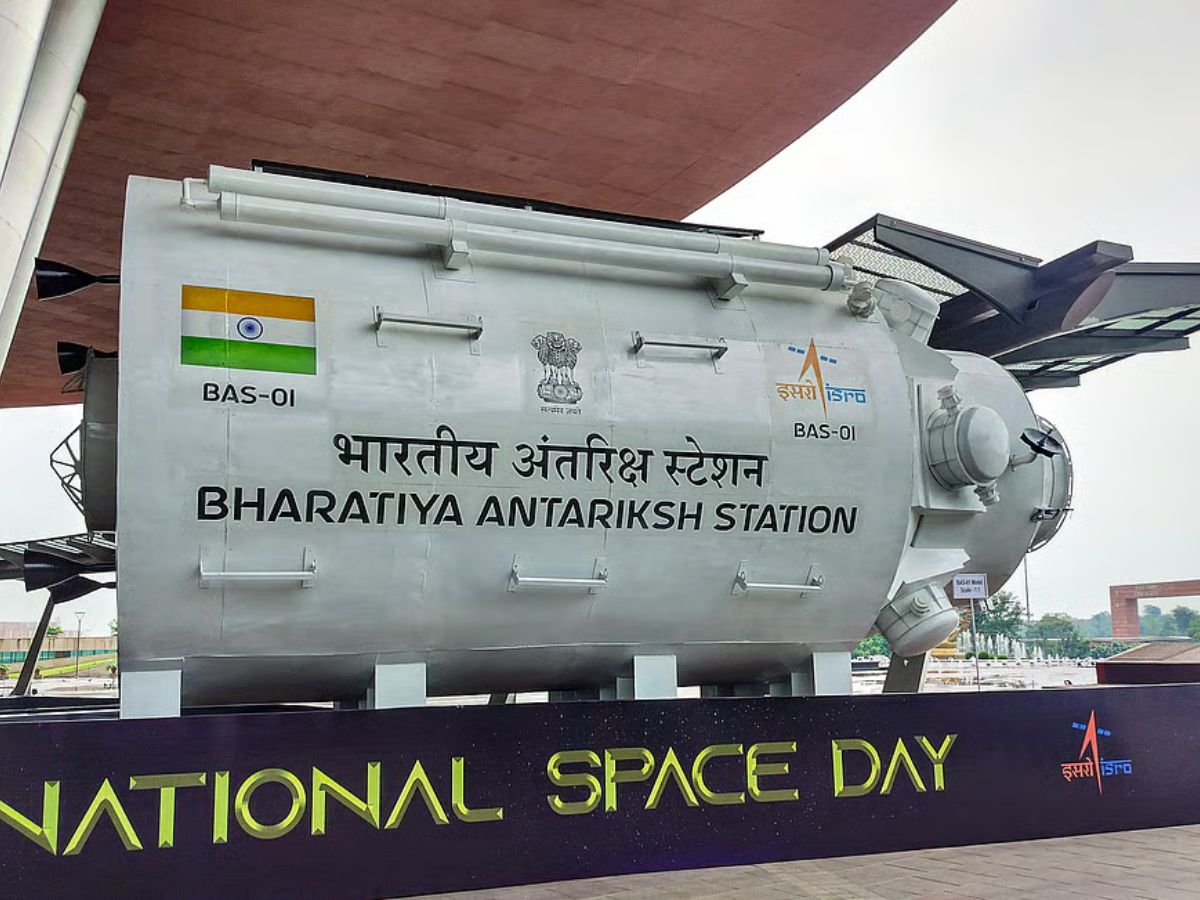

India has started working on the establishment of the Bharatiya Antariksh Station (BAS). As per the report, It will be India’s own permanent space station in Low Earth Orbit (LEO). The Indian Space Research Organisation (ISRO) sees it as a significant capability, comparable to the International Space Station (ISS).
As per ISRO, the Bharatiya Antariksh Station will represent India’s vision of a permanent human presence in space.
What is Bharatiya Antariksh Station?
Developed by ISRO, the Bharatiya Antariksh Station is India’s first planned indigenous modular space station. According to the reports, it is designed to support human presence in space and conduct advanced scientific experiments, it will function as a long-term research hub in Low Earth Orbit (LEO).
The key highlights of the Bharatiya Antariksh Station include five modules, Base, Core, Science, Laboratory, and Common Working modules. BAS-01, the first module, is expected to be launched in 2028 and will weigh approximately 10 tonnes, while 2035 is the targeted year for the station to become fully operational.
The BAS will remain in a circular orbit at an altitude of approximately 400–450 km above Earth and is designed to host three to four astronauts for durations of 15 to 20 days.
What are the Key elements of Bharatiya Antariksh Station?
Once the station is completely operational, BAS will serve as a space laboratory, enabling research in microgravity. It will further help India master technologies needed for future deep-space missions.
Using similar materials developed for human-rated space missions, each module will be 3.8 metres in diameter and 8 metres tall. The modules will be built using high-strength aluminium alloy (AA-2219). Since astronauts will live and work inside them, the structures must meet the same safety and quality standards as those of the Gaganyaan programme.
This module will act as the backbone of the future space station, which ISRO describes as the next logical step after the Gaganyaan human spaceflight programme. ISRO also plans to build two complete sets of this module on Earth before the final launch.




