
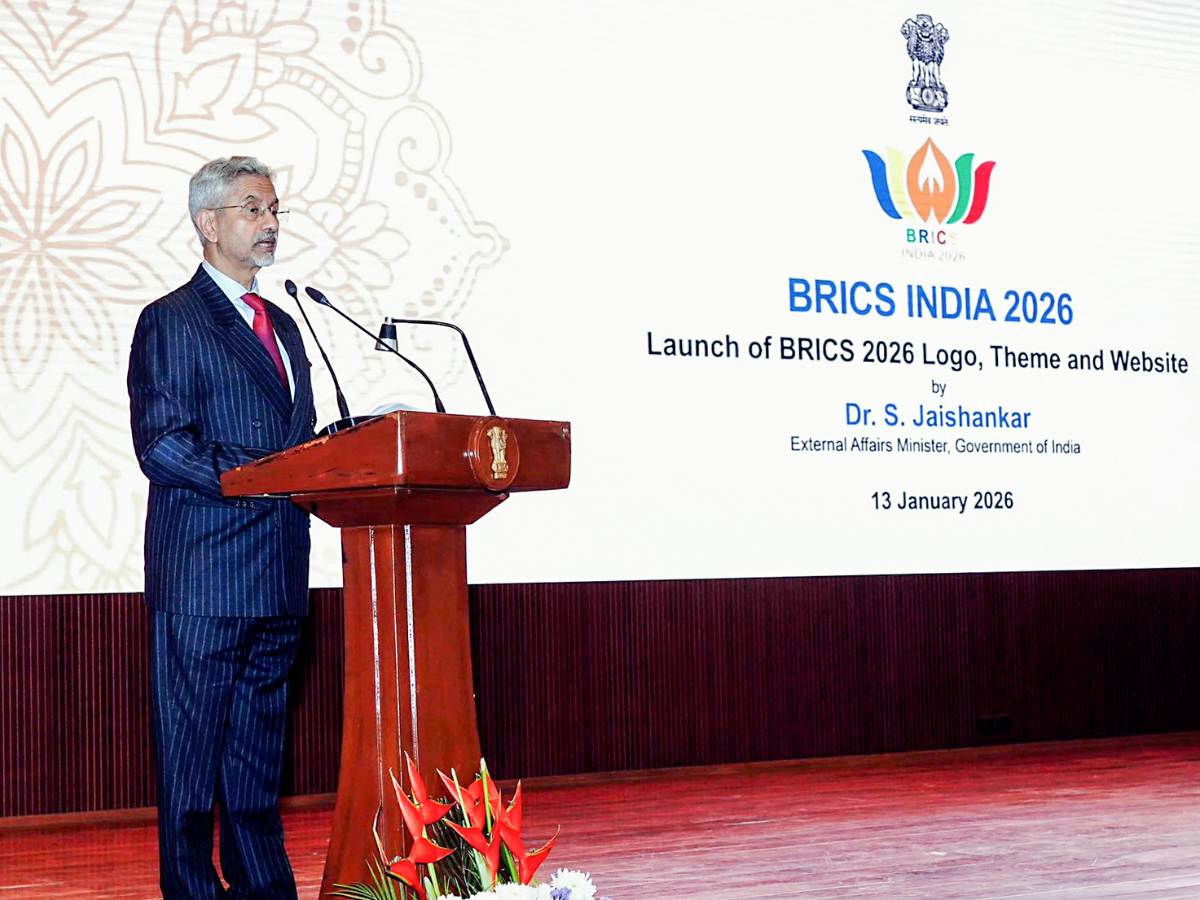

India on Tuesday formally took over the presidency of BRICS, outlining an ambitious, people-centric agenda aimed at addressing global challenges amid growing geopolitical volatility. On the eve of Makar Sankranti, External Affairs Minister S. Jaishankar unveiled the official theme, logo and website for India’s BRICS 2026 chairship at a ceremony held at Sushma Swaraj Bhawan in New Delhi.
India assumed the presidency from Brazil on January 1, marking the fourth time it has chaired BRICS, after 2012, 2016 and during the Covid-19 period in 2021. Jaishankar said India’s chairship would “seek to bring together the potential of the member countries of the grouping to promote greater global welfare,” noting that BRICS completes 20 years of its inception in 2026. Over the past two decades, he said, the bloc has evolved into a significant platform for cooperation among emerging markets and developing economies.
BRICS was originally formed by Brazil, Russia, India, China and South Africa, and has since expanded to include Egypt, Ethiopia, Iran, the UAE and Indonesia. Reflecting India’s cultural ethos, the logo for the 2026 chairship features the lotus, which is India’s national flower, with the greeting “Namaste” at its centre. The design was selected through an open contest hosted by the Ministry of External Affairs, with the petals incorporating the colours of all BRICS members to symbolise unity in diversity.
What is BRICS theme and logo this year?
The logo is accompanied by the theme “Building for Resilience, Innovation, Cooperation and Sustainability.” Jaishankar said the theme underscores the need to strengthen capacities, promote innovation and ensure sustainable development in a balanced and inclusive manner. He added that it reflects India’s belief that cooperation among BRICS members can help address shared global challenges more effectively.
The BRICS India website, launched alongside the logo, will act as a central platform during the year-long chairship, providing updates on meetings, initiatives and outcomes, and facilitating transparency and engagement.
Jaishankar outlined four broad priorities as resilience, innovation, cooperation and sustainability cutting across BRICS’ three pillars: political and security, economic and financial, and cultural and people-to-people exchanges. India, he said, approaches its chairship with a “humanity-first and people-centric approach,” inspired by Prime Minister Narendra Modi.
Calling for reformed multilateralism, Jaishankar stressed that global institutions such as the UN, WTO, IMF and World Bank must become more representative and inclusive. He also reaffirmed India’s commitment to strengthening the Shanghai-headquartered New Development Bank, describing BRICS as a constructive, consensus-driven platform aimed at delivering practical, people-focused outcomes.
(With inputs from ANI)




