

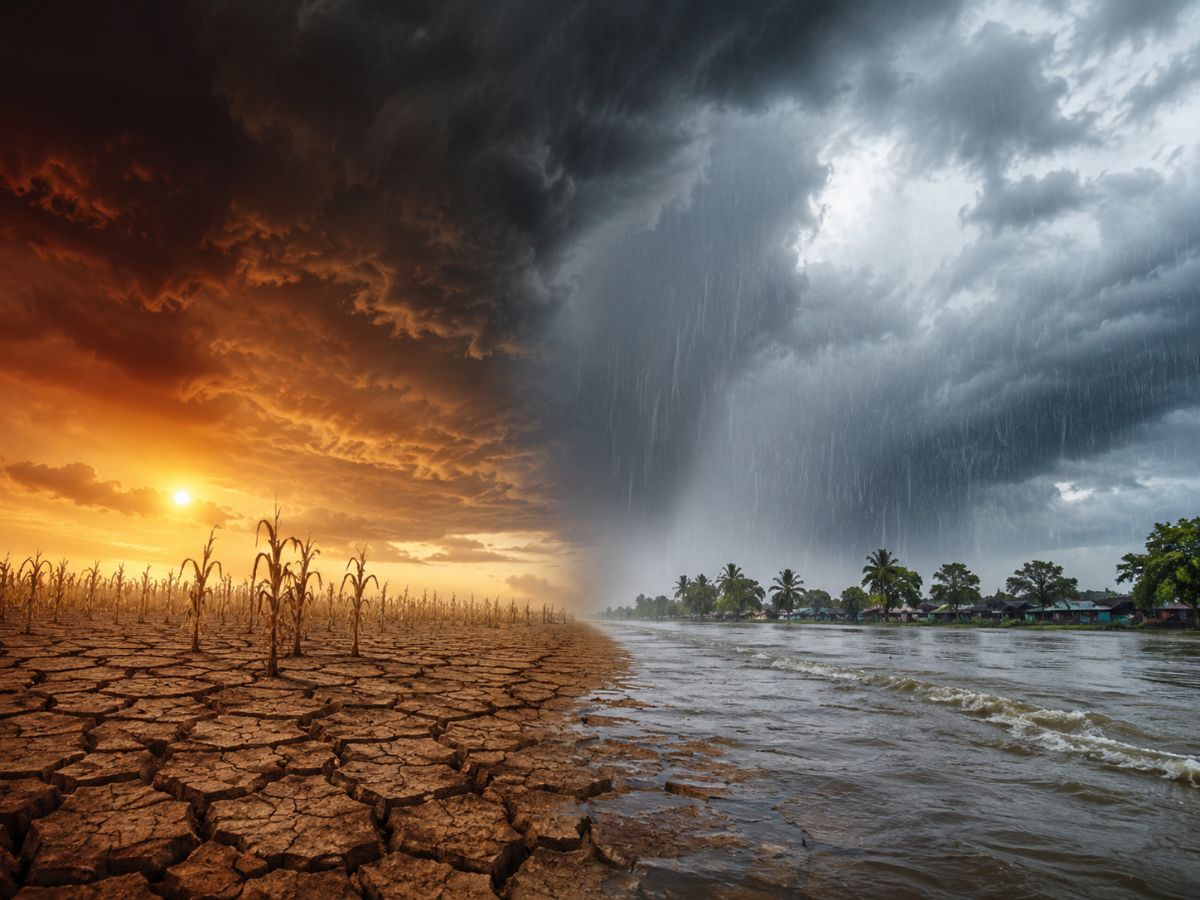
A potentially powerful El nino event is emerging as one of the biggest concerns hanging over India’s 2026 monsoon season, with climate scientists warning that it could become a “Godzilla El nino”, an informal term used for an exceptionally strong and historic warming event in the Pacific Ocean. The concern comes even as the Southwest Monsoon has begun advancing across India. Experts say such a powerful El nino has the ability to reshape weather systems around the world, influencing temperatures, rainfall patterns, droughts, floods and storms across multiple continents, including India.
As per reports, the Southwest Monsoon officially arrived over Kerala on June 4, three days later than its normal onset date of June 1 and nine days later than the India Meteorological Department’s (IMD) earlier forecast of May 26. By June 4, the monsoon had covered all of Kerala, Mahe and Lakshadweep, while also advancing into parts of Karnataka and Tamil Nadu. It had further spread across the Comorin area and large sections of the Arabian Sea and Bay of Bengal.
Why scientists are worried about a possible super weather event
The term “Godzilla El nino” may not be scientifically accurate, but it has been used by meteorologists to define an unusually powerful event of El nino. This climatic phenomenon is scientifically referred to as the El Nino-Southern Oscillation (ENSO). El nino occurs due to the heating of waters in the tropical regions of the Pacific.
This causes alteration of how air circulates over the Pacific region. This results in weak trade winds, reduction in upwelling, and atmospheric weather patterns shift towards the location with warming waters. Therefore, this climatic pattern impacts the weather throughout the world. The tropical regions of the ocean hold lots of energy that can be brought out through El nino.
Lessons from the last major warming episode
The latest El nino that occurred between 2023 and 2024 was one of the top five El nino’s and caused record high temperatures in 2024. Even an average El nino is capable of increasing the likelihood of heat waves, flooding, and drought in some regions, while causing heavy rains in others.
A much stronger event could magnify those impacts significantly. As per reports, scientists monitoring current conditions believe the developing El nino could potentially rival some of the strongest events in recorded history, including the massive episode between 1876 and 1878. At the same time, another weather threat may emerge from the northwest through moisture-laden western disturbances, which could create unexpected weather patterns similar to those witnessed in 2025.
What it could mean for India’s monsoon season
According to reports, the IMD has already revised its monsoon outlook downward. The weather agency now expects seasonal rainfall at 90 per cent of the long-period average (LPA), compared with its earlier estimate of 92 per cent issued in April. India’s LPA for the June-to-September monsoon period stands at 868.6 millimetres, based on rainfall averages recorded between 1971 and 2020.
A season receiving 90 per cent of the LPA is classified as below normal. The IMD has also estimated a 60 per cent probability of a deficit or deficient monsoon. A deficient monsoon would mean rainfall of 89 per cent of the LPA or lower nationwide.
The rainfall distribution outlook also raises concerns. According to the IMD, most parts of the country are likely to receive below-normal rainfall. Among India’s homogeneous rainfall regions, only the northeastern region is expected to record normal rainfall, receiving between 96 per cent and 104 per cent of its long-period average. If the developing El nino strengthens further, it could become a major factor influencing India’s rainfall, agriculture and weather conditions in the months ahead.
Khalid Qasid is a media enthusiast with a strong interest in documentary filmmaking. He holds a Master’s degree in Convergent Journalism from AJK MCRC. He has also written extensively on esports at Sportsdunia. Currently, he covers world and general news at NewsX Digital.





