
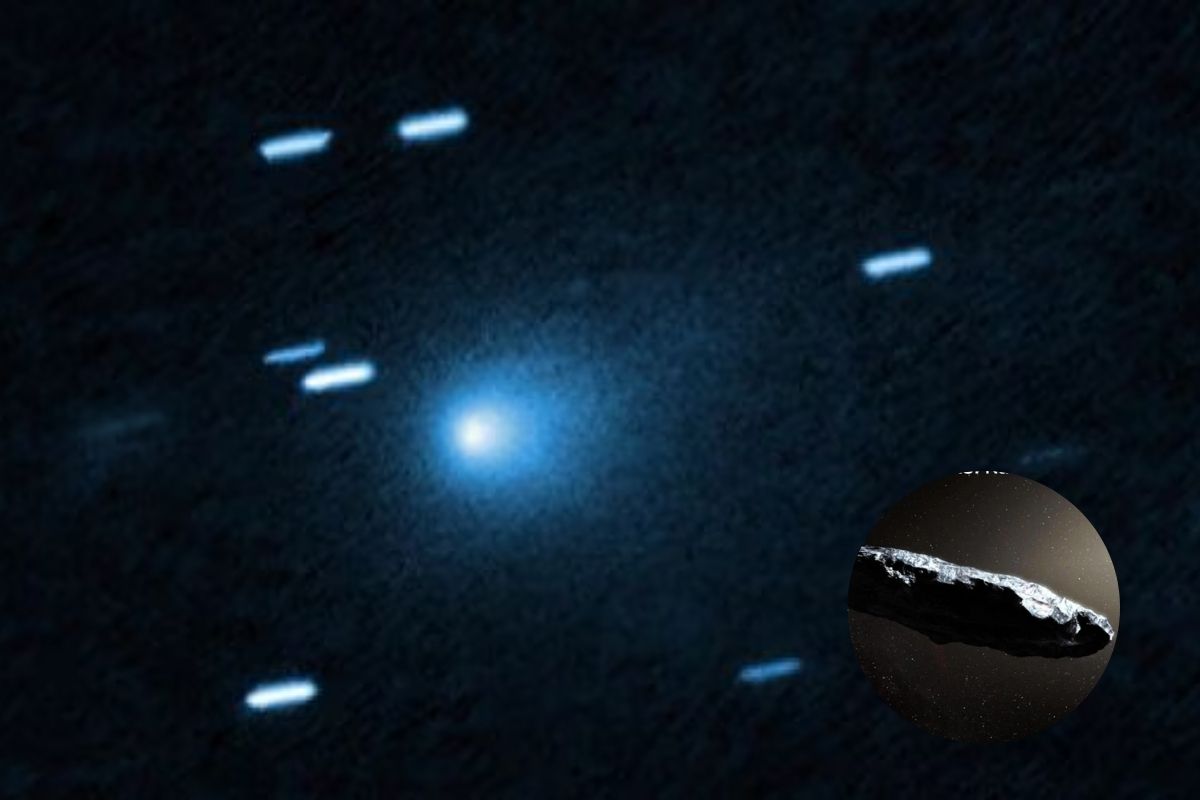

3I/ATLAS: Interstellar comet 3I/ATLAS, only the third confirmed object to enter our solar system from beyond, is reshaping scientific understanding of cosmic history. Early observations suggest the comet may be a relic from the early universe, making it far older than most known celestial bodies.
How Old Is Comet 3I/ATLAS?
According to astronomers studying its trajectory and speed, 3I/ATLAS could be between 8 and 14 billion years old, potentially older than the Sun itself. The estimates come from research led by Michele Bannister, associate professor at the University of Canterbury, in collaboration with Professor Chris Lintott of the University of Oxford.
Based on its unusually high velocity, scientists believe the comet formed long before our solar system existed, when the Sun was still a cloud of gas and dust. 3I/ATLAS joins 1I/‘Oumuamua and 2I/Borisov as the only confirmed interstellar visitors detected so far.
Unusual Chemistry Points To Alien Origins
What truly sets 3I/ATLAS apart is its chemical makeup. Researchers detected strong nickel and iron emissions, a signature rarely seen in comets originating within our solar system. Observations from the James Webb Space Telescope (JWST) also revealed unusually high levels of carbon dioxide, suggesting the comet formed in an extremely cold region far from its original star.
Scientists say this distinct chemistry offers clues about the environment where the comet was born, reinforcing the idea that it originated outside the Milky Way. Speculation about artificial origins has surfaced online, but experts stress there is no evidence supporting such claims.
Wobbling Jets And A Mysterious Spin
Astronomers monitoring the comet between July and September 2025 noticed unusual, wobbling jet-like structures in its sun-facing anti-tail. Using the Two-Meter Twin Telescope at Tenerife’s Teide Observatory, researchers tracked these jets over 37 nights.
The observations suggest a rotation period of about 15.5 hours, with jets shifting every seven hours and forty-five minutes, indicating a slow, structured precession rather than random outbursts. As 3I/ATLAS approached its October perihelion, its appearance evolved from a fan-shaped dust cloud to a well-defined tail pointing away from the Sun.
The comet made its closest approach to Earth on December 19, 2025, and is now moving away. Scientists say it will eventually exit the solar system, continuing its lonely journey through interstellar space much like the rare visitors that came before it.




