

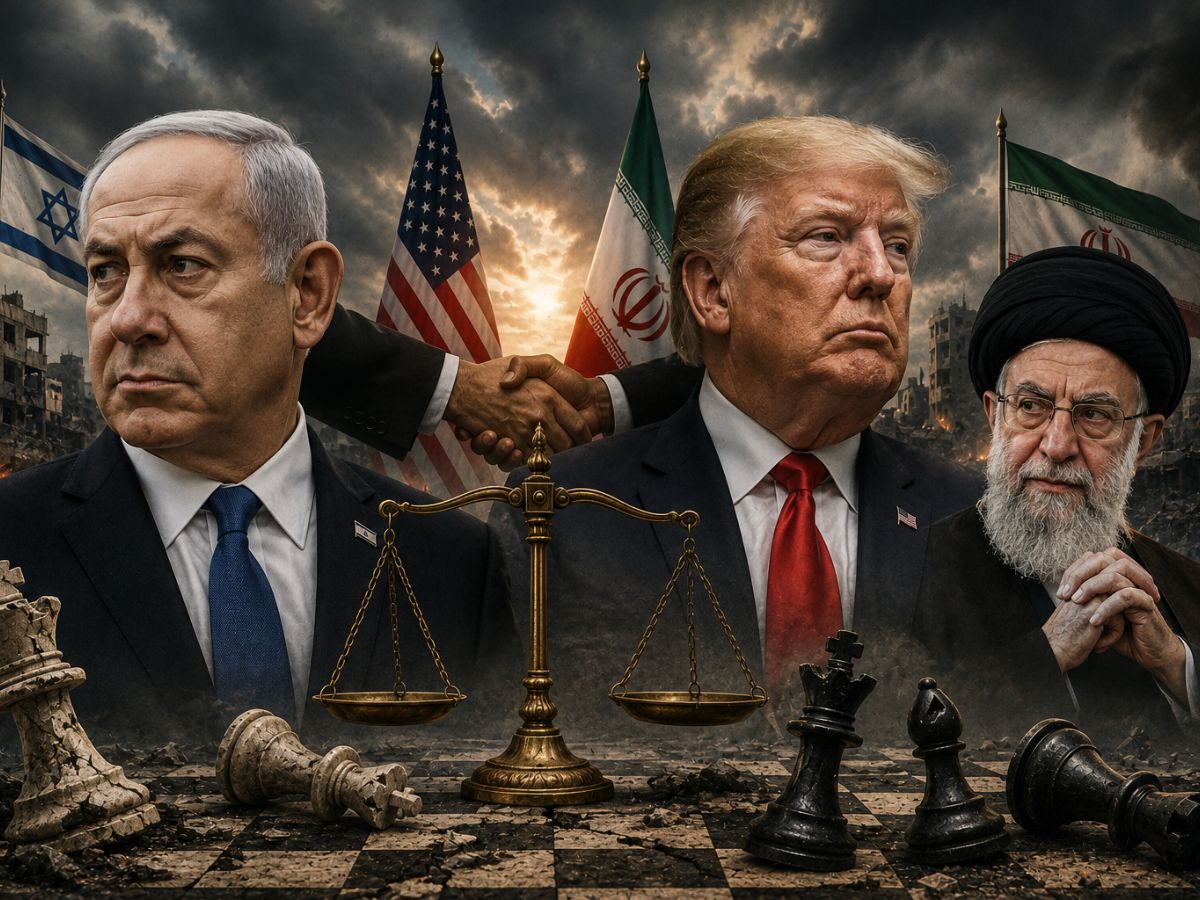
A preliminary agreement aimed at ending months of war in the Middle East has opened a new phase in the geopolitical contest between the United States, Iran and Israel, not on the battlefield, but over who ultimately gained and who lost. US President Donald Trump announced on Monday that Washington and Tehran had signed an initial agreement, though the details remain undisclosed and both sides acknowledged that a permanent truce still needs to be negotiated. Speaking after arriving in France for the G7 summit, Trump said, “the deal’s all signed.” He added that US Vice President JD Vance would attend a formal signing ceremony in Geneva on Friday.
Vice President JD Vance told Fox News that Trump may release Washington’s agreement with Tehran before Friday. According to him, the agreement had already been electronically signed by leaders from both countries and was expected to receive an in-person signing later this week.
What the Peace Deal Includes
Trump described the understanding as a “great deal” that would “bring peace and security to the whole region.” At its core, the agreement extends the fragile ceasefire first announced in April by another 60 days.
The deal also provides for reopening the Strait of Hormuz. Iranian President Masoud Pezeshkian characterised the memorandum of understanding (MoU) as the result of months of negotiations and sustained diplomatic engagement. According to Pezeshkian, successful implementation of the agreement could become a source of national pride.
Yet one of the biggest unresolved questions remains Iran’s nuclear programme.
The agreement provides only a 60-day window to address Iran’s stockpile of highly enriched uranium and determine the future of its atomic ambitions — an issue that previously required years of diplomacy during Tehran’s 2015 nuclear agreement with world powers.
Military Success For Israel, US, But Face Strategic Ambiguity
On paper, Washington and Israel point to major battlefield achievements. Pentagon officials told Congress that more than 80 per cent of Iran’s missile, drone and naval defence industrial base had either been destroyed or severely damaged.
Trump has repeatedly framed the outcome as proof that military pressure worked, arguing that sustained action pushed Tehran into negotiations and created conditions to block Iran from developing nuclear weapons.
But many analysts argue the picture is far more complicated.
One analyst quoted by PBS suggested Iran may have emerged with a new strategic advantage, becoming the effective “gatekeeper” of the Strait of Hormuz.
That position potentially gives Tehran a long-term form of economic leverage it lacked before the conflict.
What Iran Thinks About The War
Iranian officials have rejected the idea that the agreement reflects American success. From Tehran’s perspective, enduring months of military pressure while preserving the political system represents a historic defeat for Washington and its allies.
Analysts note that Iran’s war objective appeared narrower than America’s. While US goals evolved from limiting Iran’s nuclear ambitions to broader political outcomes, Tehran’s priority remained regime survival. By that measure, several observers argue Iran achieved its principal objective.
Iran’s conventional military capabilities have been significantly weakened, yet the Islamic Republic remains intact and still holds influence through Hormuz that could shape future negotiations.
Is Netanyahu the Biggest Loser?
Among international observers, one name appears repeatedly in assessments of who emerged weakened from the conflict: Israeli Prime Minister Benjamin Netanyahu. A roundup of international commentary compiled by The Week described Netanyahu as one of the principal political losers, arguing that Israel failed to eliminate Iran’s nuclear programme while becoming more diplomatically isolated.
Several analysts also suggested the United States fell short of larger ambitions, including any prospect of regime change in Tehran.
For Netanyahu, the emerging agreement appears especially difficult.
The Israeli leader entered the conflict seeking not only to reduce Iran’s military capabilities but also to create conditions that could destabilise Tehran’s government. Instead, negotiations now focus on halting hostilities, reopening global shipping routes and preventing broader economic disruption. With Israeli elections approaching, critics argue Netanyahu may now have to defend an outcome that falls well short of the broader objectives he publicly championed.
Netanyahu Pushes Back
Facing domestic criticism and speculation about tensions with Washington, Netanyahu broke his silence Monday evening and defended the campaign’s outcome. He rejected suggestions of a split with Trump and said Israel and its “American friends” had protected the country from nuclear “annihilation.” He repeated that Iran would never be allowed to acquire nuclear weapons during his tenure.
Netanyahu said, “This is what we did, we saved the State of Israel from annihilation.”
He also declared that Israel had once again “removed, for years to come, this danger hanging over us of the elimination of Israel’s population.”
Iran Emerges Victorious In Lebanon
Iran has insisted that Lebanon be included in the broader settlement framework. Tehran’s position goes beyond halting hostilities and demands that Israel withdraw the Israel Defence Forces (IDF) from all areas of southern Lebanon currently under Israeli control. Iran’s Foreign Ministry spokesperson Esmail Baghaei said Monday that ending the war in Lebanon is an inseparable component of the ceasefire arrangement.
That position has created additional tension inside Israel.
Israeli officials reacted sharply after reports emerged that the US and Iran would formally sign the agreement in Geneva on Friday.
Many critics characterised the deal as damaging to Israeli interests and directed frustration toward Netanyahu. Among the strongest responses came from Israel’s Minister of National Security, Itamar Ben-Gvir, who insisted that any agreement reached by Washington would not bind Israel.
“Israel is not subject to the United States,” Ben-Gvir wrote on X.
He added, “The State of Israel is not a banana republic. My position is clear: We are not partners to this agreement that does not ensure our security, and it does not bind us in any way.”
Also Read: Iran-US-Israel War LIVE and Latest Updates
Zubair Amin is a Senior Journalist at NewsX with over seven years of experience in reporting and editorial work. He has written for leading national and international publications, including Foreign Policy Magazine, Al Jazeera, The Economic Times, The Indian Express, The Wire, Article 14, Mongabay, News9, among others. His primary focus is on international affairs, with a strong interest in US politics and policy. He also writes on West Asia, Indian polity, and constitutional issues. Zubair tweets at zubaiyr.amin





