
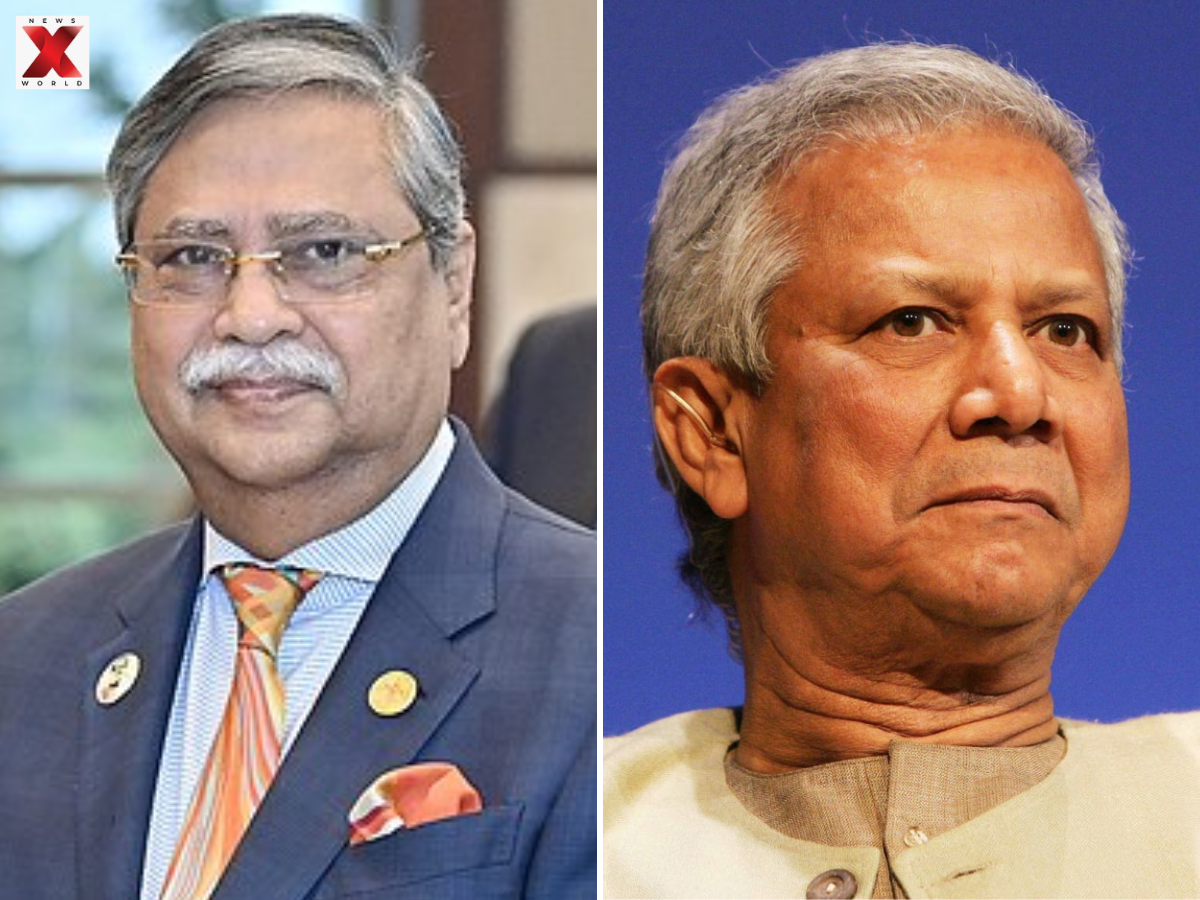

Shahabuddin VS Yunus: Bangladesh President Mohammed Shahabuddin came out swinging in an interview with Bengali daily Kaler Kantho, accusing former chief adviser Muhammad Yunus of sidelining him and ignoring the constitution during the interim government’s tenure.
Bangladesh President Claims He Was Sidelined on Key State Decisions
Shahabuddin said Yunus didn’t bother to coordinate or keep him in the loop about key state decisions, foreign trips, agreements, big policy moves, all of it. He claims Yunus cut him out on purpose, both politically and administratively, leaving him isolated.
According to Shahabuddin, Yunus flat-out ignored constitutional rules that say the President should be consulted, especially after foreign trips. “The constitution says he’s supposed to meet me and provide a written account after returning from abroad.
He travelled 14 or 15 times, never told me anything, not even once,” Shahabuddin said.
He also said he was kept completely out of the loop on major deals, like an agreement with the United States. “I knew nothing about it.
That sort of agreement has to go through the President. It’s a constitutional requirement. He didn’t tell me, not in person, not in writing,” he told the paper.
Shahabuddin Alleges Yunus Blocked His Foreign Visits
Shahabuddin sounded frustrated, saying Yunus pretty much avoided him entirely, even though the President himself started the process that made Yunus chief adviser.
“I was the one who set the wheels in motion for him to get that job, but he never coordinated with me. Never even came to see me. He tried to keep me in the dark about everything,” he said.
It didn’t stop there. Shahabuddin said even his own foreign visits were blocked without his knowledge. He mentioned invitations from Kosovo and Qatar. Instead of discussing the trips, officials just drafted letters in his name, declining the visits because he was supposedly “too busy.” “No one talked to me first,” he said, a bit sarcastically. “Is a President ever that busy, really, under our constitution?”
He went on to say there were deliberate attempts to erase him from public view, at home and abroad. “They didn’t want my name or my face anywhere. They tried to keep me invisible so nobody would know who I was,” he said. He claimed he was even kept away from university convocations and major national events that Presidents usually attend.
One incident really stuck with him. He said his official photos disappeared overnight from Bangladeshi missions abroad after an adviser objected during a foreign visit.
Shahabuddin: ‘Maybe the first step toward removing me’
“All over the world, embassies display the President’s photo because the President represents the state. That tradition ended overnight,” he said. He called it “maybe the first step toward removing me.”
Shahabuddin also accused the interim government of gutting Bangabhaban’s press office after newspapers reported a routine courtesy meeting with new members of the Dhaka Reporters Unity.
“They forced out three officials: the press secretary, deputy, and assistant. Even photographers who had worked here for 30 years were pulled out,” he said. “We can’t even put out a press release anymore.”
He said there was constant pressure to push him out, politically and institutionally, but those efforts failed. At one point, he alleged, there was even a plan to replace him with a former chief justice unconstitutionally.
“An adviser approached the judge, but he refused. He said the President is above him constitutionally, and he wouldn’t take the post illegally,” Shahabuddin said.
Tensions ran especially high during a siege of Bangabhaban on October 22, 2024. Shahabuddin described mobs trying to storm the presidential residence.
“My blood may be shed at Bangabhaban, but I’ll preserve constitutional continuity,” he said. He credited the army for providing three layers of security and eventually restoring order.
He also acknowledged the support of opposition BNP leaders and the armed forces during what he called one of the toughest periods of his presidency.
Muhammad Yunus steps down
On Monday, Muhammad Yunus said his goodbyes to the nation, stepping down as Bangladesh’s interim leader before passing the reins to an elected government.
“Today, the interim government is stepping down,” said Yunus, 85, who won the Nobel Peace Prize years ago. “But don’t let the progress we’ve made in democracy, free speech, and basic rights slip away now. Keep it going.”
Yunus had returned from self-exile in August 2024, just days after a student-led uprising toppled Sheikh Hasina’s tough regime. Hasina fled to India by helicopter.




