

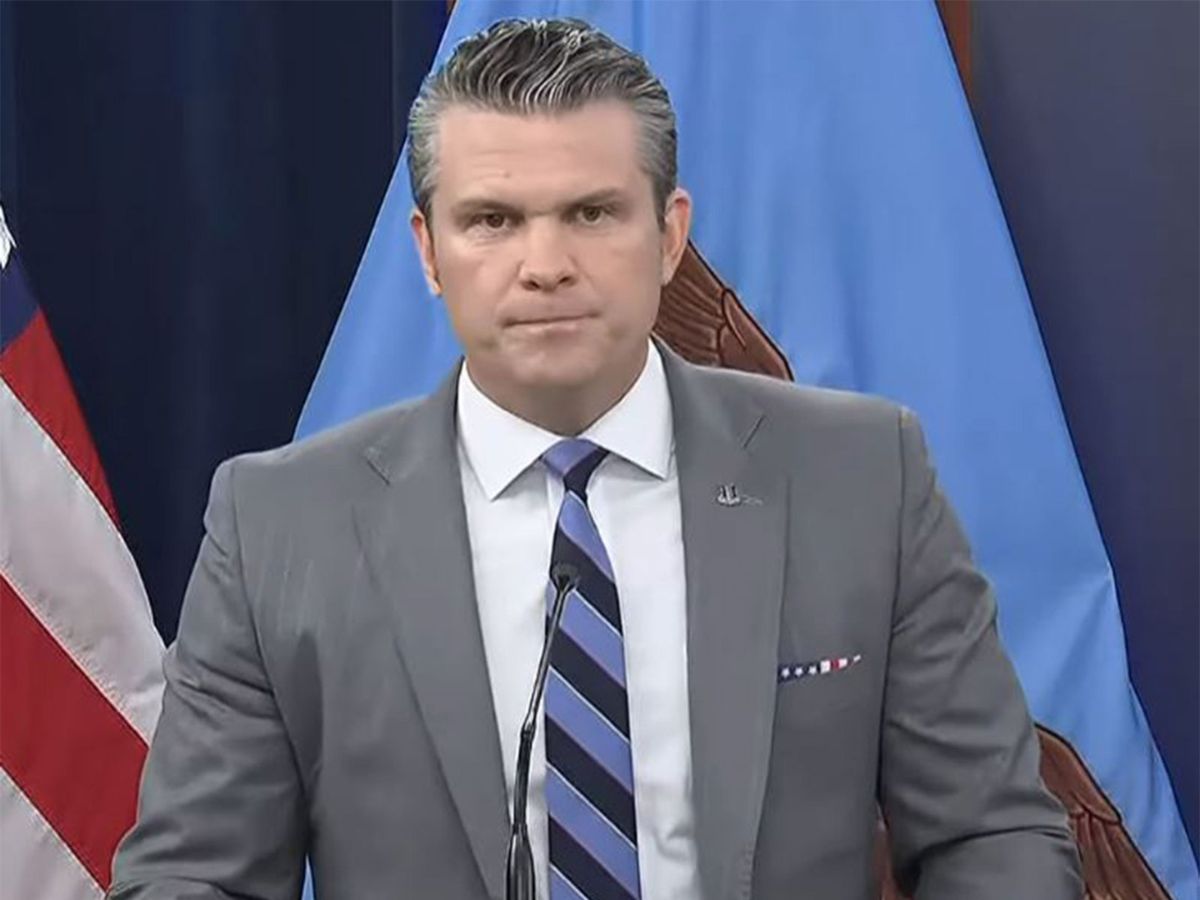
Pete Hegseth has described the ongoing conflict involving Iran as “a gift to the world,” saying the US naval blockade on Iranian maritime traffic will continue for as long as necessary.
Pete Hegseth: US Defends “Bold and Dangerous” Naval Blockade Strategy
Speaking to reporters at the Pentagon on Friday, he said the restrictions are part of a “bold and dangerous” mission aimed at countering what the US sees as Iran’s threat to global stability. Officials claimed the blockade has stopped 34 vessels, but maritime data suggests Iran is still managing to export sanctioned oil.
According to Lloyd’s List Intelligence, a “steady flow of shadow fleet traffic” continues through the Persian Gulf. Reports indicate at least 11 tankers carrying Iranian cargo have departed from the Gulf of Oman since April 13, bypassing the main strait.
In response to the American stance, Iranian state broadcaster Press TV quoted Defence Ministry spokesperson Brigadier General Reza Talaei-Nik, who warned that “a significant portion of our missile capability has not been used.” The General further claimed that the “Armed Forces had full control over the skies of the occupied territories” until the moments leading up to the ceasefire.
Pete Hegseth: Iran Claims Air Dominance Before Ceasefire
Talaei-Nik also highlighted domestic resilience, describing the continued public support following the cessation of hostilities as a “social miracle.” He noted that “over 30 million people registered in the ‘Sacrifice’ campaign”, calling it “an unparalleled example of popular mobilisation in the world.”
Directly challenging the American strategy, the spokesperson alleged that “the enemy” intended to instigate internal chaos. However, he maintained that the vigilance of the public and the coordination of security agencies have kept the nation in a “secure, stable, and cohesive condition.”
The Brigadier General further asserted that the “Strait of Hormuz is under Iran’s wise and powerful management” and has evolved into a “control lever for realising the demands of the Iranian nation.” He added that Western forces in the Sea of Oman have “repeatedly retreated in the face of the decisive response of the Armed Forces.”
Iranian Leadership Rift Emerges Over Negotiation Strategy
This defiant message from the Iranian military emerges even as a new assessment by the US-based think tank, the Institute for the Study of War (ISW), revealed a rift within the Iranian leadership. The ISW report stated that Islamic Revolutionary Guards Corps (IRGC) Commander Brigadier General Ahmad Vahidi and his “inner circle” have “repeatedly blocked attempts” by Parliament Speaker Mohammad Bagher Ghalibaf and other “pragmatist” officials to push the Iranian regime towards a “more flexible negotiating position.”
Despite this internal friction, the United States has confirmed that Steve Witkoff and Jared Kushner are scheduled to arrive in Pakistan on Saturday to participate in a “new round of talks” with Iranian officials. White House Press Secretary Karoline Leavitt told Fox News on Friday, “I can confirm Special Envoy Witkoff and Jared Kushner will be off to Pakistan again tomorrow morning to engage in talks… with representatives from the Iranian delegation.”
Leavitt indicated that the initiative for the meeting came from Tehran, stating, “The Iranians reached out, as the US president called on them to do, and asked for this in-person conversation.” While top aides report back to US President Donald Trump and Vice President JD Vance, notable absences in this second round include Vance himself and Mohammad Bagher Ghalibaf, the leader of the Iranian negotiating team in the first round.
Iran’s Foreign Minister Plans Strategic Diplomatic Tour
The diplomatic movement follows an announcement by Iran’s Foreign Minister Abbas Araghchi regarding a “timely tour” to Islamabad, Muscat, and Moscow to “closely coordinate with our partners.” Although US representatives are expected to be in the same location for a “new round of talks”, there has been no official clarification from Araghchi regarding a planned meeting with the American delegation.
Meanwhile, at the Pentagon, US Secretary of War Pete Hegseth remarked that President Trump suggested the US “had all the time in the world and we are not anxious for a deal”, adding that Tehran has a chance to make a “good deal, a wise deal.”
(With Inputs from ANI)
I am a content writer with more than 1 year of experience, currently working at ITV Digital. I cover a wide range of topics including entertainment, world news, India news, crime, and astrology, along with writing engaging lifestyle stories and reviews. With a flair for storytelling and a keen eye for trends, I aim to deliver fresh, reader-friendly content across diverse subjects.





