
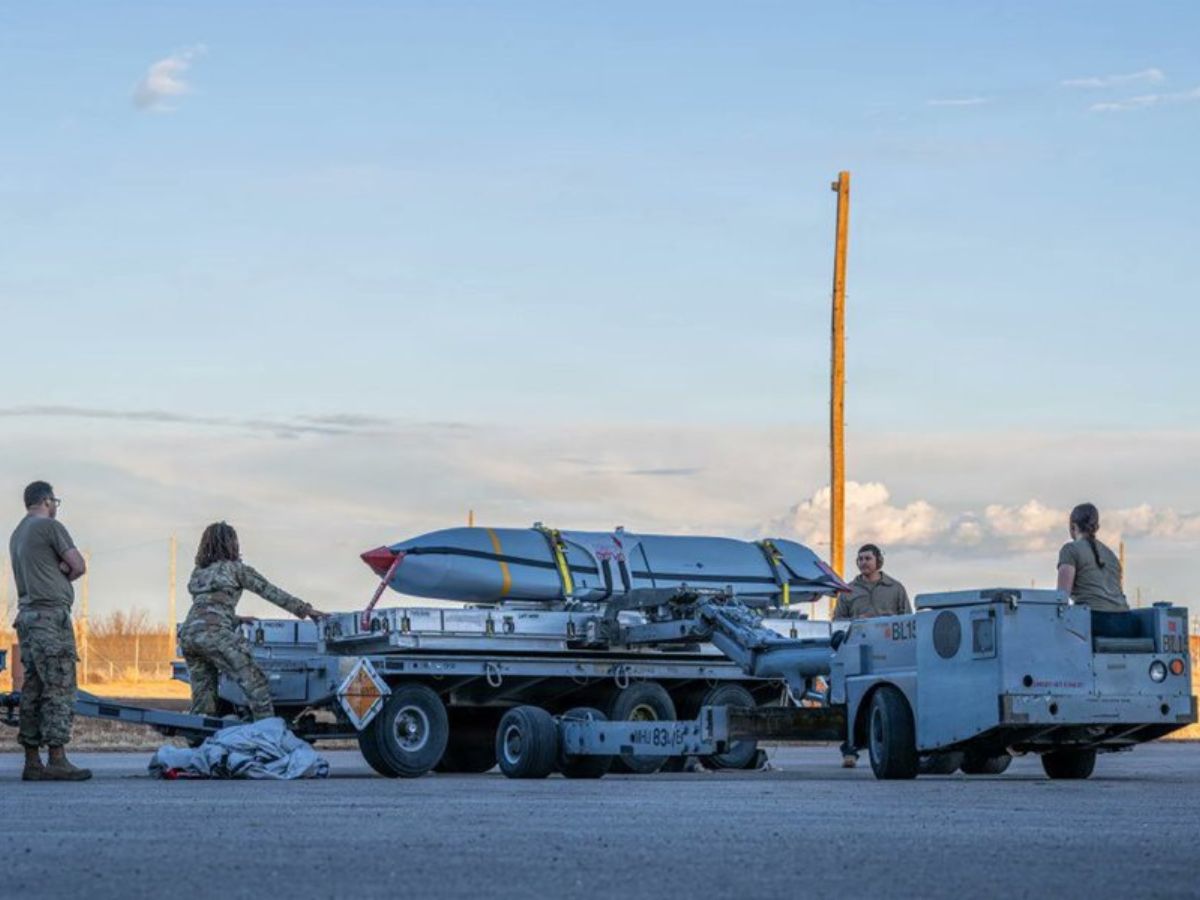

The US is on the verge of increasing the intensity of its military efforts against Iran, according to various reports, one of which includes deploying the JASSM-ER (Joint Air-to-Surface Standoff Missile–Extended Range) or JASSM, a state-of-the-art cruise missile with a long range of more than 600 miles (around 965 km).
The JASSM/ER is known to be one of the deadliest precision-guided munitions available to the US military, as it has the ability to accurately strike its target at extreme distances by utilizing it’s stealthiness to avoid enemy detection.
What makes JASSM-ER a deadly weapon
One of the main reasons that the JASSM/ER is such a deadly weapon is because it is capable of being launched from a variety of platforms, including B-52 bombers, B-1B bombers, and fighter aircraft. Hence, the JASSM/ER can allow you to conduct an attack from a distance that would otherwise put your pilot at risk of being shot down by enemy air defense systems.
The stealth nature of this missile makes tracking and intercepting it extremely challenging for any adversary. The JASSM-ER missile is capable of destroying heavily protected targets, such as bunkers, infrastructure and military assets, with its extremely precise and powerful weapon.
Large-scale deployment would be a significant escalation
Many experts are surprised by not only the missiles themselves, but also by how many the US is moving to the Middle East. Reports indicate that the US is relocating almost its entire inventory of JASSM-ER missiles from multiple areas (for instance, from the mainland US to the Pacific) to support military operations within the Middle East.
Prior to this conflict, the United States had approximately 2300 JASSM-ER missiles. However, because of the extensive use of the JASSM-ER in recent military operations, there may be very few (approximately 425) JASSM-ER missiles now available to support other missions around the world. This indicates how heavily the weapons are being employed in the context of the ongoing war.
JASSM-ER: Heavy usage raises concerns over stockpile
Both analysts and military officers have indicated that they believe at least 1000 JASSM-ER missiles have been used during the first few weeks of military operations and that this is an unusually high rate of usage and raises the question regarding how quickly the United States can restock its JASSM-ER missile inventory.
There are limits to how many missile systems can be built. In the short term, it’s possible to ramp up daily production of JASSM-ER, but rebuilding a complete reserve capacity will take many months to achieve. A number of defence experts are concerned that should another major global conflict occur almost immediately following of Iraq, the US could face serious shortages of JASSM-ER missiles in key areas, particularly through the Indo-Pacific command structure.
JASSM-ER: Long Range Strike Strategy
Military professionals believe that the JASSM-ER missile programme is part of a larger overall strategy for reducing combat risk to US armed forces through long-range strike capabilities; allowing US aircraft to strike high-value targets at lethal ranges, while still remaining outside of hostile high-volume air defence firepower.
Additionally, planners suggest that the damage done to Iranian air defence systems from earlier military engagements by the US and coalition partners will allow US forces to preserve limited military resources by using cheaper “dumb” weapons when conducting strikes against Iran in subsequent phases of a potential future conflicts. However, losses have been incurred over the course of the current operations, including aircraft that have been downed; indicating that air defence threats in Iran are not yet over.
Geopolitical Considerations and Global Tension
The geopolitical implications are global, leading to increased tensions in the Middle East, and potentially escalating an already tenuous conflict with Iran into a wider regional conflagration. In fact, Iran has launched hundreds of missiles into Iraq and other locations as an act of retaliation against the US and its allies.
Khalid Qasid is a media enthusiast with a strong interest in documentary filmmaking. He holds a Master’s degree in Convergent Journalism from AJK MCRC. He has also written extensively on esports at Sportsdunia. Currently, he covers world and general news at NewsX Digital.




