
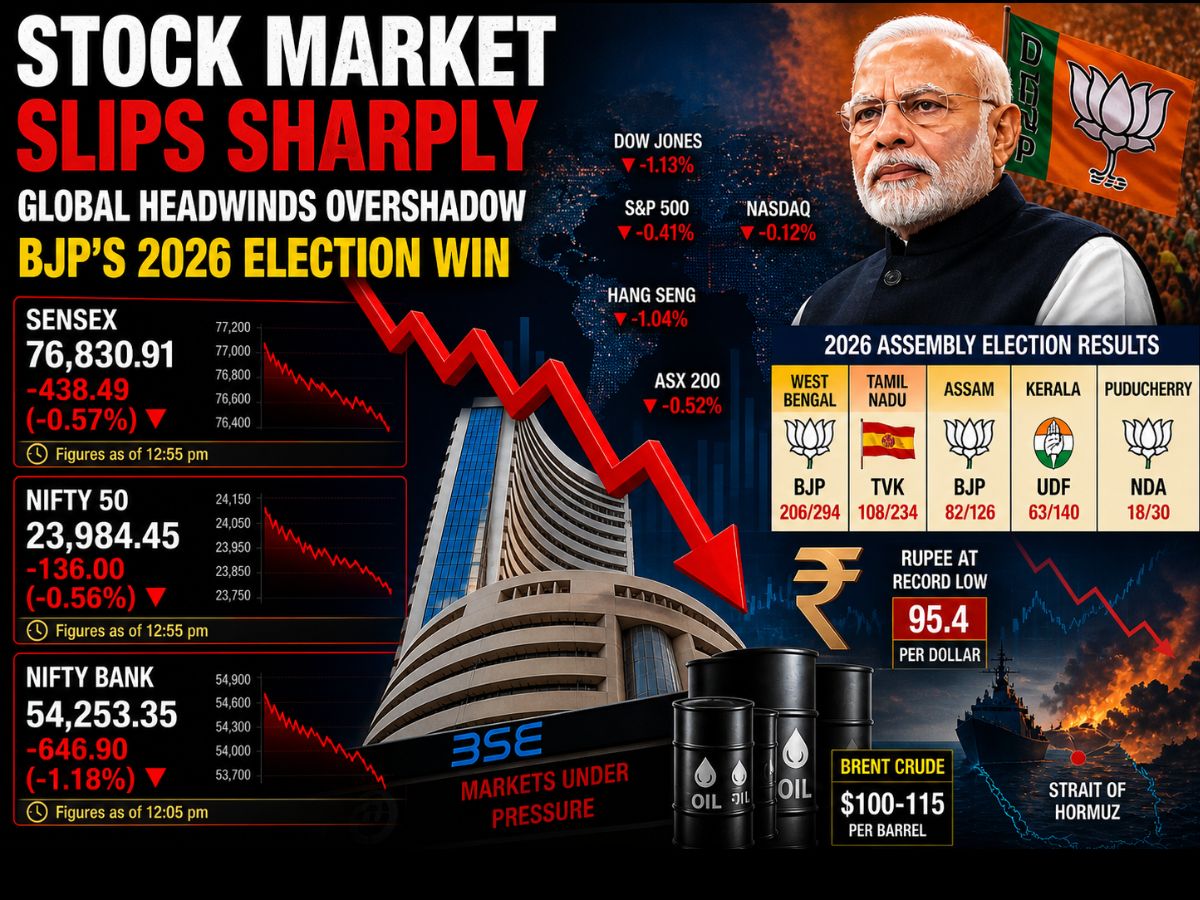

Stock Market: Indian stock markets saw a significant sell-off on Tuesday, May 5, 2026, as major indexes plunged around 600 points in intraday trade as a global risk-off mood, rising crude oil prices and mounting geopolitical uncertainties weighed on investor confidence. The strong political mandate for the ruling BJP in important state elections did not help market sentiment as domestic political news was overshadowed by macroeconomic issues on trading screens.
Around 12:55 IST the BSE Sensex was trading 438.49 points lower, or 0.57%, at 76,830.91. It made a high of 77,140.97 and traded to a low of 76,515.03 on intense selling pressure. The Nifty 50 traded along and had a lower opening as well at 23,984.45, down by 136 points, or 0.56%. Intraday, it traded a high of 24,072.10 and a low of 23,882.05.
The message from the market was clear overall: while domestic political stability is good for the longer run, the short-term direction is still being driven by global macro events.
Stock Market: Global Factors Shape Market Direction
Market investors mostly blamed the sell-off on external obstacles, not on local changes. Oil price levels are staying high due to resurgence in geopolitical tension in the Middle East region, particularly around the Strait of Hormuz – one of the world’s vital shipping routes.
Market commentary by Siddharth Purohit, Fund Manager – Equity, Investvalue Capital Pvt Ltd, on recent market drivers:
“Indian Markets reacted negatively in opening today and seeing some pressure as a result of overnight developments in middle east where Iran is reported to have fired projectiles towards UAE. In response US has claimed to have sunk an Iranian boat in Strait Of Hormuz. This puts the ceasefire at risk which was already shaky and any further escalation will cause near term volatility in crude prices again. Back home in India the BJP had a landslide victory in the West Bengal elections which will help in increasing its tally in the Rajya Sabha going ahead but will take its own time. The BJP led NDA was short of the 2/3rd majority in the upper house despite the APP MPs merging recently. West Bengal with 16 Rajay Sabha seats will help it improve to a large extent which can help the Govt in bringing more radical reforms in the years to come,” he said.
“So the overall negative reactions to the domestic market are largely due to global events rather than political. We feel now that the Govt has got a clear mandate from two large state of West Bengal and Assam it can start focusing on Marco issues which is need of the hour,” he added.
Brent crude has been ruling the roost in the $100-115 a barrel mark, thereby increasing inflation concerns and negatively affecting India’s macroeconomic perspective. The weak rupee, continued foreign fund outpour, and US bond yield increase are fuelling risk aversion.
Stock Market: Big-cap selling pressure weighs on indices
Selling was witnessed across the board, as heavyweights from banking, oil, IT, and consumption sectors were under pressure. The biggest losers, however, were RIL, HDFC Bank, ICICI Bank, State Bank of India, Larsen & Toubro, Axis Bank, NTPC, Bajaj Finance, and Hindustan Unilever, down in the 0.5 to 2% range.
The underperformance by the large caps seemed to be more of institutional selling rather than a retail-led selling spree, suggesting cautiousness by the global funds.
Stock Market: Bank Nifty’s decline dragged others down too
Financials were at the receiving end as Nifty Bank plunged near 600 points during the intra-day trading session as the index witnessed an intra-day low of 54,221.65 points. As of 12:05 IST, the Nifty Bank declined 646.90 points, or 1.18%, to 54,253.35.
The pullback reflects fears about tight global liquidity, high valuations, and rising bond yields, suggesting that this sector is likely to be more affected than others.
Stock Market: Sector pain spreads beyond banks
Major sector indices indicated some signs of selling pressure:
Nifty Auto: Down ~1%
Nifty Financial Services: down ~1%
Nifty Oil & Gas: In the Spotlight
Nifty Realty: Down about 2%, among biggest losers
Interest-rate sensitivity added to the pressure, with profit-taking seen in real estate companies in particular, after recent outperformance.
Stock Market: Weak global cues add to downside pressure
Global equity markets also lacked support. Asian markets were down, with the Hang Seng down more than 1% and Australia’s ASX 200 down around 0.5%. US markets closed down overnight with the Dow Jones down 1.13%, the S&P 500 down 0.41% and the Nasdaq a tad lower.
The overall trend is one of consolidation following recent record highs as investors reassess valuations in a macro environment of uncertainty.
Stock Market: New Risks from Geopolitical Tensions in Middle East
Rising tensions in the Middle East, especially around the Strait of Hormuz, are one of the significant overhangs for global markets.
There have been reports of a resurgence of military activity between US and Iranian forces in the area, including incidents involving commercial shipping and an escalation in regional security. According to the reports, under a security strategy, the US has enhanced maritime protection operations to ensure the safe passage of global trade routes.
The Strait of Hormuz is a major transit point for a significant portion of the world’s crude oil, meaning that any disruption there would have a direct impact on energy markets and global inflation dynamics.
Stock Market: Crude Oil and Currency Pressure on the Rise
India’s key macro issue is crude oil volatility. Brent crude oil rose temporarily above $115 a barrel, raising inflation worries. For an import-dependent economy such as India’s, this implies the following:
- Larger import bill
- Inflationary pressure
- Earnings margin squeeze
- Less policy space for manoeuvre
The Indian rupee has also been falling, hitting historic lows of 95.4 per dollar, down about 13% in the previous year, adding to the pressure on foreign investors.
Stock Market: Election Result Fails to Boost Market Sentiment
There was no market reaction to the election result despite robust political developments, underscoring the primacy of global macro forces over domestic political triggers in the medium term.
But in the bigger political scene, the 2026 Assembly elections in states witnessed extraordinary results:
West Bengal: For the first time, the BJP established a government in the state after India’s independence by winning 206 of the 294 Assembly seats and breaking the 15-year reign of the Trinamool Congress.
Tamil Nadu: Actor-turned-politician Vijay and his Tamilaga Vetri Kazhagam (TVK) emerged as the single largest party, capturing 108 of the 126 Assembly seats and coming short of an outright majority in the hung assembly. DMK won by bagging 59 seats, and AIADMK got 47 seats.
Assam: The BJP-led NDA government returned to power for the third consecutive time by gaining 82 seats and a strong majority in the 126-member legislature.
Kerala: A major success for the Congress-led UDF, which secured 63 seats, signalling a paradigm shift in the state.
Puducherry: The ruling alliance, which won 18 out of 30 Assembly members, consists of AINRC and the BJP.
The elections indicated a high degree of regional consolidation and a new political landscape, but the immediate market response has been muted as investors wait for a number of global concerns.
Stock Market: Expert View: Short-Term Trends Give Way To Macro Conditions
Market experts feel that, despite the support for long-term investment optimism, political stability is not enough to offset global macro headwinds.
Analysts say that today, continued volatility in crude oil, foreign outflows and rising global yields are the main determinants of market direction. They also cite that a strong electoral mandate tends to support economic discipline, infrastructure spending, and policy continuity over time.
Stock Market: Conclusion: International Storm Clouds Drown Out Domestic Optimism
Tuesday’s market activity underscores a crucial theme that local political strength is just not enough to maintain equities in the face of global uncertainty.
Sentiment continues to remain under pressure due to rising crude oil prices, geopolitical worries, currency weakness and foreign outflows, which have pushed Indian shares into a risk-off trend.
Dalal Street is expected to witness volatile markets unless external conditions stabilise, with stock particular moves influencing wider index patterns.
Also Read: HFCL Shares Jump 5% to ₹132 After Securing ₹84 Cr Optical Fiber Orders
(Disclaimer: This article is for informational purposes only and should not be considered investment advice. The experts give their recommendations, suggestions, views, and opinions. Please consult a financial advisor before making any investment decisions.)




