
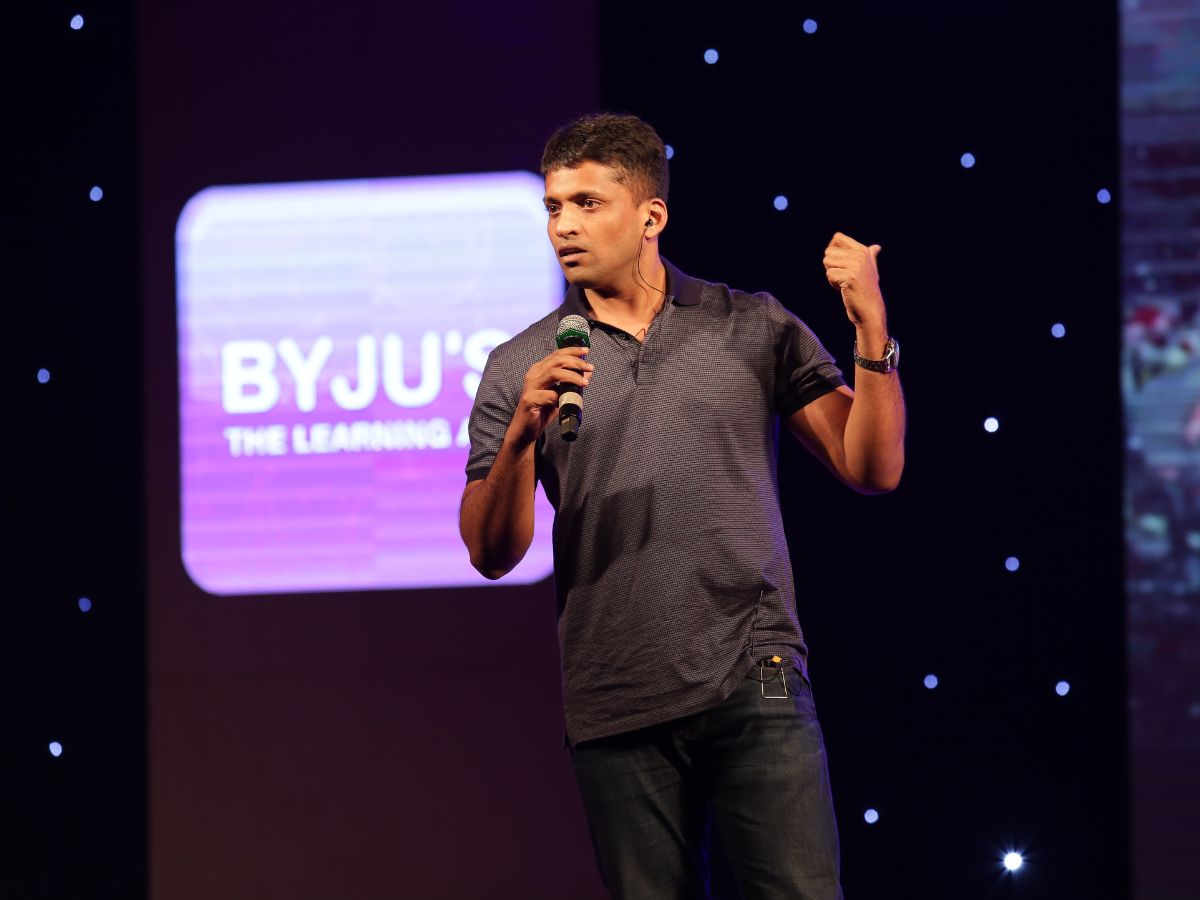

Byju Raveendran: A US bankruptcy court has ordered Byju’s founder Byju Raveendran to pay more than $1.07 billion, issuing a harsh default judgment that holds him personally liable for concealing and diverting funds from Byju’s Alpha, the edtech company’s US-based financing arm.
In its ruling, the Delaware bankruptcy court said the extraordinary penalty was warranted after months of deliberate obstruction, noting that Raveendran repeatedly blocked efforts to trace hundreds of millions of dollars missing from the bankrupt subsidiary.
The court observed that Raveendran failed to comply with discovery orders and remained evasive despite multiple opportunities to cooperate. Because of this continued non-compliance, the judge ruled that a default judgment was the only effective remedy.
According to the order, the court will enter default judgment against Raveendran for $533 million under the primary claim, and an additional $540.6 million under Counts II, V and VI of the complaint. The ruling also directs Raveendran to produce a complete and accurate accounting of the Alpha funds and all associated proceeds, including the Camshaft LP interest along with every subsequent movement of the money.
Byju’s Alpha At The Centre Of The Financial Dispute
Byju’s Alpha, incorporated in Delaware in 2021, was designed as a special-purpose vehicle to raise and manage Byju’s $1.2 billion term loan sourced from a consortium of global lenders. The entity had no operational business functions and served primarily as a holding structure for the loan proceeds, according to a report by Moneycontrol.
Court records show that the subsidiary became the core entity through which the disputed $533 million was transferred.
The heart of the legal dispute revolves around the movement of $533 million from Byju’s Alpha to Camshaft Capital, a small hedge fund based in Miami. The transfer was followed by additional transactions routed through linked entities associated with Byju’s, with the court ruling that Raveendran personally directed and oversaw these financial steps.
Lenders’ Allegations
Byju’s Alpha was created during the period when Raveendran oversaw the parent company, Think & Learn Private Limited (TLPL), which operated the Byju’s brand. TLPL had secured a $1 billion Term Loan B from US lenders. Those lenders later accused Byju’s Alpha of breaching loan terms, claiming that $533 million was moved out of the US in violation of the agreement.
Following these allegations, Glas Trust, acting on behalf of the lenders, approached the Delaware court and obtained an order granting it control of Byju’s Alpha.
Both Byju’s Alpha and Glas Trust subsequently approached the Delaware Bankruptcy Court seeking discovery related to the missing $533 million and connected financial transfers. According to the reports, the court had previously issued a contempt order after Raveendran failed to respond to discovery demands or pay the penalties imposed on him.
The judgment noted that Raveendran’s continued refusal to participate in the discovery process appeared to be a deliberate personal choice.
“The facts and circumstances of this case indicate that Raveendran’s continuing failure to adequately respond to the pending discovery requests is a personal decision by Raveendran, himself,” the order stated.
The court further observed that Raveendran, who resides outside the US, has shown no intention of paying the financial sanctions or complying with discovery orders. Because the existing penalties failed to compel action, the court said a stronger measure such as issuing a default judgment had become necessary.
READ MORE: Gig and Platform Workers Finally Get A Safety Net, Here’s What The New Labour Laws Change For Them




