
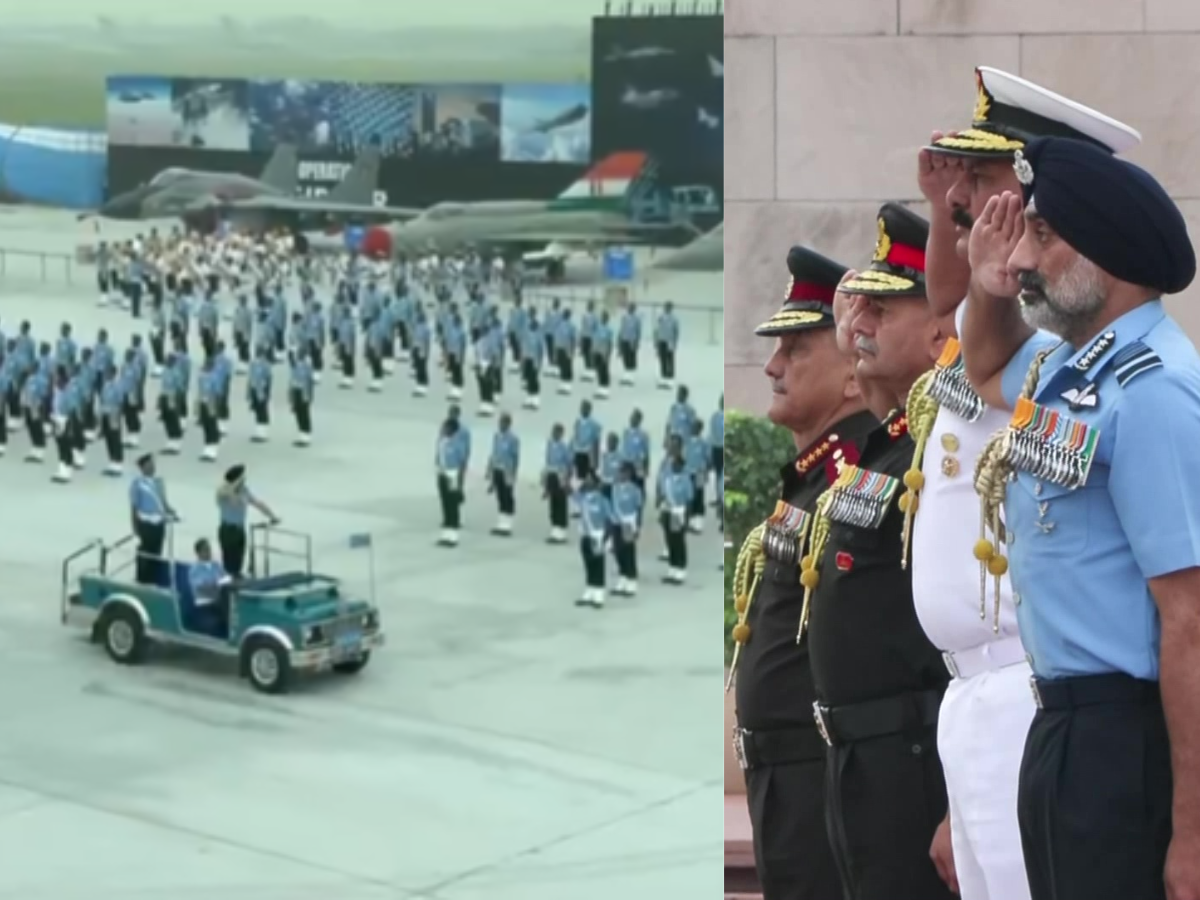

Every year on October 8, India celebrates Indian Air Force (IAF) Day, honouring the bravery, discipline, and dedication of air warriors who safeguard the nation’s skies. This year (2025) it marks the 93rd Indian Air Force Day. The Air Force Chief Marshal AP Singh inspects the parade at Hindon Air Base, where Air Force Day celebrations are taking place.
#WATCH | Ghaziabad, Uttar Pradesh: Indian Air Force Chief Air Chief Marshal AP Singh inspects the parade at Hindon Air Base, where Air Force Day celebrations are taking place.
(Video: ANI/Indian Air Force) pic.twitter.com/AkVffTFbEy
— ANI (@ANI) October 8, 2025
The IAF participates in air shows, flypasts, and exhibitions to showcase its strength and precision. This day inspires young Indians to dream of becoming fighter pilots and contributing to national defence.
#WATCH | Ghaziabad, Uttar Pradesh: Indian Air Force Chief Air Chief Marshal AP Singh arrives at Hindon Air Base, where Air Force Day celebrations are taking place.
(Video: ANI/Indian Air Force) pic.twitter.com/bI8iaLvO0y
— ANI (@ANI) October 8, 2025
Air warriors carry out a march past at Hindon Air Base, as part of Air Force Day celebrations.
#WATCH | Ghaziabad, Uttar Pradesh: Air warriors carry out a march past at Hindon Air Base, as part of Air Force Day celebrations here. pic.twitter.com/dWKoJGaWsI
— ANI (@ANI) October 8, 2025
#WATCH | Ghaziabad, Uttar Pradesh: CDS General Anil Chauhan arrives at Hindon Air Base, where Air Force Day celebrations are taking place. pic.twitter.com/D1WYd8Rm1R
— ANI (@ANI) October 8, 2025
The celebration also commemorates IAF’s historic achievements, including humanitarian missions, aerial combat, and strategic operations. Air Force Day 2025 reminds citizens of the sacrifices and courage of officers who protect the country from threats above, ensuring safety on the ground.
Well! are you looking ways to get into the Indian Air Force? Here’s a guidance:
Aspiring fighter pilots can join the Indian Air Force through the NDA, CDSE, or AFCAT routes. NDA candidates must be unmarried males aged 16.5 to 19.5 years, while CDSE and AFCAT candidates require graduation with Physics and Mathematics at 10+2 level or a B.Tech degree.
Age limits generally range from 20 to 24 years, with relaxations for candidates holding a commercial pilot licence. Physical fitness, perfect eyesight, and good health are mandatory. Candidates must pass stringent medical and vision standards. These requirements ensure that only capable and disciplined individuals can pursue the highly demanding career of a fighter pilot.
Selection Process: Written Tests to Pilot Aptitude
The IAF selection process starts with a written examination, followed by the Service Selection Board (SSB) tests. The SSB evaluates candidates through psychological assessments, group discussions, personal interviews, and medical examinations. The most crucial phase is the Pilot Aptitude Battery Test (PABT), now replaced by the Computerised Pilot Selection System (CPSS), which measures coordination and aircraft-handling skills. Only candidates who pass CPSS qualify for the flying branch. This selection process ensures that the chosen cadets possess both mental resilience and physical agility, preparing them for the intense challenges of operational flying in the Indian Air Force.
Training to Combat-Ready Fighter Pilot
Selected cadets train at premier institutions such as NDA Khadakwasla or Air Force Academy Dundigal. Training has three phases: Basic Flying, Intermediate Flying, and Advanced Fighter Training. Cadets begin on trainer aircraft like the Pilatus PC-7 MkII and progress to jets such as Kiran or Hawk AJT. Advanced combat training includes Tejas, Mirage-2000, or Su-30MKI. Each phase tests flying skills, situational awareness, and handling aircraft under extreme conditions. Upon successful completion, cadets are commissioned as Flying Officers and posted to frontline squadrons. Training ensures pilots are ready for combat missions, emergency situations, and high-pressure operations, reflecting the professionalism of the IAF.
Being an IAF fighter pilot is demanding, requiring mastery of flying, combat readiness, and strategic planning. Each mission demands focus, teamwork, and precision. Officers train in aerobatics, air-to-air combat, and tactical operations.
Cadets undergo simulator sessions and real flight missions to build endurance, decision-making, and composure under pressure. High G manoeuvres, cramped cockpits, and extreme weather conditions test physical and mental limits.
Career Options in IAF After 12th
Indian Air Force careers offer roles in Flying, Technical, and Ground Duty branches. Flying branch includes fighter, transport, and helicopter pilots, requiring NDA or AFCAT entry. Technical branch requires engineering degrees for Aeronautical Engineers. Ground Duty covers administration, accounts, logistics, education, and meteorology with graduation qualifications. Officers undergo intensive training to develop leadership, management, and operational skills. The IAF also offers permanent commissions through UPSC and temporary service under Agnipath. Career paths vary with interests and qualifications, but all require discipline, physical fitness, and mental resilience. The IAF provides a blend of adventure, prestige, and national service.
Despite its challenges, the Indian Air Force attracts thousands of young aspirants. It offers adventure, responsibility, and a chance to serve the nation. Modern aircraft such as Rafale, Tejas Mk1A, and Su-75 Checkmate make the role technologically advanced.
PM Modi, Rahul Gandhi And Others Wishes On Air Force Day:
PM Modi greets on Air Force Day 2025. Says “Their role during natural calamities is also very commendable. Their commitment, professionalism and indomitable spirit continue to make every Indian proud.”
Greetings to all the courageous Air Warriors and their families on Air Force Day. The Indian Air Force epitomises bravery, discipline and precision. They have played a vital role in safeguarding our skies, including during the most challenging situations. Their role during…
— Narendra Modi (@narendramodi) October 8, 2025
Rahul Gandhi wishes on X:
Heartfelt greetings and salute to the brave warriors of the Indian Air Force on Air Force Day.
Your courage in safeguarding our skies and unwavering dedication inspire us all. We honour your unparalleled valour, sacrifices, and selfless service to the nation.
Jai Hind 🇮🇳 pic.twitter.com/kfawducIaf
— Rahul Gandhi (@RahulGandhi) October 8, 2025
Amit Shah On X:
On Indian Air Force Day, extending warm greetings to the guardians of our skies.
The very name of the force evokes immense pride in the hearts of Indians. Whether it is carrying the weight of national security or salvaging lives during natural calamities, the Indian Air Force… pic.twitter.com/gZwILZ5gyf
— Amit Shah (@AmitShah) October 8, 2025
Honouring 93 years of courage and commitment.
Happy Indian Air Force Day! Proud of our Air Warriors who inspire the nation and keep our skies safe.
जय हिंद! #IndianAirForceDay pic.twitter.com/LE2QSIUT5S
— BJP (@BJP4India) October 8, 2025
Must Read: Indian Air Force Day 2025: Nation Celebrates 93 Years Of Valour, Best Wishes To Share
Swastika Sruti is a Senior Sub Editor at NewsX Digital with 5 years of experience shaping stories that matter. She loves tracking politics- national and global trends, and never misses a chance to dig deeper into policies and developments. Passionate about what’s happening around us, she brings sharp insight and clarity to every piece she works on. When not curating news, she’s busy exploring what’s next in the world of public interest. You can reach her at [swastika.newsx@gmail.com]




