
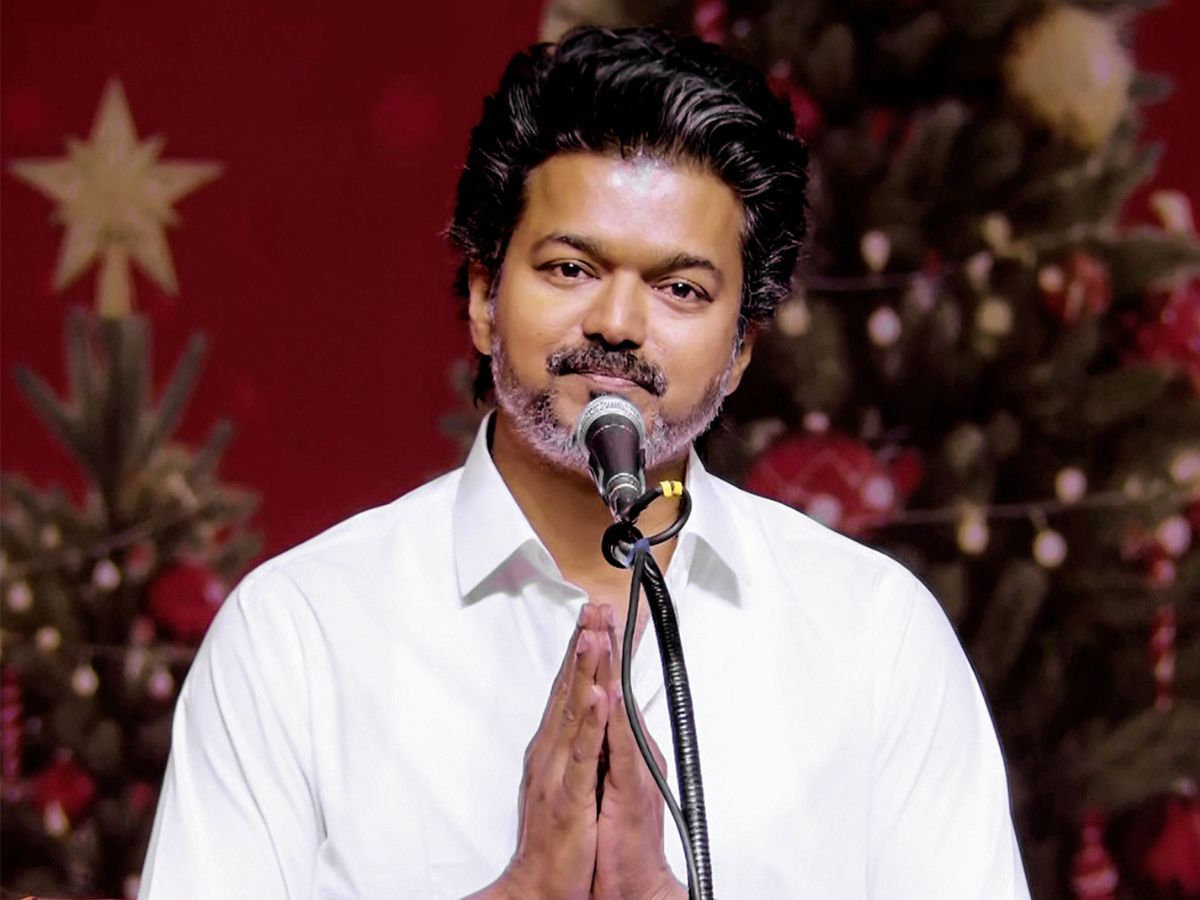

TVK Manifesto: With Tamil Nadu’s political temperature soaring as the next phase of electoral counting and results trends approach, Thalapathy Vijay has become one of the most keenly watched individuals in the race. With early trends consistently signalling a strong showing for his party the Tamilaga Vetri Kazhagam (TVK) the spotlight has now shifted firmly to the party’s ambitious 95-page manifesto. Labelled as a hybrid of welfare delivery, governance reform and employment generation, the manifesto has been at the centre of TVK’s campaign narrative. Vijay has consistently couched his pitch in the trope of “honest administration”, touting it as the cure for what he believes to be a case of promise-heavy and delivery-light governance in Tamil Nadu.
What Has TVK promised under “honest administration”?
Unsurprisingly, at the heart of TVK’s manifesto is the notion of clean and transparent governance. Vijay has fashioned “honest administration” as the core ideology of his entry into politics, and contrasted it with the systems of political incumbency.
The party says that corruption and inefficient systems have crippled welfare delivery and promises to plug leaks through direct benefit transfer and reforming service delivery. This governance-first pitch has helped TVK carve out its identity as a “new alternative” in Tamil Nadu’s polity.
What does Vijay have in mind for families’ welfare?
Welfare seems to be the TVK’s strong suit. The DMDK manifesto was also welfare heavy. But this time, TVK has put direct cash support and household relief at the heart of its political offer. Some of its earliest promises include ₹2,500 per month to women heads of families, six LPG cylinders per year, 200 units of free household electricity and piped water supply.
The party has also promised a monthly sum of ₹3,000 to senior citizens, widows and persons with disabilities, in addition to marriage and childbirth-linked benefits such as gold assistance for brides from economically weaker families. There is no doubting the intent to prop up household support across rural and urban Tamil Nadu.How is TVK addressing jobs and youth aspirations?
If welfare support is the centrepiece of TVK’s manifesto, youth employment is its second key pillar. Here, TVK has promised collateral-free education loans up to ₹20 lakh, monthly unemployment allowances of ₹4,000 for graduates and ₹2,500 for diploma holders and skill training stipends.
Perhaps its most ambitious promise is to create 5 lakh village-level jobs through the launch of the “CM People Service Associate” programme. The party has also promised recruitment transparency in government jobs and the launch of AI-based competitive exam coaching centres. The intent is apparently to combine immediate relief with job creation.
How is TVK planning to support the farming and rural communities?
Farmers are a major vote bank in Tamil Nadu, and the TVK’s manifesto reflects this core constituency. It offers crop loan waivers, minimum support prices backed by legal guarantees and a cultivator rights card that aims to formally recognise agricultural workers, including tenant farmers.
The manifesto also offers targeted subsidies for rural industries and incentives for companies that employ local workers. These include tax and power subsidies linked to employment generation, and are designed to help strengthen the rural economy while ensuring localisation of jobs in these areas.
Can TVK fix governance and public service delivery?
Beyond welfare and employment guarantees, solutions for structural governance reforms have also been promised. A citizen privilege card is expected to help simplify access to government schemes, and a right to service act will ensure time-bound provision of government services.
Yet another noteworthy proposal involves citizens directly filing petitions in the assembly, and an obligatory response for petitions that cross a certain threshold of public support. These proposals seem to be an attempt to bring in participative governance at the state level.
Why is Vijay’s manifesto getting attention now?
The growing traction for TVK’s manifesto appears to be a reflection of the larger political churn in Tamil Nadu, with voters appearing increasingly receptive towards options beyond traditional parties.
Welfare guarantees combined with anti-corruption messaging and employment guarantees offer what is essentially a stratified political pitch.
Whether this momentum is harnessed to deliver a long-term political transformation or remains limited to an electoral groundswell will depend on the vagaries of implementation and governance. For now, though, Vijay’s manifesto has clearly emerged as the sheet anchor of TVK’s growing political traction in Tamil Nadu.
Sofia Babu Chacko is a journalist with over five years of experience reporting on Indian politics, crime, human rights, gender issues, and stories about marginalized communities. She believes journalism plays a crucial role in amplifying unheard voices and bringing attention to issues that truly matter. Sofia has contributed articles to The New Indian Express, Youth Ki Awaaz, and Maktoob Media. She is also a recipient of the 2025 Laadli Media Awards for gender sensitivity. Beyond the newsroom, she is a music enthusiast who enjoys singing. Connect with Sofia on X: https://x.com/SBCism




