
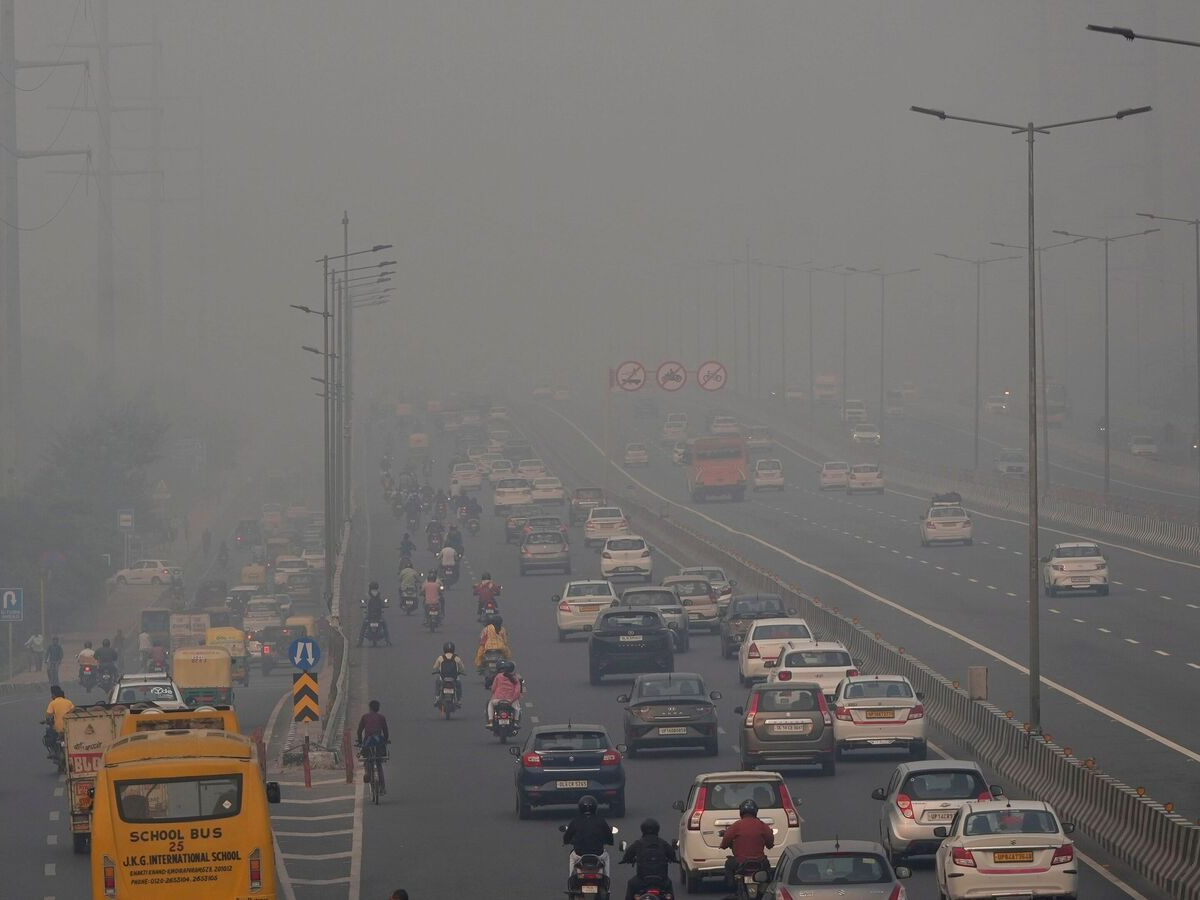

A thick blanket of toxic haze covered Delhi for the second straight day after Diwali as people continued to burst firecrackers well beyond the two-hour window allowed by the Supreme Court. The air quality remained in the ‘very poor’ category on Wednesday morning, recording an Air Quality Index (AQI) of 345 at 7 am, according to data from the Central Pollution Control Board (CPCB).
Out of 38 air monitoring stations across the city, 34 were in the ‘red zone’, meaning ‘very poor’ to ‘severe’ air quality. Punjab Bagh and Wazirpur reported AQI readings of 433 and 401 respectively, both in the ‘severe’ range.
The AQI scale categorises 0–50 as ‘good’, 51–100 ‘satisfactory’, 101–200 ‘moderate’, 201–300 ‘poor’, 301–400 ‘very poor’, and 401–500 ‘severe’.
Despite a sharp 77.5% fall in stubble burning incidents this year, Delhi’s post-Diwali AQI touched around 350, the worst in five years. The concentration of PM2.5 particles, the most dangerous pollutant, averaged a shocking 488 micrograms per cubic metre, nearly 100 times higher than the World Health Organisation’s recommended safe limit.
This pollution spike comes even after the Supreme Court restricted the use of only ‘green’ firecrackers in Delhi-NCR. The court had allowed their use from 8 pm to 10 pm on Diwali day and between 6 am to 7 pm on the day before the festival. However, widespread violations were reported as fireworks continued late into the night.
The worsening air quality has triggered a political blame game. The Aam Aadmi Party (AAP) accused the ruling BJP of inaction and irresponsibility.
AAP leader Gopal Rai alleged that BJP leaders encouraged people to burst crackers despite the pollution crisis.
ALSO READ: Will Delhi Soon Witness Artificial Rain As AQI Hits ‘Very Poor’ Category After Diwali? What We Know
Shivam Verma is a journalist with over three years of experience in digital newsrooms. He currently works at NewsX, having previously worked for Firstpost and DNA India. A postgraduate diploma holder in Integrated Journalism from the Asian College of Journalism, Chennai, Shivam focuses on international affairs, diplomacy, defence, and politics. Beyond the newsroom, he is passionate about football—both playing and watching—and enjoys travelling to explore new places and cuisines.




