
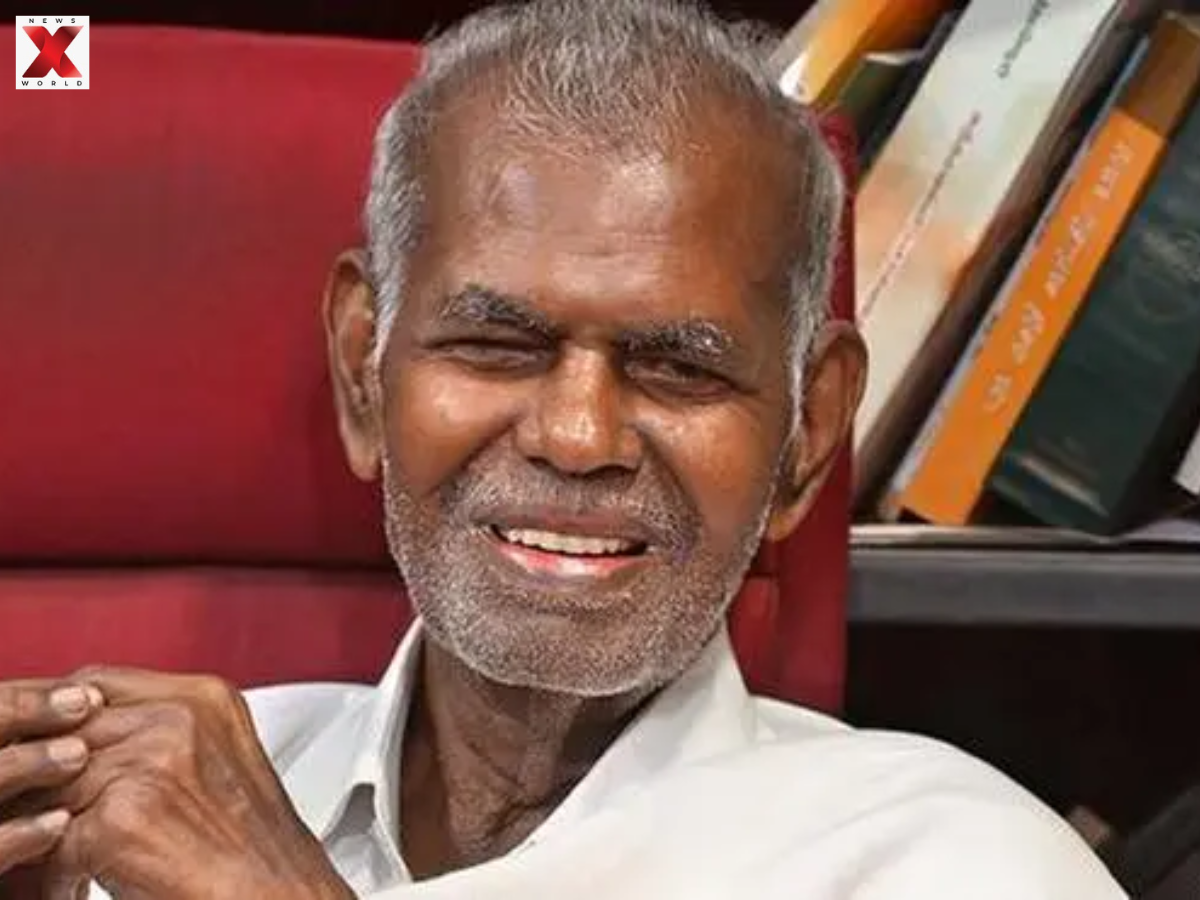

Nallakannu, who had been undergoing treatment at the Rajiv Gandhi Government General Hospital, passed away on Wednesday afternoon, February 25.
According to an official statement issued by Madras Medical College and the Rajiv Gandhi Government General Hospital, Nallakannu was admitted to the Intensive Care Unit (ICU) on February 1 due to health complications.
During the past 24 days of treatment, his health condition showed fluctuations. A multidisciplinary medical team provided intensive care and continuous advanced monitoring throughout his hospitalisation, it added.
However, from the early hours of February 25, his response to medications gradually declined, and his condition became critical. Despite being under advanced life support, all his vital organs eventually failed. He passed away at around 1:55 PM on February 25, as per the statement.
The hospital administration expressed deep condolences to his family and relatives. It also conveyed its gratitude to all the medical teams involved in his treatment and to the Government of Tamil Nadu for their support.
Tamil Nadu Chief Minister MK Stalin on Wednesday paid an emotional tribute to veteran Communist Party of India (CPI) leader R Nallakannu, calling him an “indomitable comrade” and a “political volcano” whose life would remain a guiding light for generations to come.
Nallakannu, one of the senior-most leaders of the Communist movement in Tamil Nadu, passed away at the age of 101 on Wednesday afternoon at the Rajiv Gandhi Government General Hospital in Chennai.
In a heartfelt message shared on X, Stalin recalled Nallakannu’s unwavering spirit despite physical challenges, quoting the late leader’s own words: “Even though I lack proper vision in one eye, there is another eye in my heart. That is the good eye.”
He described Nallakannu as “an uncompromising fighter” and a tireless champion of the working class who endured imprisonment, torture, and immense personal hardship without ever compromising his principles.
In his tribute, Stalin highlighted Nallakannu’s close association with former Chief Minister M Karunanidhi, fondly remembered as “Muttamil Arignar Kalaignar.” He noted that Nallakannu had stood shoulder to shoulder with Karunanidhi in protests against laws such as POTA, ESA and TESA, and strongly believed that Communist ideology and the Dravidian movement should work together as a “twin-barreled rifle for social change.”
Stalin also recalled that Karunanidhi had conferred the Ambedkar Award on Nallakannu during his tenure, and that he himself had the “great fortune” of presenting him with the Thagaisal Thamizhar Award under the present Dravidian Model government.
“He (Nallakannu) was always one who held me in affection and love. He wholeheartedly welcomed the schemes we created after establishing Dravidian model governance. I made it a habit to meet Ayya on each of his birthdays and receive his blessings,” he further wrote.
Calling him a leader who “lived not as an individual separate from the movement, but as the movement itself,” Stalin said Nallakannu had donated every award and its accompanying prize money back to the party and for public welfare.
“My deepest condolences and solace to his grieving family, relatives, and all comrades of the Indian Communist Movement,” Stalin said, adding that the state would bid farewell to the veteran leader with full state honours.
Describing Nallakannu as a man who lived solely for the working people, Stalin said Nallakannu’s life itself was the message he had left behind, one that would continue to inspire the struggle for social justice and equality.
According to an official statement issued by Madras Medical College and the Rajiv Gandhi Government General Hospital, Nallakannu had been admitted to the Intensive Care Unit (ICU) on February 1 due to health complications.
Over 24 days of treatment, his condition fluctuated despite continuous advanced monitoring and intensive care by a multidisciplinary medical team.
(With Inputs From ANI)




