
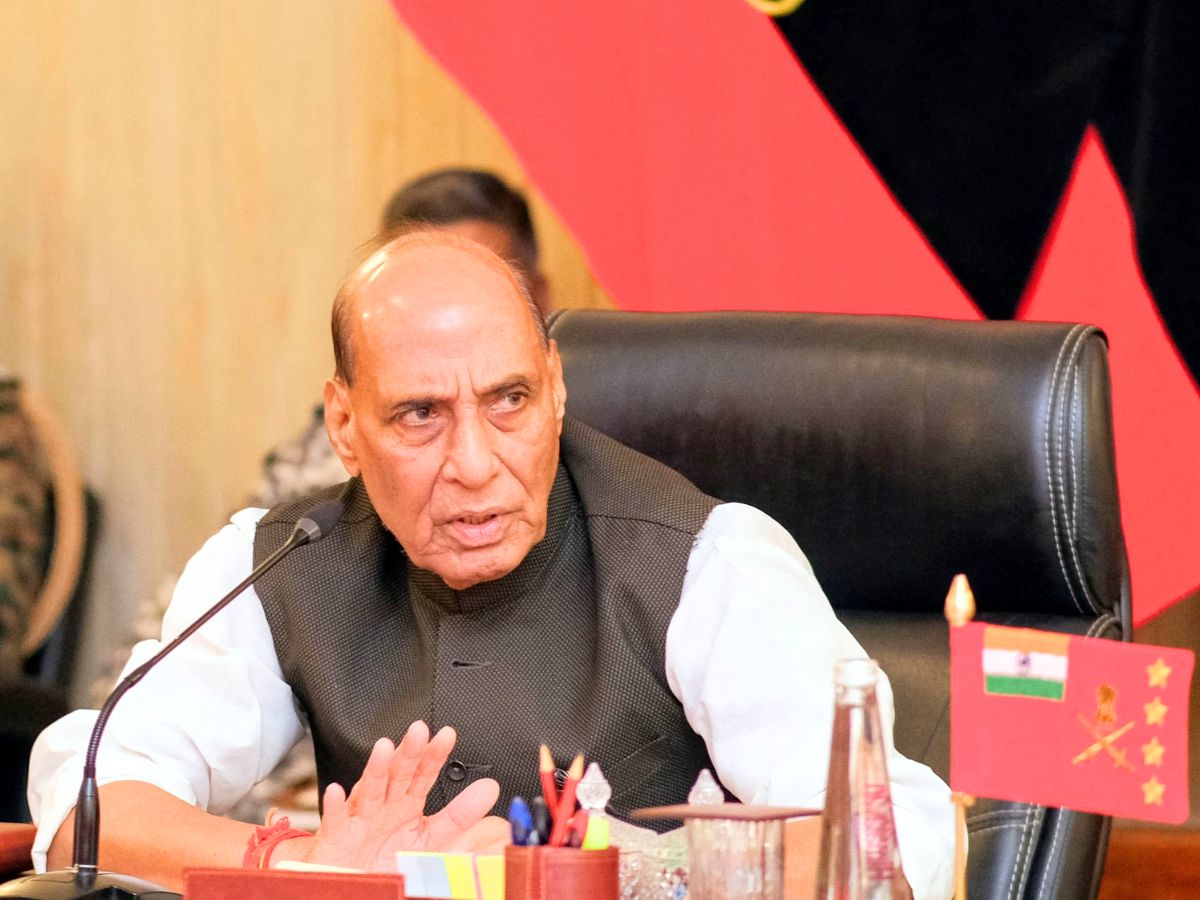

Defence Minister Rajnath Singh on Sunday made headlines with a major statement about the Sindh region, saying that while it may not be a part of India today, borders can change, and Sindh may return to India in the future. He also emphasized the enduring civilisational connection with Sindhi people, calling them “forever ours.”
Speaking at an event, Singh highlighted the cultural and historical ties between India and Sindh, a province near the Indus River that went to Pakistan following the 1947 Partition.
Quoting former Home Minister LK Advani, Singh said that Sindhi Hindus of Advani’s generation never fully accepted the separation of Sindh from India, as the Indus River holds sacred significance for Hindus. “Many Muslims in Sindh also believed that the water of the Indus was no less sacred than the Aab-e-Zamzam of Mecca,” he added.
Watch here:
सिंधी समाज भारत की सांस्कृतिक पहचान और अस्मिता का प्रतीक है। नई दिल्ली में आयोजित कार्यक्रम में संबोधन। https://t.co/irdObhKFCL
— Rajnath Singh (@rajnathsingh) November 23, 2025
“Today, the land of Sindh may not be a part of India, but civilisationally, Sindh will always be a part of India. And as far as land is concerned, borders can change. Who knows, tomorrow Sindh may return to India again. Our people of Sindh, who hold the Indus River sacred, will always be our own. No matter where they are, they will always be ours,” Rajnath Singh said.
Rajnath Singh praised Sindhi community
The Defence Minister also praised the resilience of the Sindhi community that migrated to India after Partition, noting how they rebuilt their lives from scratch and contributed significantly to India’s economic growth and social development.
Earlier, on September 22, Singh addressed the Indian community in Morocco, expressing confidence that Pakistan-occupied Kashmir (PoK) would eventually rejoin India without the need for military intervention. “PoK will be ours on its own. Demands have started being made in PoK, you must have heard sloganeering,” he said.
Rajnath Singh’s remarks on Sindh and PoK underline India’s long-standing civilisational perspective and reflect the government’s focus on cultural and historical connections alongside strategic geopolitical views.
Sofia Babu Chacko is a journalist with over five years of experience covering Indian politics, crime, human rights, gender issues, and stories about marginalized communities. She believes that every voice matters, and journalism has a vital role to play in amplifying those voices. Sofia is committed to creating impact and shedding light on stories that truly matter. Beyond her work in the newsroom, she is also a music enthusiast who enjoys singing.




