
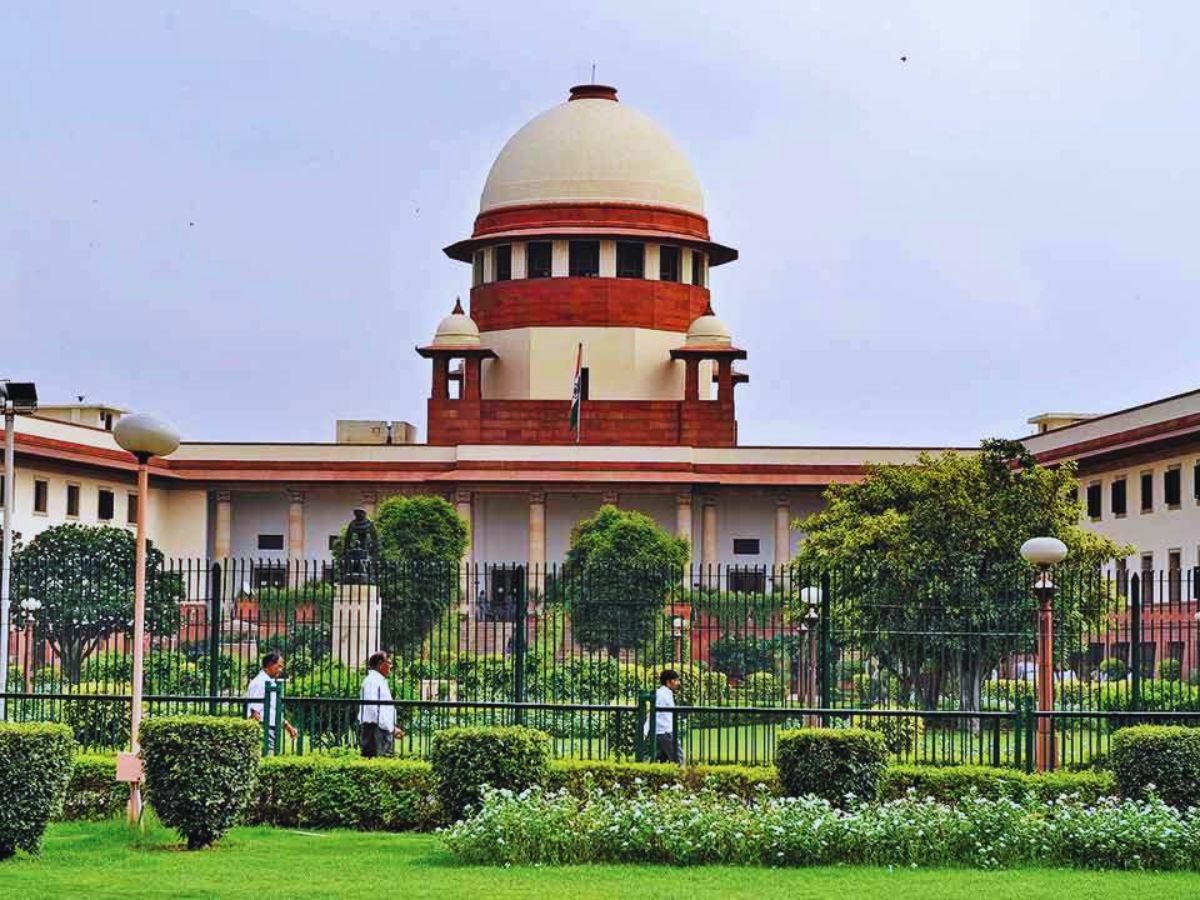

The Supreme Court on Wednesday, while raising concerns about intruders allegedly managing to obtain Aadhaar cards, questioned whether a non-citizen holding an Aadhaar card should automatically be entitled to voting rights. The court said that Aadhaar was introduced to ensure the delivery of welfare benefits and must not be mistaken as proof of citizenship.
A bench comprising Chief Justice of India Surya Kant and Justice Ujjal Bhuyan was hearing a batch of petitions challenging the Election Commission’s (EC) decision to undertake a Special Intensive Revision (SIR) of electoral rolls in several states.
‘Aadhaar Not Citizenship’: Supreme Court
During the proceedings, the bench reiterated that an Aadhaar card does not serve as “absolute proof of citizenship.”
“That is why we said it will be one of the documents on the list of documents. If anyone is deleted, they will have to be given a notice of deletion,” the bench noted.
The Aadhaar Act clearly states that the document does not establish citizenship or domicile. The Chief Justice added, “Aadhaar is a creation of statute for availing benefits. Just because a person was granted Aadhaar for ration, should he be made a voter also? Suppose someone belongs to a neighbouring country and works as a labourer.”
Election Commission Has Authority to Verify Documents, Says Supreme Court
The court further clarified that the Election Commission has the jurisdiction to verify the authenticity of documents submitted with Form 6 applications for inclusion in electoral rolls. The poll body, it said, is not meant to operate like a mere “post office.”
The Supreme Court also fixed a timeline to hear petitions specifically contesting the SIR in Tamil Nadu, Kerala and West Bengal. The bench directed the EC to file its responses by December 1, after which petitioners will submit rejoinders. The matter will then be taken up for detailed hearing.
SIR Petitioners Flag Constitutional Concerns
Appearing for some petitioners, Senior Advocate Kapil Sibal argued that the SIR process raises fundamental concerns about citizens’ democratic participation. He said the exercise imposes an unconstitutional burden on ordinary voters, many of whom are illiterate.
“Filling up the forms is not the responsibility of the elector. So many are illiterate and do not know how to read and write. If they cannot fill forms, they will be ousted (from electoral rolls),” Sibal submitted, urging the court to prioritise constitutional safeguards over procedural explanations.
Zubair Amin is a Senior Journalist at NewsX with over seven years of experience in reporting and editorial work. He has written for leading national and international publications, including Foreign Policy Magazine, Al Jazeera, The Economic Times, The Indian Express, The Wire, Article 14, Mongabay, News9, among others. His primary focus is on international affairs, with a strong interest in US politics and policy. He also writes on West Asia, Indian polity, and constitutional issues. Zubair tweets at zubaiyr.amin




