
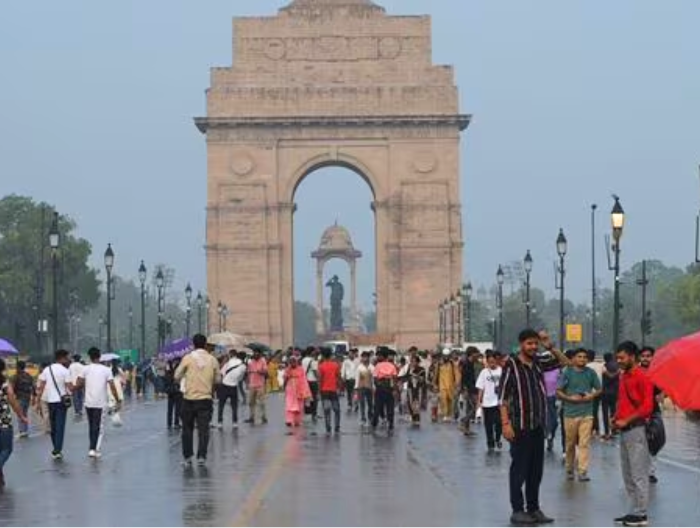

The Delhi government is now set to carry out the long-awaited artificial rain by taking part in cloud seeding this week as the quality of air in the national capital deteriorated, at least partly because of the firecrackers used during the Diwali festivities on Monday.
The government led by the Chief Minister Rekha Gupta, which assumed power in February, based on the promise of delivering cleaner air in Delhi, is hoping that the weather will give them a green light between October 24 and 26, since during this time the weather is supposed to be favourable.
Delhi Set to Witness Artificial Rain as AQI Plunges After Diwali Smog
Manjinder Singh Sirsa, the Environment Minister of Delhi, has recently established that the initial artificial rain will be experienced in the city in the post Diwali period after the Indian Meteorological Department (IMD) gives the green light on artificial rain using cloud seeding.
At one of the media briefings last Wednesday Sirsa mentioned that pilots have already done trial flights in the area where the cloud seeding operation would take place.
According to the leader of the BJP, the aircraft are fully equipped in the process and the crew are trained and know the region well.
The whole arrangement is prepared – starting with authorization to train pilots. The planes are also equipped with cloud seeding apparatus and the pilots have made flights across the target regions to make preparations. All we are awaiting is the approval of the IMD now,” he said.
The cloud seeding project by the Delhi government since the project was planned to start in July, was postponed owing to monsoon, the altering weather conditions, disturbances and the unavailability of the right cloud cover.
The operation was then threatened to be conducted before Diwali but it was delayed.
What was the AQI of New Delhi after Diwali?
On Tuesday, the residents of Delhi awoke to light grey smog, impaired sight and “very poor” air after the residents had set off firecrackers at Diwali past the two-hour deadline the Supreme Court had imposed.
The air quality index (AQI) of the city of Delhi was at 359, which is classified as very poor, at 11 am, as per the information on the Central Pollution Control Board (CPCB) website. It was 352 at 8 am, 351 at 7 am, 347 at 6 am and 346 at 5 am.
The maximum levels are idly described as bad, with 0-50 as the good, 51-100 as satisfactory, 101-200 as moderate, 201-300 as poor, 301-400 as very poor and 401-500 as severe.
Out of the total number of 38 monitoring stations, 35 were located at the red zone with air quality that was very poor to severe. There were 31 that were in the very poor category and four in the severe category.
On Monday, the AQI of Delhi was recorded at 4 pm daily and it was at 345.
Green Crackers on Diwali
On October 15, the Supreme Court gave permission to use green firecrackers in Delhi-NCR during Diwali, between 8 pm and 10 pm.
The green crackers were also limited to be used at certain times 6 am to 7 pm on the eve of Diwali and 8 am to 10 pm on the day of Diwali. Nevertheless, celebrations went on late into the night with many of its residents disobeying the court orders.
Before there was a blanket prohibition on fireworks manufacturing, sale and consumption.




