
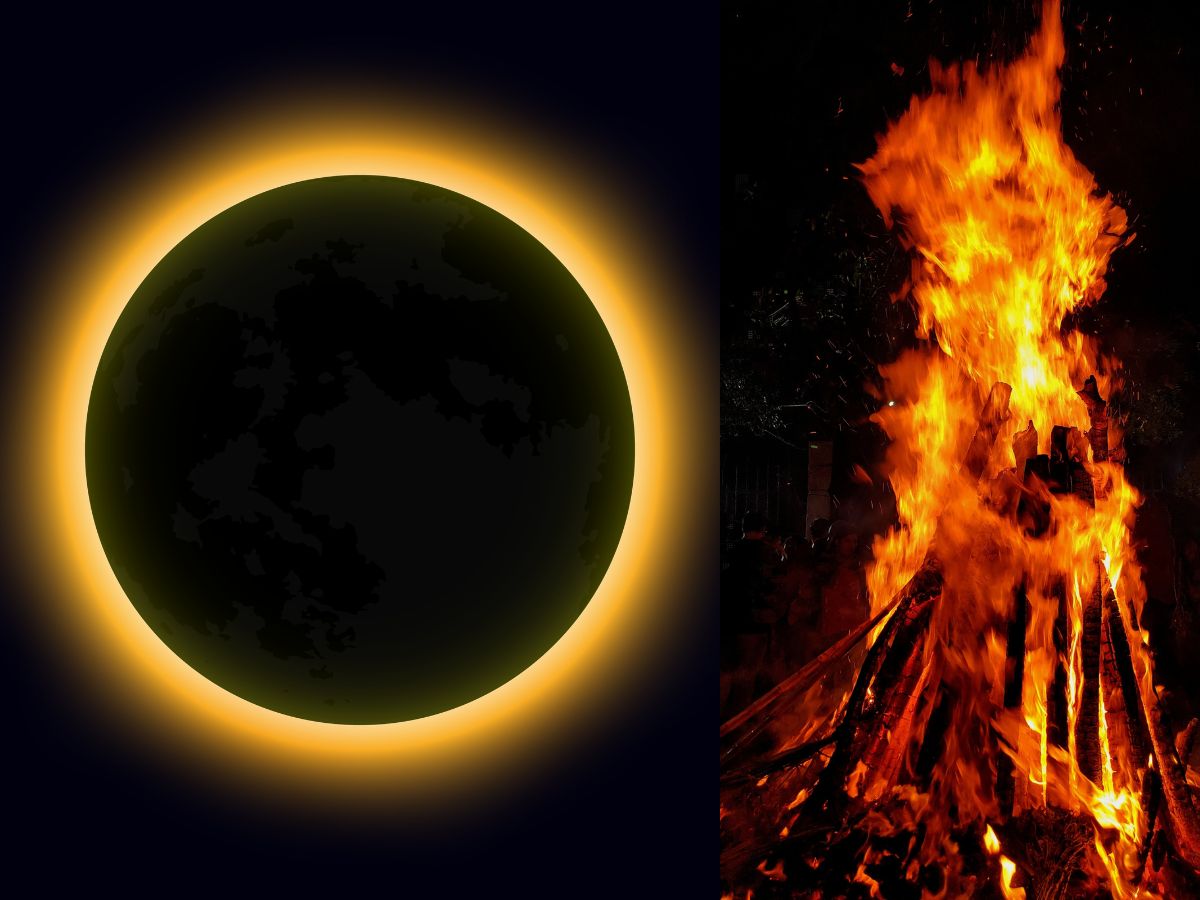

India will witness the year’s first lunar eclipse on March 3, 2026 a celestial event that coincides with the culturally significant evening of Holika Dahan. The rare alignment of Chandra Grahan with Holika Dahan has drawn attention from astronomers, astrologers and devotees alike, as science and tradition converge on the same day.
The eclipse will be visible across most parts of India, making it both an astronomical spectacle and a spiritually observed occasion.
Lunar Eclipse 2026: Date and Time in India
According to Indian Standard Time (IST), the eclipse will begin at 3:20 PM and conclude at 6:47 PM, lasting approximately 3 hours and 27 minutes.
-
Date: March 3, 2026 (Tuesday)
-
Eclipse Window (IST): 3:20 PM to 6:47 PM
-
Maximum Eclipse Time: 6:33 PM to 6:40 PM
Astronomically, a lunar eclipse occurs when Earth moves between the Sun and the Moon, casting its shadow on the lunar surface. This particular event is expected to reach its peak shortly before moonrise in several Indian cities, meaning visibility may vary slightly depending on location.
Sutak Period: When Does It Begin?
Since the eclipse will be visible in India, the traditional Sutak Kaal will be observed. The Sutak period begins nine hours before the eclipse, placing its start at 6:20 AM on March 3.
During this spiritually sensitive window:
-
Religious ceremonies are generally postponed
-
Temples in many regions remain closed
-
Cooking fresh food is often avoided
-
Devotees refrain from conducting auspicious activities
Many people instead choose to chant prayers, meditate or maintain silence. Pregnant women, children and the elderly are traditionally advised to exercise extra caution during this period.
Where Will the Lunar Eclipse Be Visible?
Most parts of India are expected to witness the eclipse, though visibility may differ regionally. In several cities, the phenomenon will be visible around or shortly after moonrise.
However, parts of the Northeast and regions such as the Andaman and Nicobar Islands may experience limited visibility during the initial phase. Beyond India, observers in Eastern Asia, Australia, the Pacific region and parts of the Americas are also expected to see the eclipse.
Astrological Significance: Eclipse in Singh Rashi
Astrologically, the eclipse takes place in Singh Rashi (Leo) under Purva Phalguni Nakshatra. In Vedic belief, the Moon governs emotions, intuition and mental balance. An eclipse in Leo is said to amplify themes of leadership, self-expression and emotional awareness.
Many followers of astrology believe this alignment encourages reflection and mindful action, especially during eclipse hours.
Numerology Impact: Who May Feel It Most?
In numerology, the Moon corresponds to the number 2 and is associated with emotional energy and subconscious patterns. This eclipse is believed to heighten emotional sensitivity and reveal hidden truths.
Life Path Numbers 2, 7 and 9 are expected to feel the effects more strongly, while Numbers 4 and 8 are advised to avoid impulsive decisions, particularly in financial or professional matters.
Energetically sensitive individuals may notice emotional shifts 12 to 24 hours before and after the eclipse. Experts suggest avoiding risky investments or ego-driven decisions during this time.
Holika Dahan and Eclipse: Balancing Rituals and Celestial Timing
With Holi celebrations beginning with Holika Dahan on the same evening, families across India are likely to plan rituals carefully. Since Sutak Kaal restrictions apply until the eclipse concludes, auspicious activities traditionally resume only after 6:47 PM, once the Moon’s energy is believed to stabilise.
The alignment of Holika Dahan symbolising the victory of good over evil with a lunar eclipse adds deeper symbolic meaning for many believers.
A Rare Celestial and Cultural Moment
Whether viewed through a scientific lens or a spiritual one, Lunar Eclipse 2026 stands out as more than just a shadow crossing the Moon. It brings together astronomy, tradition and personal introspection on a single evening.
For some, it will be a spectacular sky event. For others, it marks a moment of reflection, release and renewal making March 3, 2026, a day of rare cosmic and cultural significance in India.
Stay informed on all the latest news, breaking news updates, and check all the important headlines in India news, World News, Sports News and Entertainment News on NewsX. Follow Us on Facebook, Twitter.
Sofia Babu Chacko is a journalist with over five years of experience covering Indian politics, crime, human rights, gender issues, and stories about marginalized communities. She believes that every voice matters, and journalism has a vital role to play in amplifying those voices. Sofia is committed to creating impact and shedding light on stories that truly matter. Beyond her work in the newsroom, she is also a music enthusiast who enjoys singing.




