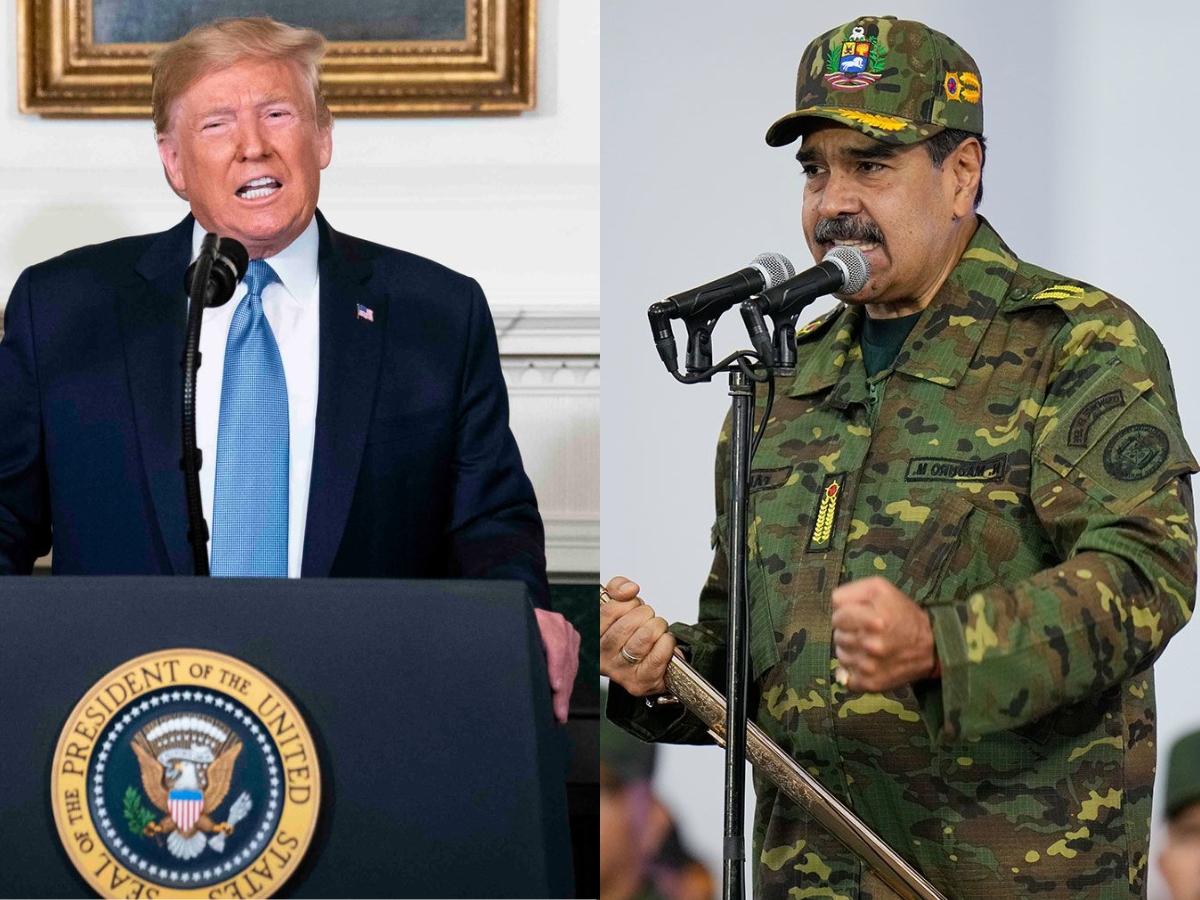

President Donald Trump delivered a stark ultimatum to Venezuelan President Nicolás Maduro during a tense phone conversation, urging him to resign and leave the country or face consequences, according to a report by the Miami Herald. According to the report, Maduro demanded two major concessions in exchange for paving the way for free elections.
These concessions include the right to retain control of Venezuela’s military and a global amnesty for all alleged crimes. Trump rejected both requests and countered with his own terms, which stated that Maduro, his wife, and his son must exit Venezuela immediately and safely.
Donald Trump-Nicolás Maduro Call
The negotiations collapsed soon after Trump’s refusal, cutting short what had been expected to be a detailed discussion of Maduro’s potential surrender. According to the New York Times, the call took place late in the week of November 16, shortly after Trump publicly expressed openness to speaking with the Venezuelan leader.
The failure of the talks heightened concerns in Washington, where officials blame Maduro’s regime for a surge of narcotics entering the United States.
Also Read: Marco Rubio Calls US-Ukraine Talks in Florida ‘Very Productive’ as Peace Efforts Continue
“We have a war that’s coming through fentanyl, through opioids, through cocaine,” US Senator Dave McCormick (R-Pa.) said on Fox News Sunday, pointing to the flow of Venezuelan-sourced drugs into the country.
“It killed 100,000 Americans last year,” McCormick said. “That’s twice the number of people that died in eight years of Vietnam – 4,000 Pennsylvanians.”
US Closes Airspace Around Venezuela, Military Positioned Offshore
Following the failed phone call, Trump escalated pressure by announcing the closure of airspace surrounding Venezuela. The move came as the USS Gerald R. Ford, America’s largest warship, and a Marine Expeditionary Unit capable of amphibious operations, positioned offshore.
Over the weekend, Trump also warned that US military operations inside Venezuela could begin “very soon.” Speaking to reporters on Sunday, Trump acknowledged having spoken to Maduro but added only, “I wouldn’t say it went well or badly.”
Surrender Terms For Venezuela’s Nicolás Maduro
According to the Herald report, US and Venezuelan teams had outlined potential surrender terms during the call, in light of the State Department’s $50 million bounty on Maduro.
“First, Maduro asked for global amnesty for any crimes he and his group had committed, and that was rejected,” the report said.
“Second, they asked to retain control of the armed forces, similar to what happened in Nicaragua in ’91 with Violeta Chamorro. In return, they would allow free elections.”
This proposal was also dismissed by the US side, which insisted on Maduro’s immediate resignation. The offer of amnesty reportedly extended to Maduro’s top allies as well.
Drug-Trafficking Crackdown Intensifies
After the talks collapsed, Trump announced that the US would soon target drug-trafficking networks “by land,” signalling an intensification of pressure on Maduro’s government.
By Saturday, Trump declared on social media that Venezuela’s airspace should be considered “closed in its entirety,” sparking fears about the possibility of war in the nation of 28 million people. While the US has no authority over Venezuelan airspace, the declaration immediately had visible effects.
Zubair Amin is a Senior Journalist at NewsX with over seven years of experience in reporting and editorial work. He has written for leading national and international publications, including Foreign Policy Magazine, Al Jazeera, The Economic Times, The Indian Express, The Wire, Article 14, Mongabay, News9, among others. His primary focus is on international affairs, with a strong interest in US politics and policy. He also writes on West Asia, Indian polity, and constitutional issues. Zubair tweets at zubaiyr.amin