
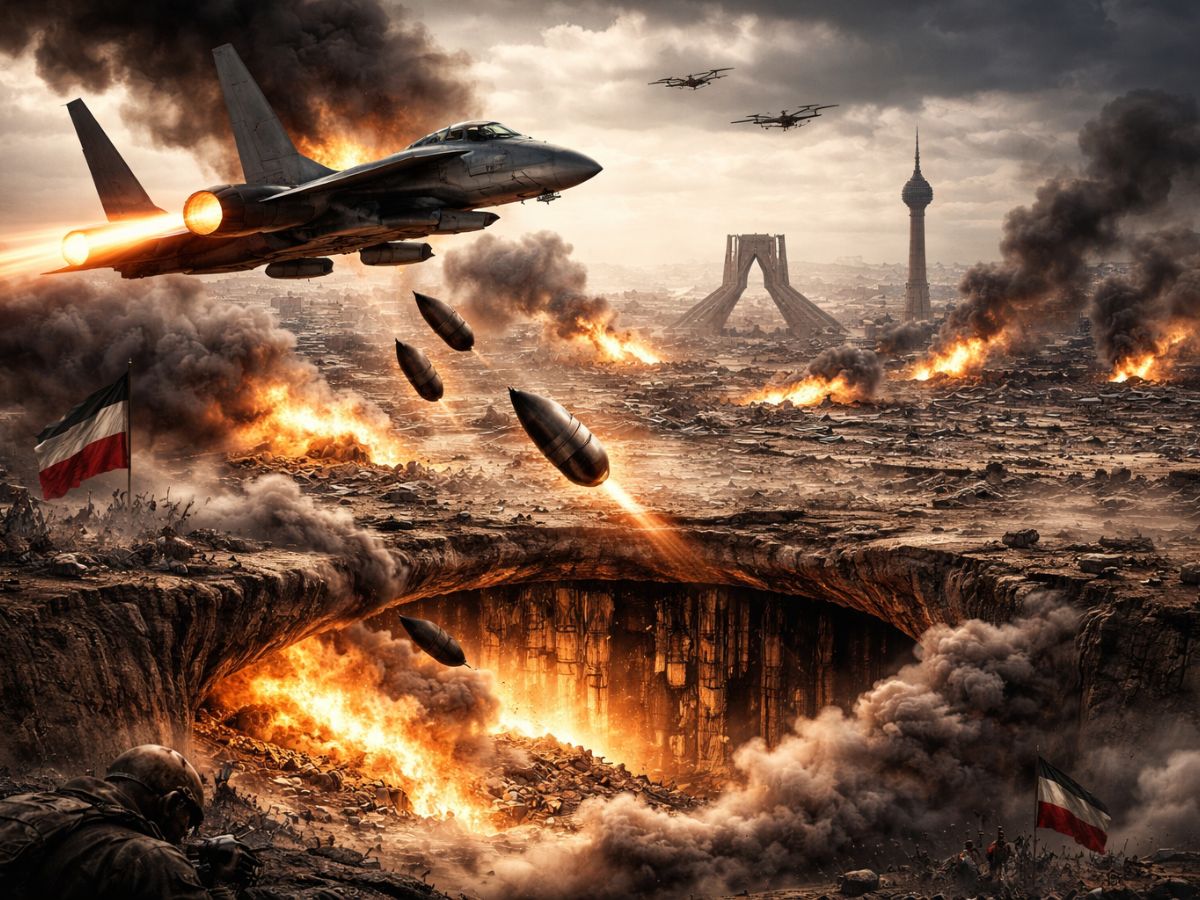

The Pentagon on Thursday said the US military has carried out massive strikes across Iran under Operation Epic Fury, using 5,000-pound bunker-buster weapons to hit underground storage facilities and targeting more than 7,000 sites linked to Iran’s military infrastructure.
Speaking at a press briefing, General Dan Caine said the operation focused on critical military assets, including underground facilities storing coastal defence cruise missiles, naval ammunition depots, mine storage sites, and afloat assets. He added that the strikes have hit over 120 vessels and 44 minelayers.
‘Penetrating Deeper Into Iran’
“We’re flying further to the east now and penetrating deeper into Iranian airspace to hunt and kill one-way attack garrisons, destroying Iran’s ability to project power outside of its borders,” he said.
Caine was joined by Pete Hegseth, who said the scale of damage to Iran’s military systems has been significant. He claimed that Iran’s ability to produce ballistic missiles has taken a major hit, and attacks on US forces have sharply reduced.
Hegseth Claims Major Damage
“To date, we’ve struck over 7,000 targets across Iran and its military infrastructure. That is not incremental. That is an overwhelming force applied with precision. And again, today will be the largest strike package yet, just like yesterday was. As I’ve said from day one, our capabilities continue to build. Iran continues to degrade. We’re hunting and striking, bringing death and destruction from above. Iran’s air defence is flattened. Iran’s defence industrial base, the factories, and the production lines that feed their missile and drone programs, are being overwhelmingly destroyed,” Hegseth said.
He further added, “We’ve hit hundreds of their defence industrial bases directly. Their ability to manufacture new ballistic missiles has probably taken the hardest hit of all. Ballistic missile attacks against our forces, down 90 per cent since the start of the conflict.”
Naval Power Crippled
Hegseth also pointed to heavy damage to Iran’s naval strength, claiming that more than 120 ships have been damaged or sunk, and that Iran’s submarines are no longer operational. “The last job anyone in the world wants right now…? Their military ports are crippled,” he said.
Conflict Intensifies After Khamenei Killing
The most recent spike in tension occurred at the same time as a large-scale confrontation that started on the 28th of February when Ali Khamenei was murdered in a combined US/Israeli attack. Following the murder of Khamenei, Iran has attacked US and Israeli connected infrastructures/Domains throughout the Gulf of Arabia as retaliation for the murder, as well as causing disruptions to the shipping and general global energy markets.
Iran has effectively shut down the Straits of Hormuz, which is one of the world’s main supplies of oil. Since taking command of the Iranian armed forces immediately following Khamenei’s Bahdah, the son of Khamenei has taken on his father’s mantle and has continued to lead to his father’s murder.
(With inputs from ANI)
Khalid Qasid is a media enthusiast with a strong interest in documentary filmmaking. He holds a Master’s degree in Convergent Journalism from AJK MCRC. He has also written extensively on esports at Sportsdunia. Currently, he covers world and general news at NewsX Digital.




