

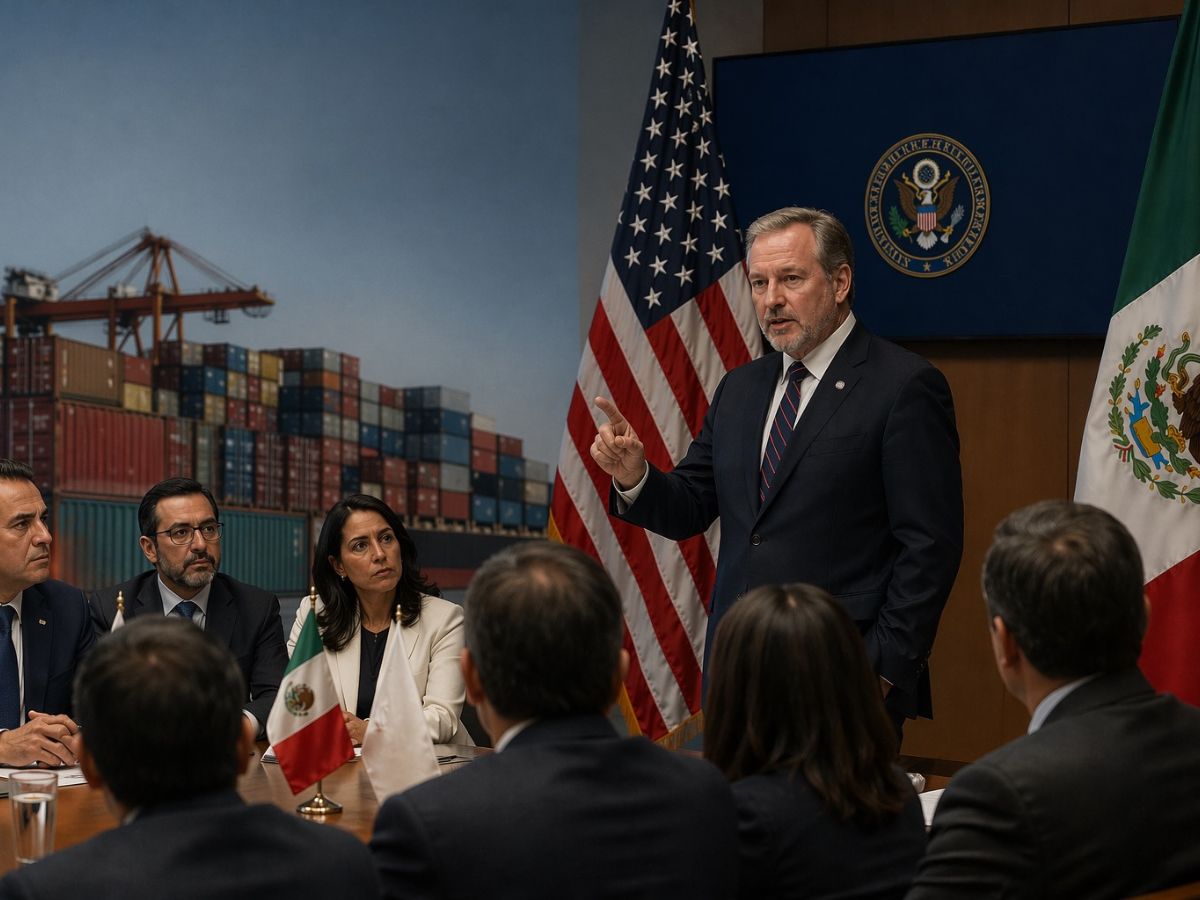
US Trade Representative Jamieson Greer has told Mexico’s auto and steel companies not to expect revision in the US-Mexico-Canada Agreement (USMCA) to remove tariffs imposed by Donald Trump, according to four industry sources familiar with the talks.
Greer made the comments on Monday to the industry groups and other top business leaders in meetings in Mexico City to discuss goals for revamping the USMCA with Mexico’s president and economy minister as a July 1 deadline for a six-year review approaches.
“Greer said tariffs are here to stay. President Trump likes them. We will never go back to a zero-tariff world,” said one of the four sources, who attended one of the meetings and, like the others, spoke on condition of anonymity due to the sensitive nature of the discussions.
Greer also told the auto industry that US officials are exploring ways to help Mexico but did not offer specifics, the source said.
The comments to industry mark the first time Greer has publicly said Mexico will have to live with at least some level of tariffs after changes to theUSMCA are negotiated this year.
Mexico and Canada have been looking to the USMCA negotiations as a way to provide relief from the steep duties Trump imposed last year that have caused difficulties for automakers and other industries in a highly integrated North American economy.
A spokesperson for the US Trade Representative declined to comment on Greer’s private meetings.
Greer met with the American Chamber of Commerce of Mexico, Mexico’s Business Coordinating Council, the Mexican Automotive Industry and the National Chamber of the Iron and Steel Industry among other groups.
Mexico’s automotive and steel industries are highly dependent on the US, with more than 50% of their exports destined for there, leaving them exposed to the tariffs.
Under USMCA and its predecessor NAFTA, there had been more than three decades of tariff-free trade in autos and auto parts between Mexico, the US and Canada, until Trump last year imposed a 25% duty on global automotive imports on national security grounds under Section 232 of the Trade Expansion Act of 1962.
Since then, Trump has cut deals for 15% tariffs on automotive imports from Japan, the European Union and South Korea and 10% tariffs from Britain, making it cheaper to ship some cars from these countries to the US than from Mexico.
A second source, who attended a meeting between Greer and Mexico’s auto industry, confirmed he told them at least some level of tariffs are here tostay, regardless of the ongoing USMCA review. This source said there may be an easing of auto tariffs to ensure that Mexico is competitive with rival regions, but Greer emphasized they were not going back to zero.
The first source also said US negotiators proposed at a meeting last week between the two sides in Washington changing the rules of origin to require that 100% of key components such as engines, major electronics and software be sourced from North America. USMCA now requires about 75% of a car’s value be sourced from the region, with certain levels of content from the US or Canada.
STEEL TARIFFS
Two of the sources said that Greer delivered a similar message on tariffs never returning to zero to Mexico’s steel industry, which is facing a 50% US duty on commodity steel and aluminum products and a 25% duty for derivative goods containing at least 15% of the metals by weight.
After the meetings on Monday, Greer and Mexican Economy Minister Marcelo Ebrard issued a joint statement saying they agreed to launch formal bilateral negotiations to work out US-Mexico issues in the USMCA during the week of May 25 in Mexico City.
They said the two sides will continue technical talks this week on economic security, strengthened rules of origin for key industrial goods, collaboration on critical minerals and bilateral trade irritants.
Greer has defended Trump‘s Section 232 tariffs as critical to bringing back manufacturing jobs to the US after decades of factories migrating to Mexico, where labor costs are lower.
Mexican President Claudia Sheinbaum said on Monday, prior to meeting with Greer, that Mexico sought to reach a preliminary agreement on steel and automotive duties before completing the USMCA review.
BIGGEST CUSTOMER, SUPPLIER
Mexico’s auto industry relies heavily on the United States. US buyers purchased 2.8 million of the 4 million vehicles produced in Mexico in 2024, according to the Mexican Automotive Industry Association (AMIA). But the sector has struggled since Trump imposed the 25% tariff in March 2025.
After three decades of growth, vehicle exports to the US fell nearly 3% in 2025, AMIA said. Its president, Rogelio Garza, has warned the drop will deepen this year if tariffs stay in place. Mexico lost about 60,000 auto industry jobs last year, government data shows.
“We cannot continue like this,” Garza told Reuters earlier this year, noting Mexico’s sudden disadvantage to key competitors.
(Inputs from Reuters)





