
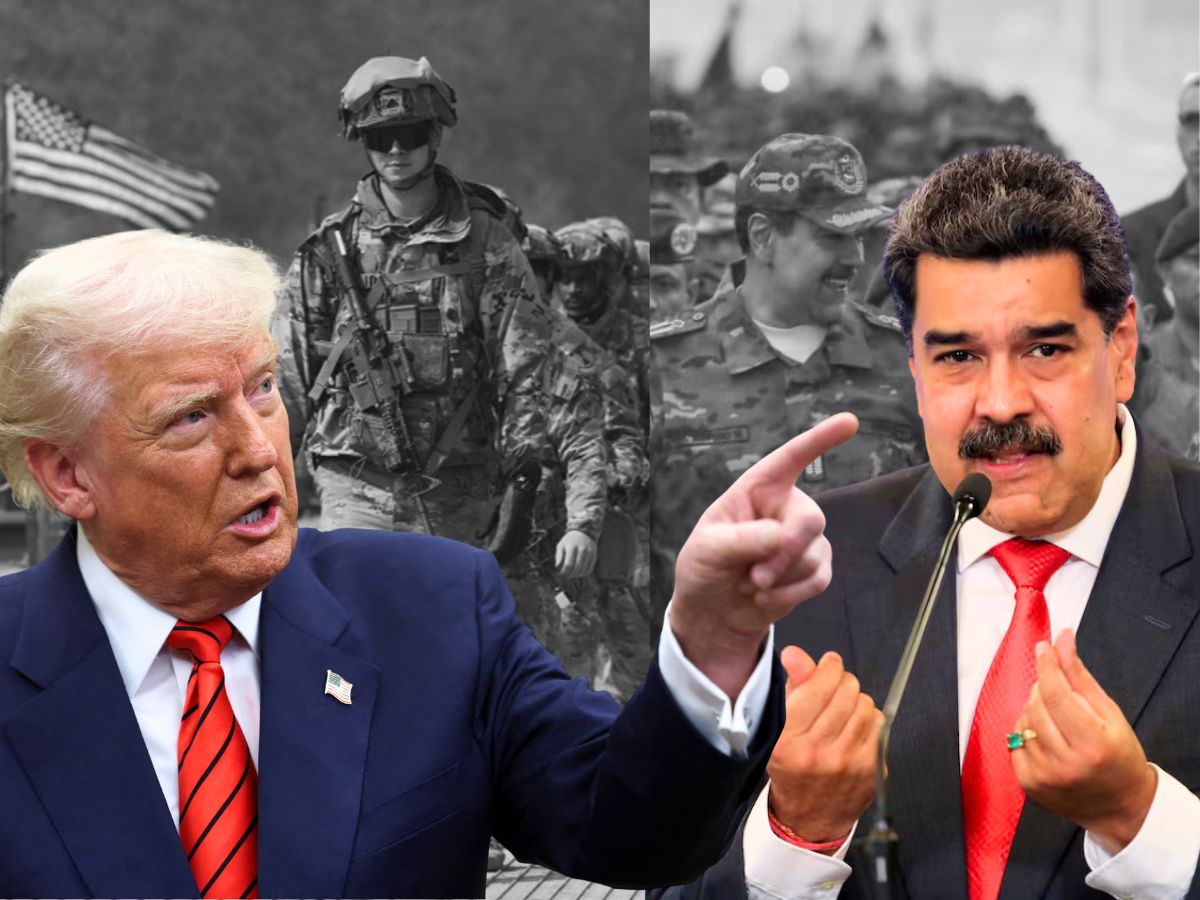

Tensions between the United States and Venezuela sharply escalated Saturday after US President Donald Trump declared all airspace over and surrounding Venezuela “closed in its entirety,” ramping up fears of potential military action against Nicolás Maduro’s government.
Trump‘s announcement came amid months of US military buildup in the region and ramped-up counter-narcotics operations. Major airlines have already been warned of “potentially hazardous” conditions while flying over Venezuela, with some carriers having already suspended flights to the South American nation. The Venezuelan government retaliated by revoking the operating rights of six international airlines, amid a growing stand-off.
While Washington accuses Maduro of drug trafficking, the Venezuelan leader has repeatedly denied these accusations, accusing Trump of wanting to effect regime change as a way of seizing oil reserves in Venezuela. Analysts say any direct standoff between the U.S. and its southern neighbor would largely be one-sided in favour of America.
US Military Power: An Unrivaled Global Superpower
The United States enjoys a commanding lead in world military power in both resources and technological capability.
Manpower: The U.S. maintains 1.328 million active personnel and 799,000 reserves, with more than 4.4 million citizens reaching military age every year. In contrast, Venezuela has 109,000 active troops and a mere 8,000 reserves, with only 625,000 of its citizens reaching military age every year. This huge disparity gives the U.S. overwhelming capacity to deploy forces quickly.
Air Power: The U.S. Air Force has 13,043 combat aircraft, including advanced stealth fighters like the F-22 Raptor and F-35 Lightning II. This technological edge allows for precision strikes and air superiority in any conflict. Venezuela’s air fleet is limited to just 229 mostly Russian and Chinese-made planes, many of which are outdated or out of commission due to maintenance issues.
Ground Forces: The U.S. deploys 391,000 armoured vehicles, 5,500 main battle tanks, and modern rocket systems such as HIMARS. Venezuela has just 8,802 armoured vehicles and a smaller, outdated tank fleet. Equipment limitations and poor maintenance further reduce Caracas’ ground combat effectiveness.
Naval Strength: The U.S. Navy maintains 440 warships, including 11 nuclear-powered aircraft carriers, advanced destroyers, and attack submarines capable of projecting force globally. Venezuela manages only 34 vessels, primarily for coastal patrol, and without carrier or deep-sea warfare capabilities.
Budget & Resources: America spends $895 billion annually on defense, more than the next ten countries combined, supporting advanced technology, global logistics, cyber operations, and space warfare. Venezuela’s defense budget is less than $2 billion in total, which directly limits modernization and reduces operational readiness.
The U.S. is ranked number 1 with a Power Index rating of 0.0744 by the Global Firepower Index 2025, while Venezuela sits at rank 50 with 0.8882, which emphasizes the huge imbalance.
Venezuela’s Military Strategy: Tactics of Guerrilla and Resistance
Against all odds, Maduro has drawn plans to withstand the presumable U.S. attacks: asymmetric wars and not conventional combat is what he would use.
Guerrilla-Style Resistance: Venezuelan planning documents and sources indicate that the military could disperse small units across more than 280 locations, conducting sabotage and hit-and-run attacks to disrupt U.S. operations.
Missile Systems: Venezuela has deployed 5,000 Russian-made Igla portable missile systems, which could threaten low-flying aircraft and helicopters. While symbolic, these are unlikely to counter U.S. air superiority effectively.
Civilian Militias: Maduro reportedly says that there are 8 million civilians who are trained as militia members, though sources say only a fraction intelligence operatives and armed party loyalists, plus select militia are likely to participate actively in defense.
Urban Turmoil (‘Anarchization’): Under this option, “anarchization”-as described in the original government documents-intelligence services and armed groups under the government’s command could be used to create urban turmoil in Caracas with the objective of rendering the country ungovernable during a military strike.
Regional Alliances and Insurgent Groups: Western Venezuela is home to Colombian guerrilla factions, such as the National Liberation Army, especially in areas that grow coca. Government-aligned colectivos, normally armed and organized into motorcycle groups, might support localized resistance.
But experts caution that most of the recent operational experience of Venezuelan forces has come from suppressing protests, not conventional warfare. The low pay, poor training, and lack of modern equipment could lead to desertions if there is an American attack.
Can Venezuela Counter the United States?
The reality is clear-cut: in all spheres, Venezuela is greatly outmatched. Advanced U.S. technology, global logistics, overwhelming manpower, and naval and air superiority thus leave Caracas with little hope of conventional victory.
For Maduro, survival in a confrontation with the United States would depend not on parity, but rather on asymmetric strategies, guerrilla tactics, and perhaps foreign support from partners such as Russia, China, or Iran.
Any direct confrontation would lead to a significant loss of civilian life and destabilization, making Venezuela a long-term conflict zone. While Maduro’s regime remains defiant, military analysts warn the country’s armed forces are incapable of defeating a U.S. attack head-on. Survival, resistance, and operational difficulties would likely be the focus rather than open battlefield success.
ALSO READ: How A Cancelled Oxford Union Debate Turned Into A Full-Blown India-Pakistan Social Media War
Sofia Babu Chacko is a journalist with over five years of experience reporting on Indian politics, crime, human rights, gender issues, and stories about marginalized communities. She believes journalism plays a crucial role in amplifying unheard voices and bringing attention to issues that truly matter. Sofia has contributed articles to The New Indian Express, Youth Ki Awaaz, and Maktoob Media. She is also a recipient of the 2025 Laadli Media Awards for gender sensitivity. Beyond the newsroom, she is a music enthusiast who enjoys singing. Connect with Sofia on X: https://x.com/SBCism




