

It was in April 2011 that I had my first personal meeting with Shri Na rendra Modi, then the Chief Minister of Gujarat. I had gone to meet him at his office in Gandhinagar along with my patidev, Shri Siddhartha Dave and my mother-in-law, Harshada ben. What struck me most about him was not just the warmth of his reception but the intensity of his curiosity. He was eager to know more about Operation Sadbhavana, an initiative of the Indian Army in Baramulla, where I had served. As I shared with him how we had reached out to the people of the militancy affected valley, and par ticularly how livelihood opportunities were created for the women of Baram ulla, he listened with rapt attention. Not a single de tail was lost on him. He wanted to understand not just the operations but the human story behind it—the silent resilience of Kash miri women, the dignity they found through self reliance, and the message of peace that women could carry even in a conflict zone. That conversation, brief yet profound, revealed to me an aspect of Modi’s personality that has defined his journey as a leader—his deep belief in Shakti, both as spiritual strength and as the living power embodied in women.
Modi’s Personal Belief in shakti
For Narendra Modi, Shakti is not merely a symbolic ideal but a lived reality. His personal discipline of ob serving fasts during every Navaratri without excep tion is well known. It is not a mere ritual but a spiritual reaffirmation of his faith in the Divine Feminine. Yet, his interpretation of Shakti goes beyond ritual—it is visible in governance, policy, and vision for India. From celebrating In dia’s first tribal woman President, Smt. Droupadi Murmu, to steering the his toric Nari Shakti Vandan Adhiniyam that reserves one-third of seats in Parlia ment and State Assemblies for women, Modi has trans lated belief into policy. His constant refrain has been that India must move from “women’s empowerment” to “women-led develop ment.” For him, women are not to be seen as beneficia ries of welfare but as lead ers of national transforma tion.
Shakti in Governance:
froM dePendence to leadershiP The last eleven years under his leadership have seen In dian women emerge as cen tral stakeholders in every sphere of nation-building. Schemes launched under his government do not stop at short-term relief; they have systematically disman tled long-standing barriers. Financial Inclusion through Jan Dhan Yojana:
For the first time, crores of women were brought into the banking system. To day, 61% of bank accounts under the scheme are held by women, creating a quiet revolution in financial liter acy and autonomy. A home maker in a remote village, once dependent on cash in the hands of others, now controls her own savings.
Freedom through Ujj wala Yojana:
More than 10 crore LPG connections un der Pradhan Mantri Ujjwala Yojana liberated women from the hazardous smoke of chulhas. It was not just about fuel—it was about dignity, health, and time saved for self-growth. Dignity through Swachh Bharat Mission (SBM): Over 12 crore toilets under SBM ended generations of indignity where women had to wait for nightfall to relieve themselves. Surveys revealed over 90% women felt safer, healthier, and more respected after toilet construction. Relief through Jal Jeevan Mission: The drudgery of walking miles to fetch water has ended for over 15 crore households, with women themselves becoming key decision-makers in village level water management committees. Each of these schemes il lustrates how Shakti, when unchained from toil and de pendency, becomes a force multiplier for society. shakti in education and skillinG The Prime Minister has been unequivocal about the need to save and educate the girl child. Beti Bachao Beti Padhao, launched with great urgency, has yielded visible results. States like Haryana, once infamous for skewed sex ratios, now boast figures like 910 girls per 1000 boys. Nationwide, enrolment of girls in sec ondary schools has steadily risen. Further, initiatives like Sukanya Samriddhi Yo jana have fostered financial security for the girl child.
Relief through Jal Jeevan Mission:
The drudgery of walking miles to fetch water has ended for over 15 crore households, with women themselves becoming key decision-makers in village level water management committees. Each of these schemes il lustrates how Shakti, when unchained from toil and de pendency, becomes a force multiplier for society.
Shakti in education and skilling:
The Prime Minister has been unequivocal about the need to save and educate the girl child. Beti Bachao Beti Padhao, launched with great urgency, has yielded visible results. States like Haryana, once infamous for skewed sex ratios, now boast figures like 910 girls per 1000 boys. Nationwide, enrolment of girls in sec ondary schools has steadily risen. Further, initiatives like Sukanya Samriddhi Yo jana have fostered financial security for the girl child,
while skill development missions and digital literacy programmes have opened new doors for women in entrepreneurship and tech nology. India today leads the world in women gradu ating in STEM (Science, Technology, Engineering, and Mathematics). The suc cess of Chandrayaan-3 was made possible by women scientists—an achievement celebrated not just as scien tific triumph but as Shakti in action.
Shakti in social Welfare and everyday life
The Modi government has recognised that empower ment must touch daily life in tangible ways. Owning a home under PM Awas Yojana, having access to healthcare under Janani Suraksha Yojana, or ben efitting from maternity leave extended to 26 weeks—all of these are silent revolutions giving women control over their lives. Mission POSHAN and Saksham Anganwadis are ensuring that adolescent girls, pregnant mothers, and infants are nourished and healthy, building the foundation of a stronger In dia. Women-led Self-Help Groups, supported by DAY NRLM, are driving rural entrepreneurship, making women economic actors in their communities rather than silent bystanders.
Shakti in defence and Governance
As a veteran in uniform, I have personally seen the pride with which young women now wear the stars and stripes of the Indian Armed Forces. From the first batch of girl cadets graduating at the National Defence Academy to per manent commissions for women officers, Bharat is witnessing history unfold. This transformation was poignantly visible dur ing Operation Sindoor, Bharat’s firm and calibrat ed response to Pakistan’s nefarious jihadi attack in Pahalgam. The very no menclature—Sindoor—was chosen with deep symbol ism. Sindoor is not merely a mark of matrimony; it rep resents sacrifice, continu ity, and the eternal bond of duty. By naming the opera tion thus, the nation sent a clear message that our re sponse was rooted in the timeless values of dignity and resilience, and that ter ror would be answered with both strength and sanctity. Equally noteworthy was the press briefing on Op eration Sindoor conducted by two women officers— Colonel Qureshi and Wing Commander Vyo abrogation further reaf firmed Modi’s conviction that justice and equality for women cannot be compro mised.
Shakti as Strategic Impeerative
Prime Minister Modi has of ten said: “We cannot achieve success if 50% of our popula tion is locked at home.” This is not mere rhetoric but a na tional strategy. With women and children forming nearly 68% of India’s population, their empowerment is not charity but necessity. India cannot aspire to be a Vish waguru if its women are not leaders in its growth story. By bringing women into mainstream economic, so cial, political, and defence structures, Modi has en sured that the idea of Shakti is no longer confined to be lief or ritual—it is alive in everyday India.
A LEADER’S BLESSING, A NATION’S STRENGTH:
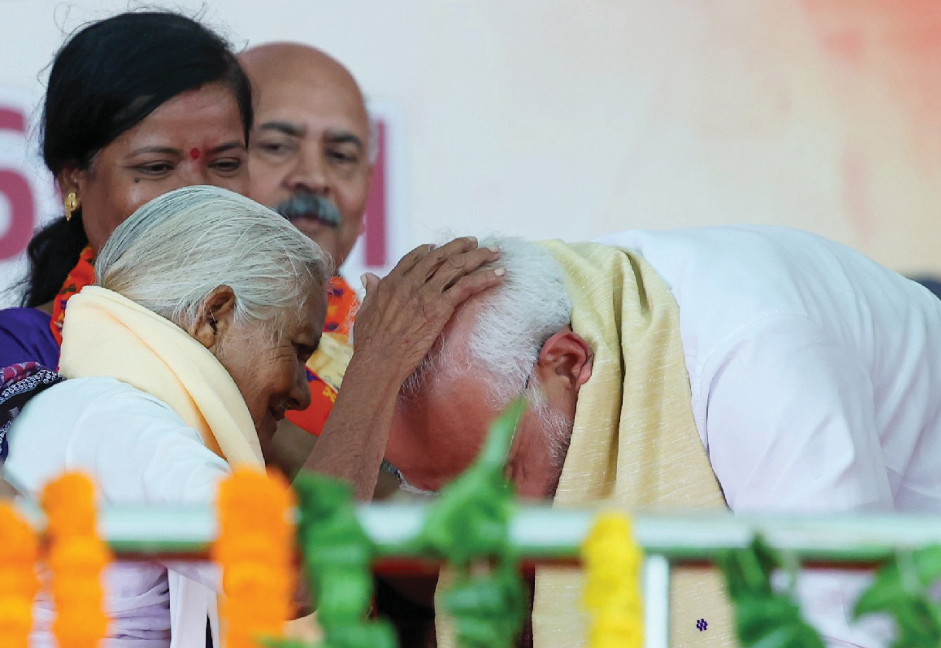
As India celebrates the 75th birth anniversary of its Prime Minister, I look back at that April after noon in 2011 with a sense of gratitude. The way Shri Narendra Modi listened to my account of women led livelihood projects in Baramulla showed me that he already understood what many leaders take decades to realise—that empower ing women is the surest way to heal societies, strengthen nations, and secure the fu ture. I received his blessings in the form of a letter on the occasion of my marriage, I preserved it preciously. To me, it is not just a letter—it is a reminder of a leader’s vision rooted in belief, discipline, and respect for Shakti. Today, that vision has be come a national mission. From homes to parliaments, from schools to space, from villages to cantonments, Bhartiya women are script ing a new destiny. This is not just women’s empow erment—it is Bharat’s em powerment. And at the heart of it stands a leader who believes in the power of Shakti. My last meeting with him was equally memorable, during the 25th anniver sary of Kargil Vijay Di was at the Drass War Me morial. After the solemn wreath-laying ceremony, as he walked towards the Hut of Remembrance, my husband and I could not resist uttering two simple greeting words that came straight from our hearts— “Jay Hatkesh.” To our sur prise, the Prime Minister paused, turned towards us, and acknowledged the greeting with a glance full of warmth. Later, as he inter acted with those gathered, including where I was seat ed beside General V.P. Ma lik, he inquired about the Kargil Vijay Gyan Yatra— our humble endeavour of driving 2,500 kilometres from Surat to Drass in our own car to honour 25 years of Kargil Vijay. The pride and encouragement he ex pressed for this journey meant a great deal. For us, it was not just a conversa tion—it was the recognition of a soldier’s tribute and a citizen’s commitment by the highest leader of the land. Moments such as these re veal the human depth be hind the statesman. As India celebrates the 75th birth anniversary of its Prime Minister, I look back at both those encoun ters—first in Gandhinagar in 2011, and then at Drass in 2024—with immense grati tude. The way Shri Naren dra Modi has consistently encouraged endeavours rooted in Shakti—whether in the battle-scarred valleys of Kashmir, or in the com memorations of Kargil— reflects his conviction that women and men together must shape Bharat’s des tiny. And as I preserve his blessings in the form of a letter received on the occa sion of my marriage, I am reminded every day that leadership is not just about policies and power—it is also about personal touch, human warmth, and an un shakable belief in the power of Shakti




