
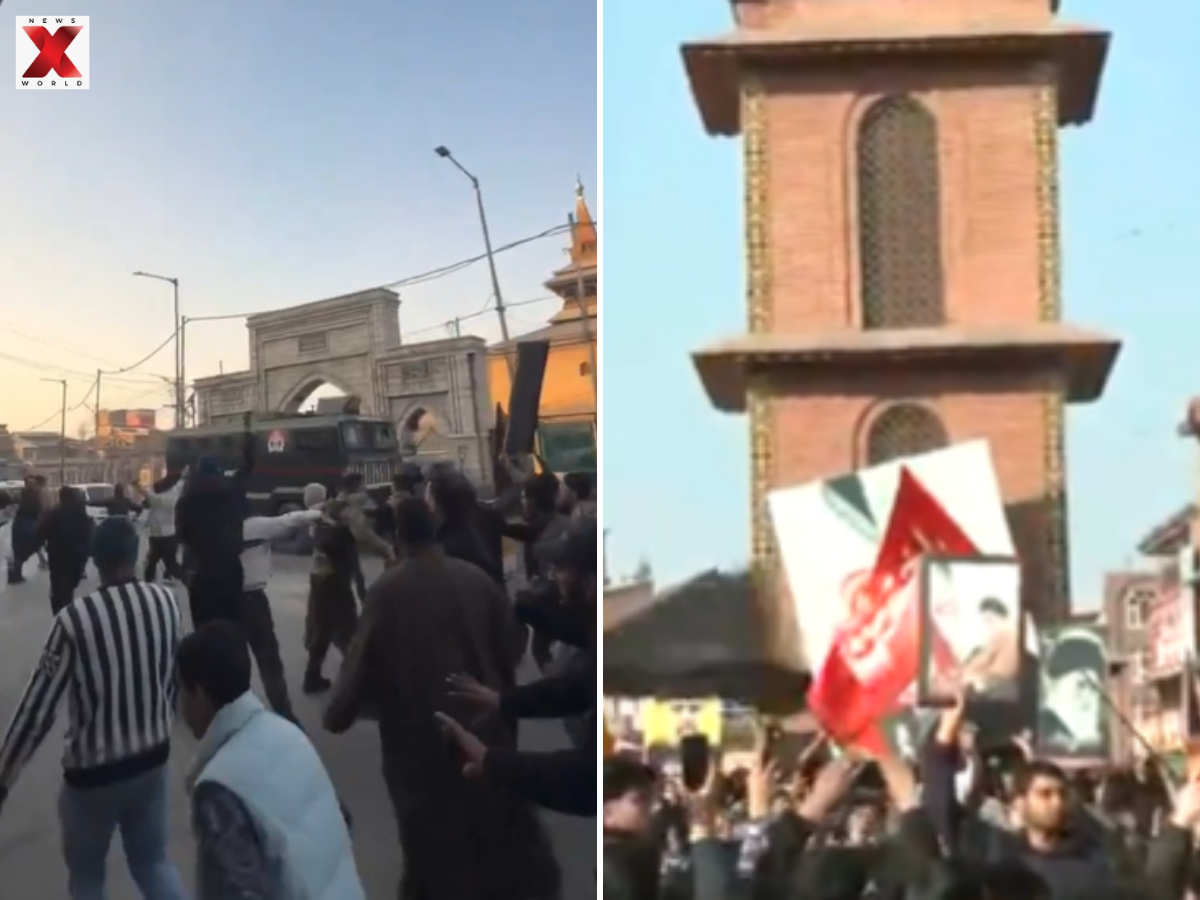

Ali Khamenei’s death: Protests erupted in parts of Jammu and Kashmir after Iran confirmed the death of Supreme Leader Ali Khamenei. Iranian state media said the Ayatollah died early Saturday during joint military strikes by Israel and the United States.
People poured into the streets in Srinagar, Sonawari, and Bandipora. You could hear angry chants as crowds, mostly Kashmiri Shia Muslims, carried Khamenei’s photos and banners showing support for Iran. Black flags fluttered above the crowds.
Some held portraits of the Ayatollah, while others marched and recited mourning songs, Nauha, through the neighborhoods.
One protester told ANI, “We just heard from Iran that Supreme Leader Ali Khamenei is gone. The US and Israel killed him brutally. We’re heartbroken.” For Shia Muslims in Srinagar, Khamenei meant more than just politics. He was their Marja-e-Taqlid—a religious guide.
Tension rises in Jammu & Kashmir as news of Khamenei’s death news spreads#Khamenei #Iran pic.twitter.com/VupwMZkXEF
— Surajit (@Surajit_) March 1, 2026
Khamenei, who led Iran for over three decades and shaped its clashes with the US and Israel, died at 86, according to Iranian state media.
The news triggered sharp reactions. Mehbooba Mufti, president of the Peoples Democratic Party, condemned the US-Israel strikes. In her words, it’s “a deeply tragic and shameful point in history.” She accused Israel and the US of “boasting about killing Iran’s beloved leader.”
Mufti also called out several Muslim countries for staying silent or even supporting the attack.
“What’s more disgraceful is the support from Muslim countries who chose convenience over conscience,” she said. She believes history will remember who stood with Iran and who, in her words, “helped the oppressors.”
#WATCH | Jammu and Kashmir: Kashmiri Shia Muslims in Srinagar stage a demonstration at Lal Chowk against the killing of Iran’s Supreme Leader Ayatollah Ali Khamenei, who has been killed in Israeli and US strikes pic.twitter.com/qOhIpB5Sq5
— ANI (@ANI) March 1, 2026
Ali Khamenei’s death
Khamenei’s death marks a turning point. US and Israeli forces launched major strikes Saturday, targeting military and nuclear sites across Iran. It’s the most dramatic escalation yet, after months of rising tensions and direct clashes.
Khamenei came to power in 1989 after Ayatollah Khomeini, the leader of Iran’s 1979 revolution, died. Khomeini was the firebrand, the visionary.
Khamenei, once a lower-ranking cleric, was quieter, more of a bureaucrat than an ideologue. He turned the revolutionary spirit into a stable, lasting state.
And he ruled longer than Khomeini. Over 35 years, Khamenei built up the clerical establishment and made the Revolutionary Guard the real muscle behind his rule. The Guard grew into Iran’s top military force, packed with missiles and a sprawling business empire from oil and construction to telecom and finance.
Khamenei had the final say in Iran’s political life. Through appointed councils and committees, he could override anything the voters decided. Among hard-liners, his authority was second only to God.




