
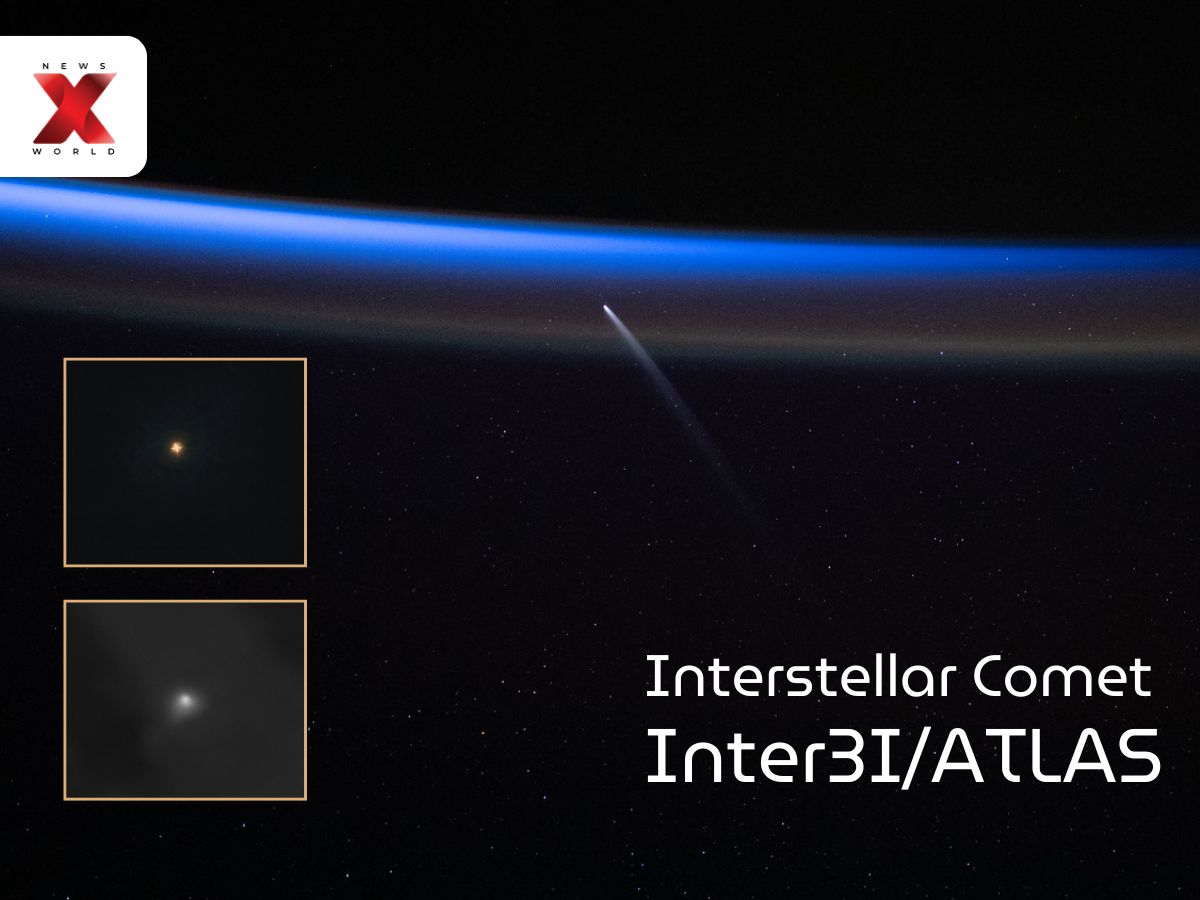

Comet 3I/ATLAS is a very special cosmic visitor to our solar system that has fascinated astronomers from different parts of the world very much fascinated. It was found on July 1, 2025, as a part of NASA’s ATLAS survey in Chile and thus became the third confirmed interstellar object after ‘Oumuamua (2017) and Borisov (2019). Its hyperbolic orbit confirms that the comet is indeed coming from a region that is not captured by the Sun’s gravity and is moving at a speed of 220,000 km/h, which is more than that.
Discovery and Path
The ATLAS telescope in Rio Hurtado first detected 3I/ATLAS very near to Jupiter’s orbit, more than 410 million miles from the Sun. Pre-discovery images from Palomar Observatory and, rather, others dating back to June 14 showed the comet as a faintly glowing object still with a coma and tail. NASA’s Minor Planet Center assigned it the temporary name of C/2025 N1 (ATLAS), of which counting “3I” indicates it as the third interstellar find. It was at perihelion on October 29 at 1.36 AU; in other words, it was between the orbits of Earth and Mars, and it was at the closest point to Earth on December 19 at 1.8 AU, no threat at all.
NASA Observations
The passage of the comet was marked by stunning data from NASA’s Parker Solar Probe, PUNCH, STEREO, and SOHO. Hubble got an image of the coma on July 21 and came up with a nucleus smaller than 5.6 km; JWST’s NIRSpec studied composition in August, and found out that the volatile ices were active at a distance of 6.4 AU. Ultraviolet spectroscopy provided the detection of water and a potential sulfur-to-oxygen ratio, which is an indication of ancient origins, possibly the comet has a 7-14 billion years old claim from the Milky Way’s thick disk. XRISM’s X-ray views revealed emissions even at a distance of 248,000 miles.
Scientific Significance
In contrast to solar system comets, 3I/ATLAS provides pure interstellar material that has been created elsewhere and then sent out into space. Its retrograde path is quite close to the ecliptic, as it is coming from Sagittarius close to the galactic center. By December, it was fading to magnitude 12 and going through Virgo and Leo; it was never to return. Vera C.Rubin and TESS pre-images underscored its early activity from non-water ices.
This “message in a bottle” advances exoplanet studies, probing distant star systems’ chemistry. Ongoing JWST observations in December 2025 promise deeper insights into rogue wanderers.
Shubhi is a seasoned content writer with 6 years of experience in digital media. Specializing in news, lifestyle, health, sports, space, optical illusions, and trending topics, she crafts engaging, SEO-friendly content that informs and captivates readers. Passionate about storytelling, Shubhi blends accuracy with creativity to deliver impactful articles across diverse domains.




